Hello Laverdahuib
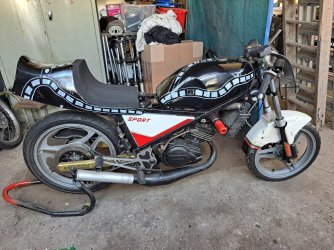
Finland has a notable amount of LB125 series Laverdas. Seems to be the only Laverda model ever in Finland that use to be laying in garages and the owners not knowing what to do for them. We have quite much both the older and latter series engines. I would coarsely divide these engines around 1980's and 1990's production, these somewhat differs.
I have the earlier. I would say about the 1980's production engines that the engine is probably much more high tech than any other Laverda engine I have ever seen, but the engine has some very serious and very non-evident design flaws. These engines use to run perfect until a sporadic blow up. The most usual is that the engines run around 3000 kms and then the cylinder and piston seizes. And there is not just one reason for this, and not just one way how this can happen. To my understanding the 1990's series engines are very similar, but the factory got done at least something for them, but I don't exactly know all of them. The modifications are mostly very minor modifications for the flaws and additional stuff like the oil fill plug you seem to have and electrical starter.
One of my projects is to establish a repeatable method to get all of these engines eventually to work properly. The already existing documentation has action items generated in Finland from 1980's, some of them from factory, etc. There is several partial solutions, but some more are needed and I'm working on these sometimes.
Please, if you have these easily available, I would ask following ones:
-What year model is this engine or the engine number range?
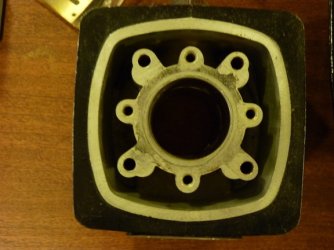
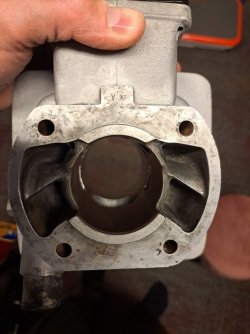
-Photo of the water space in the cylinder
-If the long studs are wet, how the long cylinder studs are originally sealed from the upper end?
Other way I will get this info probably a couple of years later from now when we get a couple of engines disassembled from one shed.
Some of these:
-The correct cylinder and pistons use to be rare. The owners used to bin the blown ones. Today these could have been repaired. I think the Lesmo cylinder need the Asso 4730 piston with two rings.
-The Lesmo cylinders were sold as spare for earlier LB125 series engines, which had a different piston with one ring, and different ports. This one ring piston is also different than LZ125 piston that also has just one ring if I recall correct. This cylinder at least if installed to the earlier engines needs a thick bottom end gasket. The importer used to install 3 pcs of bottom end gaskets on top of each other. I have cut my own gaskets, but I can say that the cylinder will need several retightenings with the either of these solutions.
-One mod from the factory suggested was to change the left hand crankshaft bearing to cylinderical roller bearing. I don't know if the later engines had this originally. The earlier engines had two deep groove ball bearings. The cylinderical roller bearing can't be installed to the right side that is the primary side, but the ball bearing is strong enough. The cylinderical roller bearing is for heat expansion to my understanding.
-The cylinder studs and bolts use to snap. On the earlier engines the long studs are dry, on the latter engines these are wet. To my understanding this mod is for two reasons: corrosion of the studs (the cast aluminium seems to be very noble to corrode these), secondly this is to correct a design flaw in the water gallery of the cylinder. Always replace also the short studs if you get them off from the engine. If the long studs have been even a bit loose for some time, this creates additional stress for the short ones. I have always used 8.8 grade bolts from a good supplier, but once one short bolt snapped when I reused one and was tightening it.
-I have seen just Dell'Orto PHBH 28 or 30mm carbs used originally.
-The two stroke oil pump is made by Mikuni, it has a standard kind of oil seal but is of non-standard size. I will possibly subcontract some of these from a local manufacturer, the price will be high, but I don't know anything else.
-The standard exhaust is very good and of correct tune. The engine starts to pull well from 5000 rpm and pulls to 10 000rpm. The red segment is 8-10 000 rpm on the meter. Earlier exhaust possibly had a design flaw on the cylinder end and some of these eventually brake down, at least I have seen a couple of damaged exhausts in addition to my own standard exhaust. I suggest a machined flange to the cylinder end like some racing exhausts for the engine has. Not sure about the factory supplied exhaust kits, but I also have a Jollymoto racing exhaust. It had the machined flange but too high tune. Its power range is 6700 rpm to 10 000rpm, does not work if you don't change the gearing inside the gear box. Don't even know if the factory ever even produced alternative gearing ratios for the gear box. I think I have no use for the Jolly moto racing exhaust at the moment.
-Do not turn the engine without spark plug if the key is not off. The Motoplat ignition will kill itself. The Motoplat has a such a failure mode it works perfect until a complete darkness. Often a diode gets shorted inside the plastic molding inside the magneto. If I recall correct, the earlier engines had five wires and the latter engines six wires with an electic box on the frame. I don't know if the latter had a altering ignition advance, at least the earlier has fixed ignition advance. The ignition is magneto type and the engine will fire perfectly with a totally flat battery and then starts to charge.
P.S. I used to make small wheelies with LB125 on second and third gear in small slopes.

With Best Regards,
-Jouni