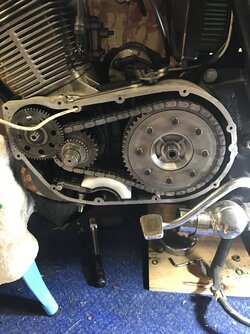
AFAIK (what the hell DIK) the guide/tensioner wheels on 750's are plain when new, and get to show "teeth" after a fair bit if use
Seems to me that this is something that can be improved upon.
A steel idler sprocket is a much better engineering solution as a chain tensioner idler than a cylindrical plastic roller. Steel idler sprockets are not unusual as chain tensioners in many applications, including timing chains on engines.
A cylindrical roller will bear on the side plates of the chain, until the side plates cut grooves into the roller, which would probably happen quite quickly with a plastic roller. Then the tensioner roller will then bear on the chain rollers and the wear rate will slow down. Eventually the chain could wear corrugations resembling sprocket teeth into the tensioner wheel, as Clem observed above. So why not start with a sprocket in the first place to avoid all this bedding in and constant re-tensioning as a result?
Plastic idler sprockets running in hot engine oil don't last long in my experience. A steel sprocket would have a greater service life and shouldn't wear the chain any more than the crankshaft and camshaft sprockets, and it'll maintain constant chain tension way longer than anything made of plastic. Actually, I strongly suspect (for a number of reasons) that it would be easier on the chain than a plain roller. The Laverda 750 cam chain is massively over-engineered anyway.
If anyone can provide an explanation as to why a plastic roller is preferable, I'd be happy to learn something new. A few arguments I can think of are noise reduction, shock absorbtion, low friction and cost reduction. None of which are compelling reasons in my opinion. I suspect Laverda chose to go with a plastic roller for no other reason than cost management.
If I had a 750 that needed a new tensioner, I'd buy an industrial sprocket blank of the right size and bore it to suit the needle roller.
I dunno what size sprocket would be required if anyone wants to do this. I believe the chain is an 06B duplex. If someone can tell me the tensioner roller diameter, I'll work out the equivalent sprocket size.
Sourcing a sprocket shouldn't be a problem. An industrial type would be perfectly adequate. There's bugger-all load on the teeth because the chain isn't transmitting any power to the sprocket. It's just an idler.
ISO-Nr.: 06 B-2 (3/8“ x 7/32“) pitch: 9,525 mm inner width: 5,72 mm roller-dia.: 6,35 mm Tooth width bf2 15,4 mm ba 1 mm (radius width) rx 10 mm (min. tooth radius) hardened teeth (45-55 HRC) No. of tooth pitch … Weiterlesen →
www.kettentechnik.com