Hi Andy,
I've ridden the Laverda Corse TTF2 bike and wrote something about it at the time for my Laverda 500 website and have I've included it below. I'm bound to have some pics somewhere
On the technical front, as you probably know I built a race bike with an Atlas engine and one of the numerous interesting things Pip Higham did when he built the engine was to time the cams quite differently from the factory. Pip used 107 degree lobe centre timing on both cams which is a lot softer than the standard F500 and it worked very well indeed. You'll know the standard cam timing on an F500 has a huge amount of overlap, obviously in a quest for top end power.
My riding partner with Laverda Corse was Max Simani who at one time had been Italian F1 champ and obviously was no slouch. Max was very impressed with engine set-up and he certainly went very well on it, Bill Swallow also got a 3rd on it the first time he rode it in a VMCC meeting at Cadwell. Both Bill and Max were very complimentary about how well the bike went, testament to Pip's development work on the engine.
When it was first built the compression was 14:1 and it went really well but unsurpisingly suffered with head gasket problems. I think we ended up with 12:1 in the interests of reliability.
Here's what I wrote back in the day:
Riding test; Laverda Corse TT2 at Spa
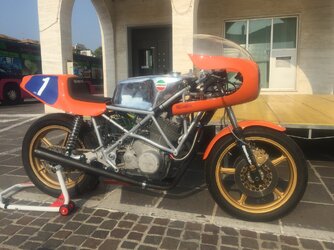
Although superficially similar in silhouette to the Formula 500 the factory TT2 machine differs in detail execution sporting hand-fabricated rearsets, magnesium wheels and suspension, fibreglass tank and a re-modelled fairing, plus of course a larger capacity engine. The factory built approximately 10 specially prepared TT2 machines for the Italian TT2 [600cc] championships. Some of these machines were prepared by Moto Laverda and some were prepared by either Augusto Brettoni or Antonio Cavasin.
The experience gained in developing the factory F2 machines prompted AugustoBrettoni to develop his own F2 machine with the full endorsement of the factory. Development work was carried out in Brettoni’s own workshop with the final set-up and dyno testing at the factory under the supervision of Ing. Mariano Roman, who later in his career became Technical General Manager at Aprilia.
Brettoni’s TTF2machine eventually yielded 72bhp on Laverda’s dyno and was campaigned in the Italian F2 Championship and a World Championshipround at Villa Real in Portugal. This unique machine is in Brettoni’s personal collection occasionally making parade outings with Laverda Corse.
TTF2 riding impressions
I was lucky enough to be offered a test ride on one of the original works TTF2 machines which forms part of the Laverda Corse collection. Piero had generously suggested that I might like to try the team’s TT2 machine during one of the public test sessions when the team was at Spa in 2008. Under normal circumstances I would have been nervous about testing one of the team’s bikes but as the team had crashed my Spaceframe Endurance bike during the previous nights race I felt a bit more relaxed. Piero politely asked me not exceed 9000 rpm[11,000rpm is available for the mechanically unsympathetic] and soon I was in the holding area gently warming it up anxiously trying to hear the engine note over the noise of the pits.
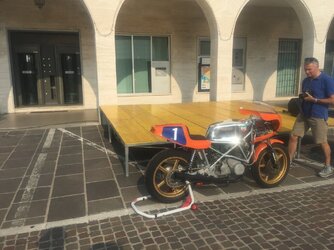
Piero came across this machine about 10 years ago at an Italian autojumble. It was being sold by its owner and had finished its competitive days in hillclimb trim and was now looking rather forlorn. Fortunately Piero recognised the bike as one of the ex works machines and a rare piece of Laverda history was saved from potential oblivion.
Cocking a leg over the bike my first impression was how comfortable it was. The Formula has a very cramped, almost jockey–like riding position but this 600, with just a few subtle ergonomic changes, felt much more spacious. I funnelled out of the pit lane onto the track with Giovanni Laverda astern keeping a watchful eye . After a fairly gentle lap Giovanni must have satisfied himself that the bike was inreasonably safe hands and motored past me leaving me some free space on the track to start exploring the performance potential.
The TT2 is very similar to my Formula in that it instantly makes the rider feel relaxed and in control, these small Laverdas are very forgiving with no particular handling vices. The only criticism one could make is that they need to be kept on the boil at all times to keep the engine on the cam; not a problem on a track bike, particularly on a big open track like Spa. On a tighter circuit it can be a challenge to keep everything spinning. I had hoped that the larger capacity would endow the TT2 with a bit more mid range but if anything it felt even more peaky than my 500, this is possibly down to cam timing; the machine would carburate cleanly from 4000 RPM but the real punch was delivered above 7000rpm and I would have felt comfortable exceedingthe 9000rpm limit had I not been mindful of Piero’s request.
Laverda middleweight twins usually sound a lot nicer from the side of the track than they do from the rider’s seat. At lower revs a tuneless drone rises from the intakes which then builds to a more satisfying cammy rasp once it comes on song. This bike was no exception except that once it came on the cam the revs built incredibly quickly and rapid upward changes on the close ratio ‘box were needed to prevent over -revving. Crouching down behind the screen with the throttle pinned the TT2 ha dan impressive turn of speed and was able to keep pace with larger capacity machines. Very impressive for a bored –out 500; 68bhp in 150kg is a good combination for a classic race bike.
The lively performance is not surprising when you consider that a well fettled 600cc machine like this will have a superior power to weight ratio than a triple and, being something like 66kgs less, can carry more corner speed and feels more controllable under heavy braking. The session test was over all too quickly and I returned to the pits and handed the precious machine back to its owner.