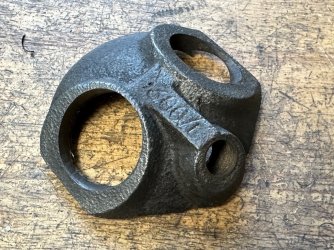
Hello Laverdamax
I consider that you can agree that this is more than just a curiosity. It reads that you are located in Vicenza, you need to know what it is.
This represents very notable achievement, knowledge and high level of European sophistication from the era.
Generally different kind of combustion chamber skulls for different functions and of different materials do exist. There isn't many grades available that survive without immediately cracking with the surrounding Aluminium alloy in Laverda heads. I do some material testing, but I can say that element analysis works fine with the surrounding aluminium alloy, but probably just a bit helps for the skulls. The crystal structure is important with the skulls and I consider they are very likely austenitic.
In your photo this is a sort of main component of a certain system in the earlier Laverda four stroke engines that has somewhat similar effect than a charger. Dottore Francesco Laverda and Luziano Zen constructed this system on their motorcycle design in late 1940's. Many myths and legends about Laverda motorcycles and their engines were built in at this point. Dottore Francesco Laverda had a five year university degree in pure physics and was specialized in thermodynamics.
This can be read from many articles about Laverda and some of them are even available online at the moment. Even the system is mentioned on them and the principle of operation of the system can be sometimes read between the lines. My personal suggestion is that one of several reasons why they chose this system was that it enables usually much better high speed driving on curvy race tracks and similar driving conditions than an actual charger system and especially the ones that were available on the era. Ron on this site is a real Laverda hero, he is right, and he is after this system.
When I was at school, eight school year after kindergarten, it was the first time for me when we were taugh at course of physics how this kind of system can be built on an internal combustion engine. This course of physics was held at Espoo that is next town west from Helsinki and the year was 2000. At least then, this content was standard and taught in all similar schools in Finland if you chose the optional courses in physics.
The trick with the Laverda skulls is that they have notable weak heat conductivity to form a so called semi-adiabatic engine that means that it is partially trapping the heat energy inside the combustion chamber. Nowadays the technology is widely used in Diesel engines with ceramic materials working as heat insulators in different locations. Laverda used it in petrol engines which makes them quite a peculiarity, and even more that it was a motorcycle engine in 1940's with already available weakly heat conducting special cast irons.
I can guarantee that the system works and it does not break any laws of the physics, it is rather based on good understanding of basic physics. (I'm sure it will be soon stated that anyone after two beers would know this better than someone who has an university degree about it. And this by experts who actually never understood even the basic school physics.)
The system is almost ridiculously simple, but it has actually more than just one way how it has an effect (to my understanding both physical and an indirect chemical effect), and it also causes some new technical challenges, both in stages when these engines were designed and also when the engines are rebuilt, tuned, and adjusted. Two of the several effects are, for example, that these engines use to hole pistons more easily with wrong settings, and in some cases melted spark plug electrodes are found.
It needs some knowledge if you want to build, tune, and adjust your Laverda engine systematically that way that you get the charger like effect well out of it and avoid the technical challenges that may appear, and all this especially with current fuels available. I can do that for the earlier Laverda engines, but some of the later engines are more challenging. Actually I think that in some of the very late engines even some of the constructions are not suitable for this technology which throws the bullet proof reliability immediately out from the window. I think that on some of the later engines they tried to make somewhat similar, but actually on the earlier designs there were details that supported the system to work reliable, and when some of these were changed some problems started. Seems that when I go forwards enough on this Laverda hobby I need to redesign at least the cooling systems for some of the engines including some of the castings.
I have heard so much incredible stupid ridiculing about this very notable achievement in motorcycling history that I can say that I'm very tired with it and I think that no-one else than someone completely moped guy would ridicule it. I have planned to take this everything on a video on a racing track and have good presentations about it with showing the videos and the charging like effect at full throttle and on certain ride that clearly indicates some phenomena at some partial throttle conditions, the system can cause a step with a hysteresis on the throttle grip at some partial load conditions. Also photos about phenomena in engine components that show some of the side effects of the system inside the engine. The videos will be for all of the nice people and especially for the ridiculers.
My dad build the most powerful Laverda motorcycles probably ever build in Finland. This happened something 40+ years ago. He worked in such a corporation that practically trained all of the very successful engine builders in 1960's and 1970's in Finland that build the engines for the very successful racers that Finland had. One major part of the training was kept by Roll's Royce. Later he, for example, got exactly the same degree in vehicle and mechanical engineering that Jarno Saarinen had. He also wrote a Finnish book for Laverda engine building and better maintenance with his friend. At some point he send faxes with Massimo Laverda. He has built around 1300 engines in his life. When I was a kid he was one of the owners in Finland's importer for Vege engines Netherlands and was supposed to start the whole Laverda and Moto Guzzi service for Helsinki area. I was something six years old and sometimes disassembled passenger car engines, and sometimes assembled them on the working place. A moment later half of the country went bankrupt including us.
When I was a small kid my dad used to tell me, for example, as a bedtime story what Jarno Saarinen actually did. Nowadays some people use to ridicule him with similar all wrong arguments than Ron used to be ridiculed at this forum. I know that some of these bad speeches hurted my dad. Nowadays some people come to ridicule me if I tell how this system should work in the Laverda engines and what kind of results I have got even myself and what I did. In Finland's first Laverda club that my dad and his friend found in mid 1970's the bikes were in reality often ridden like Ron on this site. I do systematically build and adjust that way myself, I have no reasons to doubt.
I can often, for example, do a simple trick for a Massimo era Laverda engine even in standard tune, often more or less with the following consequences. Then I start the engine, let it warm for a while, even the exhaust gas has somewhat different smell than an usual engine without the system. I consider that the reason is mostly high amount of nitrogen oxides caused by unusually hot burn. I take a warm up ride. Then I put a small gear in, enough revs to allow the throttle to be opened quickly fully open, then I do it, grey smoke burst out from the silencers, notably hot and rich burn, and the Pirelli draws 10's of meters of black line on the asphalt. I didn't used the clutch or brakes. ...I'm sure that I felt the same frustration that Ron did.
-Jouni
Hi Juni,
Your considerations are very interesting.
I'm a mechanical engineer, and I've taken some thermodynamics exams, so I can understand and appreciate what you're saying. How do you determine that the cast iron used is austenitic? Perhaps a Ni-Resist that approaches the performance of alloyed stainless steels, with a structure that remains stable even when heated. Here in my area, home of Laverda, no one knows exactly what type and characteristics it is.