Leak down tester

Dellortoman

Hero member
This is how slowly my brain works ...
I need to pressurise the cylinders in my old Datsun 260Z to install new valve springs without removing the head. I figured I'd cobble together an adaptor from a gutted spark plug and a Nitto air coupling so I can connect an air hose to the spark plug holes. Then I figured I may as well incorporate a valve and pressure gauge. By measuring pressure drop in cylinders over a fixed time interval, it would also work as a kind of comparative leak down tester. But then I had a look at the price of leak down testers on ebay, and I couldn't make one as cheaply as I can buy a proper regulated dual gauge unit that will work a whole lot better.

http://www.ebay.com.au/itm/New-Cylinder-leak-down-tester-compression-leakage-detector-kit-set-petrol-engine-/162236210038?hash=item25c6081b76:g:eRcAAOSwYIxX~dA5

Blimey, if I'd realised the things were so cheap ($31 including postage) I'd have bought one years ago!  ::)
 
I bought one of those, it works really well now that I have replaced all the useless chinese pneumatic parts with SMC!  As with much of this unbranded chinese stuff it would have been cheaper and more satisfying to buy a decent quality one in the first place, but some of it is fine, some is useless.  Luck of the draw.  The hose and spark plug adapters work fine though.
 
Yes, I noticed after I pressed the "buy" button that it has the wrong coupling type. I use Nitto couplers on all my stuff. For some reason most of the tools I buy have the other sort (dunno what it's called) as a default. Dunno why. So I suppose fitting the correct adaptor for my air hose will be the first thing ...

Maybe I should just make up a Nitto to ?whatever the fuck it is? adaptor.
 
I like good quality tools too. If you're using them all the time as Red probably does, it makes sense to spend a couple of hundred bucks on something that will last the distance.

But this thing will be lucky to get out of its box once a year. If it does a half-decent job for a few dozen uses, that'll do me.
 
Oh, I own one as well, which is how I know how much he loves them.

Modify like this
 
Hey Cam if you remove the spark plug and get the piston at BDC then you can feed some thin nylon rope into the cylinder... now rotate the crank by hand until it stops. Now you can change the valve springs with ease knowing the rope will keep the valves in situ...
 
The leak down tester arrived the other day.

As Steve said, there were a couple of things that needed doing to make it useable.

Firstly, it came with the wrong sort of air hose coupling for me. All my air tools and hoses have Nitto type couplers, and this thing had some other breed (Charge Air I think). No problem, just unscrew it and screw in a Nitto type. How hard can that be? Well, quite hard is the answer. The thread in the device is 1/8" NPT, and I didn't have a Nitto coupler with that thread, so I went shopping for one. I may as well have gone shopping for rocking horse poo. All the Nitto fittings seem to use 1/4" or 3/8" BSP threads. I could have used a 1/4" to 1/8" reducer, but that would have stuck out another 15mm or so, and the unit wouldn't have fitted back in its box.  ::)

Long story short, I made a fitting on the lathe.

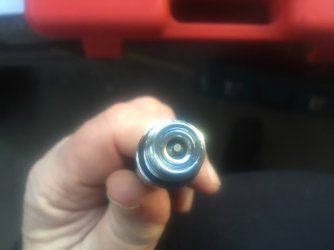
The other thing was that the gauge showed no leakage at all, even when the business end was not screwed into a spark plug hole (which should have shown 100% leakage). Closer inspection of the fitting that goes in the spark plug hole revealed that it had a Schrader valve in it. WTF?  There was no way air could pass through the device unless the valve plunger was depressed. There was nothing in the plug hole or the adaptors that came with it to push the plunger in, so it was never going to work like that. At least that was a simple fix - unscrew the guts of the valve and discard it. No idea what it was doing there in the first place.

All good now. The tester seems to work OK.
 

Attachments

  • WTF.JPG
    WTF.JPG
    61.8 KB · Views: 15
Cam, Jod has the alternative idea to hold the valves in place. We do it on airplane piston engines, not so much to change springs but to be able to drop the valve into the cylinder so we can ream the valve guides.

BTW, what did you end up paying for the tester?

Clay
 
Yes, thanks Clay and Jod. I'm still mulling over which way to go with the valve spring job. Compressed air or or the soft rope idea.

I now have all the gear to do the compressed air option, including a suitable spring compressor. I want each cylinder at TDC when I do it so if the seal doesn't hold, I won't lose the valve down the hole. The only thing that worries me is that I don't have any way of locking the crank. If I don't get it spot on TDC, the air pressure will exert a torque on the crank creating the potential to suddenly swing the engine to BDC. The rope idea avoids that issue so is probably the safest way to go.

Lately it's been too bloody cold in the shed to do it anyway. The little time I spent on the lathe the other day just about gave me frostbite. I think the lathe felt the same. It was quite slow to spin up when I first switched it on. The oil in the gearbox must have been as thick as grease.

The leak down tester was dirt cheap at a bit over $31(Aus) including postage within Australia. So I wasn't expecting top quality but was pleasantly surprised that it's actually a useable tool.

I'm now wondering why you'd want to ream valve guides on an engine that has been in service. Do they get a build-up of carbon in them? Also wondering how you retrieve the valve after you've dropped it into the cylinder.

Cheers,
Cam
 
Dellortoman said:
I now have all the gear to do the compressed air option, including a suitable spring compressor. I want each cylinder at TDC when I do it so if the seal doesn't hold, I won't lose the valve down the hole. The only thing that worries me is that I don't have any way of locking the crank. If I don't get it spot on TDC, the air pressure will exert a torque on the crank creating the potential to suddenly swing the engine to BDC. The rope idea avoids that issue so is probably the safest way to go.

Put the bike in 1st gear and tie the back wheel in place when the engine is at TDC. repeat for each piston.
 
It's a car that I'm doing the springs on. I thought about putting it in gear with the handbrake on, but I'll need to work out how much backlash there is in the drive train to know whether it'll be effective.
 
Datsun 260Z

Great machine - Surprised it hasn't rusted out - Leak Down Tester requires a STOP WATCH with about 150LB's of Air Pressure into a CLOSED Chamber with an ear listening for leakage from the Intake/Exhaust/Oil Pan and Radiator.

Say timing leak down between 120 PSI to 60 PSI per cylinder locked at the same degree. You want the same time or very close to it.

Cam Clocked where - Sometime after TDC ensuring all valves are closed and NOT in overlap - Check Cam Specs and whether installed Advanced or Retarded - Who worked on this thing last. Just remember the valves are not necessarily closed at TDC - HIC!

Providing you have a garage, a descent 3 or 5 Hp compressor you can fabricated a Leak Down System for about $100 from your local hardware store plus the price of a STOP WATCH.

Clock every cylinder with a Degree Wheel at the same degree ensuring all valves are closed when testing throw various lengths of the compression stroke - Very time consuming.

I know how to leak down test ;o)

You're probably better off just blowing about 120 PSI into each Cylinder clocked at about 20 degrees after TDC (Assuming both Intake and Exhaust Valves are CLOSED) and listening for air leakage through the Intake, Exhaust, Oil Pan and Water System - BLOW JOB - LOL.

Leak down is more or less a TEST just how well you built the engine and not a definitive test for and old engine.

PS: You have to JAM the crank from turning using Heavy Vise Grips on the Flywheel and need a perfect air sealed spark plug adapter ;o)
 
Dellortoman said:
Yes, thanks Clay and Jod. I'm still mulling over which way to go with the valve spring job. Compressed air or or the soft rope idea.


I used the 'indian rope trick' when changing valve collets on one of my Mirage's valve springs recently: straightforward and easy.
 
Cam, reaming the valves was usually done on Continental lower compression engines that were running 100LL Avgas but were designed to run on 80/87. We never oversized the guides, just used them as a chaser to clean out any lead or coking. It's a real treat to get the valve back into the hole but it beats the hell out of dropping a cylinder.

Clay
 
Finally got around to the valve spring job on the Datsun 260Z (sorry, no Laverda content here). Rope trick worked perfectly. Thanks for the suggestion Jod.

Actually, holding the valves against their seats turned out to be the easy part.

I bought this tool to compress the valve springs http://www.ebay.com.au/itm/Universal-Engines-Overhead-Valve-Spring-Compressor-Removal-Installation-Tool-AU/152611060091?ssPageName=STRK%3AMEBIDX%3AIT&_trksid=p2060353.m2749.l2649

Only to discover that there wasn't enough room around the springs to get the tool onto them (OHC + cam bearing blocks in the way). So I spent about 5 hours dreaming up a tool that would work, then make it, try it, fail, go back to the drawing board, modify it ... 

I eventually got it to work and did cylinder #1 last night, by which time it was well and truly past beer o'clock.  Will do the other 5 cylinders later today.
 
Here's a tip for anyone doing the rope trick to hold valves on their seats while removing the springs:

Choose a piece of rope that's thin enough to pass through the spark plug hole when knotted!

On one cylinder, my rope managed to loop through itself inside the cylinder and tied itself in a simple knot as I withdrew it, jamming against the inside of the plug hole. I thought how the fuck am I going to get that out? I got another piece of the same rope and tied a knot in it as a test. When pulled tight it would just fit through a plug hole. So I pulled like buggery on the stuck piece until the knot tightened itself enough to pop out. Phew!

I was lucky to be using 3mm para cord. Any bigger than that and I would have been up shit creek.

Anyway, job done now.
 
Dellortoman said:
Here's a tip for anyone doing the rope trick to hold valves on their seats while removing the springs:
Choose a piece of rope
I was lucky to be using 3mm para cord. Any bigger than that and I would have been up shit creek.

Anyway, job done now.
It could only happen to you, Cam ::)
Actually, I expect it became knotted because it was too Thin. I used about a metre and a half of 9mm into a Lav pot and it was easy peasy...
AndyW 8)
 
What am I doing wrong?

Instructions say to connect the leak down tester to a spark plug hole with the piston at TDC compression stroke, then turn the pressure regulator valve until the main gauge reads 60psi. The secondary gauge should then read the % leakage.

Bur when I screw the hose into a spark plug hole and wind up the pressure regulator, by the time I get to about 10psi on the main gauge, the % leakage gauge goes down to zero leakage, but there's clearly leakage going on because I can hear it hissing. If I go any higher than 10psi the gauge goes off the scale into the area of negative leakage (air leaking into the cylinder). It makes no sense at all.

If I leave the spark plug fitting disconnected so the thing is just blowing off to atmosphere, it'll still show zero leakage if I wind the supply pressure up a bit more. It should show 100% leakage because it's just venting directly to atmosphere.

Have I bought a dud instrument or am I doing something stupid?

 
Back
Top