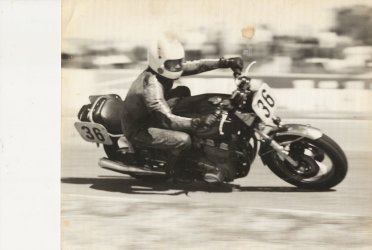
Sorry if you thought Rob's response was long-winded......
Extract from Pre-TT regs (and this is just for protective clothing!!)
2026 Blackford Pre TT Classic Technical Regulations
14th January 2026 Page
1 of
13 Issue 2.0
The BLACKFORD FINANCIAL SERVICES 2026 Pre TT Classic Road Race Meeting
TECHNICAL REGULATIONS
3. PERSONAL PROTECTIVE EQUIPEMENT
3.1.
Helmets
3.1.1. Maximum 5 years old, helmets with date stamp or code removed cannot be used
3.1.2. FIM homologated (hologram) to FRHPhe-01 or FRHPhe-02 protocol and QR code. See
http://www.frhp.org/ for details
3.1.3. Helmets which have not received FIM approval to the FRHPhe-01 or FRHPhe-02 homologation protocol will not be accepted.
3.1.4. External and internal damage above what would be considered cosmetic will render the helmet unusable
3.1.5. Visor should be fitted and free from scratches or defects that could impair the competitor’s vision
3.1.6. It is recommended that visors with the capability of taking ‘tear-off’s’ should be used
3.1.7. Cameras affixed to or within a helmet are prohibited.
3.2.
Clothing (Leather suit)
3.2.1. Solo competitors
3.2.1.1. One piece racing leather suit must be worn
3.2.1.2. To EN17092 standard
3.2.1.3. CE approved
3.2.1.4. Class AAA
3.2.1.5. Fitted with CE approved protection pads in the shoulder, elbow, knee and hip.
3.2.1.6. Impact areas double layer
3.2.1.7. No major damage
3.2.1.8. Stretch aramid fabric permitted on non-impact areas
3.2.2. Sidecar competitors
3.2.2.1. One piece racing leather suit must be worn in Cowhide leather, minimum 1.2mm thick or Kangaroo leather, minimum 0.9mm thick
3.2.2.2. Double layer leather or external leather with internal aramid fabric in the seat and all impact areas being the shoulder, elbow, knee and hip.
3.2.2.3. Double layer leather or external leather with internal aramid fabric must also be included in the back for Drivers only.
3.2.2.4. Stretch aramid fabric permitted on non-impact areas. Double layer stretch aramid fabric to be applied if used in the forearm
3.2.2.5. Double internal stitching to all construction seams
3.2.3. General
3.2.3.1. Leather suits must be in good physical condition with no major damage visible
3.2.3.2. Leather suits are recommended to be no more than five years old
3.2.3.3. Any damage must have been professionally repaired with leather of the same thickness covering all tears or holes and must be double stitched in place. Any damage must be declared and inspected by the Race Organiser
3.2.3.4. The use of Kevlar or other fabric suits are prohibited.
3.2.3.5. The use of titanium knee sliders is prohibited.
3.2.3.6. If the lining of the leather suit has been removed, then a letter of conformity from the manufacture of the suit is to be presented at signing on. Should the lining of the leather suit be removed then the competitor must present a cotton undergarment that covers all areas of skin at signing on and this must be worn at times when qualifying or racing.
3.3.
Back Protector
3.3.1. A back protector must be used by all solo and sidecar competitors
3.3.2. To EN1621-2 CB (central back) or FB (full back) level 1 or 2 standard
3.3.3. If an airbag suit is used the integral back protector to be to EN1621-2 CB (central back) or FB (full back) level 1 or 2 standard
3.4.
Chest Protector
3.4.1. Solo competitors
3.4.1.1. A chest protector must be worn
3.4.1.2. To EN1621-3 standard
3.4.1.3. If an airbag suit is worn it must have an integral chest protector
3.4.1.4. Two piece chest protectors are permitted but must be manufactured in two pieces, one piece chest protectors cannot be cut in half to make a two piece chest protector
3.4.2. Sidecar competitors
3.4.2.1. The use of a chest protector is discretionary for sidecar competitors, however, if used it should be to EN1621-3 standard
3.5.
Gloves
3.5.1. Solo competitors
3.5.1.1. To EN13594 minimum level 1-KP standard must be worn
3.5.1.2. Leather construction with full length cuff
3.5.1.3. Double cuff closure to prevent the glove pulling off the competitor’s hand when fastened
3.5.1.4. Glove should have a cuff length sufficient to overlap the leather suit by at least 50mm
3.5.1.5. Knuckle protection must be present to a minimum level 1-KP
3.5.1.6. No metal studs should be present on the palm
3.5.2. Sidecar competitors
3.5.2.1. Gloves of a full leather construction must be worn
3.5.2.2. Knuckle protection must be present to a minimum level 1-KP
3.5.2.3. There are to be no gaps between glove and suit that may expose skin
3.5.2.4. Fabric gloves not permitted
3.5.3. General
3.5.3.1. Gloves should be free from visible damage, if damaged they must be replaced not repaired.
3.6.
Boots
3.6.1. Solo competitors
3.6.1.1. To EN13634-2017 standard must be worn. Boots manufactured by Daytona will be allowed at the discretion of the organisers
3.6.1.2. Boots must be full length, at least 70mm higher than the competitor’s ankle, either fixing underneath or over the competitor’s suit, no skin exposed
3.6.2. Sidecar competitors
3.6.2.1. If not wearing boots that conform to the EN13634-2017 standard they must conform to the following:
3.6.2.1.1. Must be of full leather construction with a rubber sole
3.6.2.1.2. Made from Cowhide leather minimum 1.4mm thick
3.6.2.1.3. Must be zip fastening which has a leather cover
3.6.2.1.4. Toe, ankle and skin bone protection forming part of the construction of the boot (internal or external)
3.6.2.1.5. Must be full length i.e. shin length and sits underneath or over the competitor’s suit, no skin exposed
3.6.3. General
3.6.3.1. Boots must be in good condition and should be free from visible damage, if damaged they must be replaced not repaired
3.8.
Airbag suits
3.8.1. Air bag suits are permitted but not mandated.
3.8.2. The use of airbag suits must be declared by the competitor on initial clothing check at signing on.
3.8.3. Airbag suits are used at the discretion of the competitor who must be aware of the risk (hazard) associated with false deployment
3.8.4. By signing on at this event, the competitor accepts this hazard and its associated level of risk
3.8.5. Airbag vests designed to be worn on the outside of the competitor’s leather suits not permitted
3.9.
Post accident rider’s personal protective equipment check
3.9.1. After an accident, it is compulsory for the competitor to present their personal protective equipment for inspection prior to the start of the following qualifying session, warm up or race. A stop shall be placed upon the competitor until a satisfactory personal protective equipment check
has been completed.
3.9.2. In the event that any item of personal protective equipment is considered, by either the Chief or Deputy Chief Technical Official, to be too damaged for use on the course, the rider will be required to replace or repair the item before being permitted on the course, the damaged item may be confiscated and returned at the end of the event.
3.9.3. Any question concerning the condition and suitability for use of the competitor’s personal protective equipment shall be decided by the Chief Technical Official, who will consult with the Clerk of the Course and may consult with the manufacturers of the product before making a final decision. In the case of any dispute concerning the condition and suitability of safety equipment the decision of the Chief Technical Official will be final.
3.11.
General
3.11.1. The Race Organisers also reserves the right for all or certain aspects of any competitor’s personal protective equipment to be checked at any time during the event should they deem it necessary to do so.






 ). He'd bought them off the Australian 125cc road champ. I even did a couple of Phillip Island track days in them. Only tested them once, fortunately - a high side at Winton in about 1983.