You are using an out of date browser. It may not display this or other websites correctly.
You should upgrade or use an alternative browser.
You should upgrade or use an alternative browser.
License Plates
- Thread starter 78jotadave
- Start date

chrisk
Hero member
- Location
- Brisbane, Australia
No annual rego stickers for full rego in Victoria (Australia) these days - cameras everywhere see and assess your vehicle's reg status (and speed!) via its number plate. AI at work - for some odd reason Club Permit rego for 25yo bikes and cars still have to attach the stupid stickers.
A mate got done in a Sydney tunnel recently (Northconex) normally 80kph down to 60kph for some reason
20kph over
No seat belt
Eating (read driving distracted)
We didn’t know the tunnel had variable speed cameras and crutch cam. And he will get a massive fine


Dellortoman
Hero member
- Location
- Tasmania, Australia
Dunno about other states, but in Tassie the classic vehicle registration system (called Special Interest registration) is way cheaper than full registration and allows you a limited number of rides per year, so you have to log every ride. They provide a log book which must be filled in with the current date and departure location before you actually set off on the ride. If you're pulled over by a cop, they ask to see your log book and it doesn't have the current date and departure point filled in, your registration will be non-compliant and you'll be deemed to be driving an unregistered vehicle. Big fine plus demerit points apply. In addition to the penalties, your registration will be cancelled and you'll be prohibited from re-registering that vehicle again under the special interest scheme. Your choices then become: re-register it with full registration or sell the vehicle. It seems a bit heavy-handed to me.
I often forget to fill in the log book before I set off on a ride. I've only ever been asked to produce my log book once (when I was pulled over by a motorcycle cop for speeding on the Jota). I'd actually forgotten to fill in the log book that day, but I'd visited a mate and he reminded me, so I did it before leaving his place. I got pulled over about 1 minute after leaving his place - phew, I was lucky he reminded me! Also got away with a warning for the speed. He was a friendly cop and was more interested in asking me about the Jota than giving me a ticket.
I often forget to fill in the log book before I set off on a ride. I've only ever been asked to produce my log book once (when I was pulled over by a motorcycle cop for speeding on the Jota). I'd actually forgotten to fill in the log book that day, but I'd visited a mate and he reminded me, so I did it before leaving his place. I got pulled over about 1 minute after leaving his place - phew, I was lucky he reminded me! Also got away with a warning for the speed. He was a friendly cop and was more interested in asking me about the Jota than giving me a ticket.

motoddrob
Hero member
- Location
- S/W Australia
I have the Motodd on the same scheme in West Oz. Called C4C. Have 30 days of private use and 60 days with club rides.
!00 bucks/year compared to 500. The compulsory 3rd party injury insurance is included in the rego fee.
The Motodd does more days on track than it does on the road so that scheme works for me.
!00 bucks/year compared to 500. The compulsory 3rd party injury insurance is included in the rego fee.
The Motodd does more days on track than it does on the road so that scheme works for me.
I have lived in the same house for 40 years and have never seen an RBT in my suburb. One day I was doing a quick trip around the block to check that all was well before a club ride the next day. 300m down the road, what do I see but a Highway Patrol Car doing RBT. He waves me in, and the first question after my licence is Can I see your logbook. I shit my pants, as the fine for Classic Rego with no logbook is the same as zero rego: $1000. I tell the tale, and he lets me off. NEVER EVER DOING THAT AGAIN.

Andy
Hero member
- Location
- Auckland, roughly
Sounds a bit simpler here. If a vehicle is over 40 years old it gets “classic” registration, automatically. Which at today’s rates drops the Argy from $850 to $75 and there’s no usage restrictions. Still has to have a regular mechanical check.
Also no compulsory insurance.
Also no compulsory insurance.

Germany has a "historic" registration scheme for vehicles 30+ years old. These need to be in more-or-less stock spec and in good condition to be eligible for certification. Period mods are allowed to a certain degree. While the insurance rates are still calculated on type and size/engine capacity/engine power as all others, road tax becomes a flat rate for all. This is especially advantageous for owners of large engine capacity vehicles, 7l V8s and the kind. Means wifeys' 500 Fiat road tax costs the same as a fuckin' Corvette, which is more than it would cost if the Fiat were "normally" registered! Only real advantage of the "H" registration for the Fiat would be allowance into environmental zones from which non-complient vehicles would otherwise be banned and lower insurance rates under the "H" scheme. No limit on mileage or days of use. Everyday use is discouraged but I've not heard of anybody getting nicked for that.
Insurance rates are generally quite reasonable for historic vehicles, often based on an agreed-limit annual mileage.
Then there's the red "collectors plate" that can cover an entire vehicle fleet. All vehicles must comply to their specific conditions and have been checked and thus certified. The plate can be swapped from one vehicle to the next with its details filled into a log book that is to be carried on the ride. Insurance rates for a historic fleet can often be haggled over, often based only on the most expensive vehicle. This scheme is meant especially for rally attendances or road testing, everday use is not allowed. Doesn't mean it doesn't happen though... Biggest disadvantage is that only one vehicle at a given time can be used. Want to ride out with the boys on parts of your collection? Multiple plates and insurance required.
Then we have the limited rego scheme for everyday vehicles, ie, rego only for the months April-October, which is the most common for bikes that are laid up during winter. Any period can be agreed upon, many classic car owners have a winter hack, accordingly registered. The vehicle can be used for the agreed period only, annual insurance and tax rates are reduced accordingly, rego is suspended for the remainder. Bikers (or Porsche, Ferarri, etc. drivers) that wanted or needed to save cash were previously required to de-register and re-register their bikes every year, with all the attached hassles. The limited period scheme has made this an absolute breeze. The allowed period of use is stated on the rego plate.
Generally, almost all are catered for in Germany and mostly, pretty fairly.
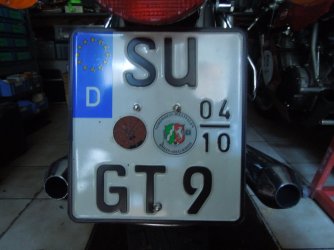
GTL rego plate. Limited registration period April-October, TÜV expires May 2028. SU → Administrative region Rhein-Sieg Kreis (Rhine-Sieg region, the Sieg river being a major tributary to the Rhine) in the federal state of North-Rhine Westphalia. The code for the administration region is usually the first letter of the major city in that region, ie D=Düsseldorf, E= Essen, M=Munich, S=Stuttgart, etc. These can be up to 3 letters. In this case, SU=Siegburg, a major town on the river Sieg. Because all possible letter/digit combos have been used up in many major regions, smaller regions/codes that once fell victim to slimlining these regions are popping up again, proving that the growth in vehicle numbers was not anticipated 50-odd years ago!
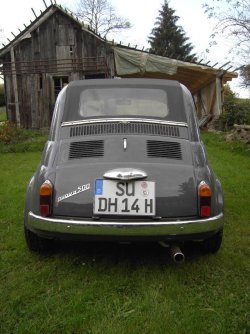
Fiat historic rego. (yes, I know the plate is at an angle... will be rectified when current resto is finalised!)
Hope that clarifies things for those that have always wondered what german plates actually denote. Registration, test and tax certificate, all in one. Not really complicated, just efficient.
piet
Insurance rates are generally quite reasonable for historic vehicles, often based on an agreed-limit annual mileage.
Then there's the red "collectors plate" that can cover an entire vehicle fleet. All vehicles must comply to their specific conditions and have been checked and thus certified. The plate can be swapped from one vehicle to the next with its details filled into a log book that is to be carried on the ride. Insurance rates for a historic fleet can often be haggled over, often based only on the most expensive vehicle. This scheme is meant especially for rally attendances or road testing, everday use is not allowed. Doesn't mean it doesn't happen though... Biggest disadvantage is that only one vehicle at a given time can be used. Want to ride out with the boys on parts of your collection? Multiple plates and insurance required.
Then we have the limited rego scheme for everyday vehicles, ie, rego only for the months April-October, which is the most common for bikes that are laid up during winter. Any period can be agreed upon, many classic car owners have a winter hack, accordingly registered. The vehicle can be used for the agreed period only, annual insurance and tax rates are reduced accordingly, rego is suspended for the remainder. Bikers (or Porsche, Ferarri, etc. drivers) that wanted or needed to save cash were previously required to de-register and re-register their bikes every year, with all the attached hassles. The limited period scheme has made this an absolute breeze. The allowed period of use is stated on the rego plate.
Generally, almost all are catered for in Germany and mostly, pretty fairly.
GTL rego plate. Limited registration period April-October, TÜV expires May 2028. SU → Administrative region Rhein-Sieg Kreis (Rhine-Sieg region, the Sieg river being a major tributary to the Rhine) in the federal state of North-Rhine Westphalia. The code for the administration region is usually the first letter of the major city in that region, ie D=Düsseldorf, E= Essen, M=Munich, S=Stuttgart, etc. These can be up to 3 letters. In this case, SU=Siegburg, a major town on the river Sieg. Because all possible letter/digit combos have been used up in many major regions, smaller regions/codes that once fell victim to slimlining these regions are popping up again, proving that the growth in vehicle numbers was not anticipated 50-odd years ago!
Fiat historic rego. (yes, I know the plate is at an angle... will be rectified when current resto is finalised!)
Hope that clarifies things for those that have always wondered what german plates actually denote. Registration, test and tax certificate, all in one. Not really complicated, just efficient.
piet
Silvaire
Junior member
- Location
- California
My head hurts 
I pay registration on a couple of motorcycles (a bevel SS and a LeMans) that I rarely ride. There is no practical reason not to do so because annual registration for both combined costs me only a few hours pay, and then I can ride them any time I want to do so in good weather that occurs whenever nature creates it. That’s surely simpler than stamped hieroglyphics on the license plate to reflect a particular owner's seasonal usage, and no inspections are required on my bikes so nothing like that is on my plates either. The plate never needs replacement over the life of the vehicle, regardless of who owns it or their usage.
Registration cost based on engine size is another one of those antiquey things that makes zero sense. It’s the value of the vehicle that should be taxed, logically, if it’s a property tax. A large displacement vehicle already pays more in fuel tax.
I’m reminded of the Munich public transport system (I was just there for a month). Decades of layers, features and payment options at the ticket machine, built up on top of each other until my even my wife (who bought tickets every day of her life for decades) recently got caught with an incorrect ticket because she wasn’t competent to buy the correct one. The ‘modern’ solution that I used is to put the app. on your phone which uses GPS to trace your start and end stops, and bills your credit card automatically for whatever it costs. You just let them take the money, however much the system calculates based on a computer model that compares costs for the myriad payment possibilities that exist for you and your specified group size to make that trip. They then email you a detailed receipt. Satellites, smart phones, a computer model and the internet are apparently required to make the system ‘simple’ and as a byproduct the consumer loses direct control over his costs - which by the way are three times what it costs to go to the same place on a motorcycle. We mostly used the motorcycle because yours truly decided he didn’t want to spend €15 to take the S-Bahn or bus for every short trip, plus the weather was nice.
As usual in 2026, the ultimate objective is to get everybody on the third parallel system, a fixed price monthly subscription that provides predictable cash flow for the provider.
Meanwhile last time I was in Prague they had two types of tickets to go anywhere on their entire system, one good for 30 minutes or something, another good for a longer period like 2 hours. Both were quite inexpensive. That’s simple.
I pay registration on a couple of motorcycles (a bevel SS and a LeMans) that I rarely ride. There is no practical reason not to do so because annual registration for both combined costs me only a few hours pay, and then I can ride them any time I want to do so in good weather that occurs whenever nature creates it. That’s surely simpler than stamped hieroglyphics on the license plate to reflect a particular owner's seasonal usage, and no inspections are required on my bikes so nothing like that is on my plates either. The plate never needs replacement over the life of the vehicle, regardless of who owns it or their usage.
Registration cost based on engine size is another one of those antiquey things that makes zero sense. It’s the value of the vehicle that should be taxed, logically, if it’s a property tax. A large displacement vehicle already pays more in fuel tax.
I’m reminded of the Munich public transport system (I was just there for a month). Decades of layers, features and payment options at the ticket machine, built up on top of each other until my even my wife (who bought tickets every day of her life for decades) recently got caught with an incorrect ticket because she wasn’t competent to buy the correct one. The ‘modern’ solution that I used is to put the app. on your phone which uses GPS to trace your start and end stops, and bills your credit card automatically for whatever it costs. You just let them take the money, however much the system calculates based on a computer model that compares costs for the myriad payment possibilities that exist for you and your specified group size to make that trip. They then email you a detailed receipt. Satellites, smart phones, a computer model and the internet are apparently required to make the system ‘simple’
and as a byproduct the consumer loses direct control over his costs - which by the way are three times what it costs to go to the same place on a motorcycle. We mostly used the motorcycle because yours truly decided he didn’t want to spend €15 to take the S-Bahn or bus for every short trip, plus the weather was nice.As usual in 2026, the ultimate objective is to get everybody on the third parallel system, a fixed price monthly subscription that provides predictable cash flow for the provider.
Meanwhile last time I was in Prague they had two types of tickets to go anywhere on their entire system, one good for 30 minutes or something, another good for a longer period like 2 hours. Both were quite inexpensive. That’s simple.
Last edited:

78jotadave
Hero member
FFS, life is simple in California compared to the bulky bureaucracy being presented here by riders/owners from other lands. Classic rego is cheaper, yes? I know it is still a revenue source, but now you need logbooks to go for a ride and restricted days to ride your classic.
What exactly do you record in the logbook? Does it have to be an officially approved book? Do you have to use #5 black Indian ink? Do you have to present it when you renew Rego? Maybe the authorities can come up with an APP for your phone for a fee $$; you can download it.
An Englishman who is running for Governor of California is promising he will introduce a flat $75 Registration fee for any vehicle in California, with no restriction (except large commercial rigs), and elimination of California fuel tax. Sounds like a winning ticket to me: "Go Steve"

TeddyG
Hero member
- Location
- Portland Oregon