Dellortoman
Hero member
- Location
- Tasmania, Australia
My mate Rick dropped his bike at Mac Park last weekend. It was a a pretty normal low-side fall on the left side in which he slid along on his arse and was unharmed. The bike (a Period 4 Guzzi) had a set of Maxton 38mm forks with fully adjustable cartridge internals. Rick opted for magnesium sliders rather than aluminium to reduce unsprung weight.
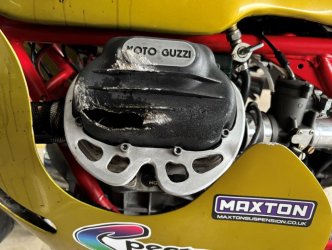
While the magnesium sliders are quite a bit lighter than the aluminium equivalent, it would appear that they're quite fragile. This is what the left slider looked like after he picked the bike up (ignore the grey bar in the foreground, it's the paddock stand). I've never seen a low-side drop do that to an aluminium fork slider. It's hard to tell what caused the break. There's no damage elsewhere on the fork leg, axle, disk or rim so it doesn't appear to have hit anything. Maybe it was just a shock from the steering hitting the stop. Who knows? The right leg was still intact.
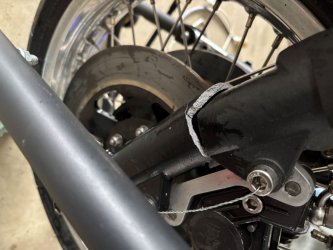
Mg has the advantage of being less dense (lighter for the same size) than Aluminium. But for the same cross sectional area, Mg is weaker. It appears that the Mg slider above was made from an identical mould as the aluminium version. Whereas to achieve the same strength as the aluminium slider it would have needed a thicker wall.
Ductility is a factor too. Mg is more brittle (or less ductile) than aluminium. A clout that might bend aluminium could shatter magnesium.
I'm not saying Maxton products are poorly made. Indeed, lightness may be more important than strength for racing. As long as it'll do the job when the bike is on its wheels, it's good enough. Race bikes are generally pretty fragile. Just look at how Alex Marquez's bike disintegrated at the Catalonia MotoGP. The forks worked well under normal racing conditions but failed during a reasonably gentle crash. That's fine if you have a generous racing budget or sponsorship, and can afford to replace expensive magnesium parts. But most normal weekend hobby racers don't have unlimited budgets. These Mg sliders were twice the price of aluminium alloy.
The above may be of relevance to anyone considering magnesium fork sliders. Treat them gently. I wouldn't recommend them for road use, or for racing if you're on a shoestring budget.
While the magnesium sliders are quite a bit lighter than the aluminium equivalent, it would appear that they're quite fragile. This is what the left slider looked like after he picked the bike up (ignore the grey bar in the foreground, it's the paddock stand). I've never seen a low-side drop do that to an aluminium fork slider. It's hard to tell what caused the break. There's no damage elsewhere on the fork leg, axle, disk or rim so it doesn't appear to have hit anything. Maybe it was just a shock from the steering hitting the stop. Who knows? The right leg was still intact.
Mg has the advantage of being less dense (lighter for the same size) than Aluminium. But for the same cross sectional area, Mg is weaker. It appears that the Mg slider above was made from an identical mould as the aluminium version. Whereas to achieve the same strength as the aluminium slider it would have needed a thicker wall.
Ductility is a factor too. Mg is more brittle (or less ductile) than aluminium. A clout that might bend aluminium could shatter magnesium.
I'm not saying Maxton products are poorly made. Indeed, lightness may be more important than strength for racing. As long as it'll do the job when the bike is on its wheels, it's good enough. Race bikes are generally pretty fragile. Just look at how Alex Marquez's bike disintegrated at the Catalonia MotoGP. The forks worked well under normal racing conditions but failed during a reasonably gentle crash. That's fine if you have a generous racing budget or sponsorship, and can afford to replace expensive magnesium parts. But most normal weekend hobby racers don't have unlimited budgets. These Mg sliders were twice the price of aluminium alloy.
The above may be of relevance to anyone considering magnesium fork sliders. Treat them gently. I wouldn't recommend them for road use, or for racing if you're on a shoestring budget.


 It's probably to do with the position of the leg within the slider at the moment of impact?