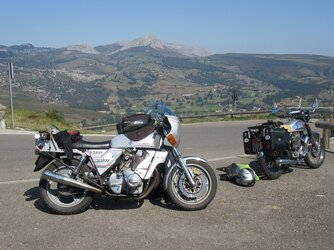
Moving brake calipers behind fork leg

Well if you are running standard cast wheels and iron discs, nowt.  They weigh a bleeding ton and the calipers are relatively light, but calipers behind the discs look tidier IMHO.
 
The weight of the calipers is closer to the centre of mass of the bike.
Some folk reckon it gives a measure of anti-dive, but I can't see it myself.
 
Hello 3crider. Welcome to the forum.

I don't think it has so much to do with getting the calipers closer to the centre of mass of the bike, rather than getting them closer to the centre of the steering axis (which is behind the fork legs). That reduces the moment of inertia of the steering system about the steering axis, making the steering more responsive to rider input.
It also changes the natural frequency of steering oscillation, so may be beneficial if you're looking to eliminate any tank slapping tendency.
Someone reported earlier (after having just done the modification) that it also reduced the tendency of his bike to stand up and run wide when braking in a turn. I haven't quite figured out the physics of why that should be so, but it's certainly a desirable side effect.

Cheers,
Cam
 
Thank's cam

I can see some of what you say might make a difference. With regard to tank slappers, my frame is very subtlety but very strongly braced around the steering head and the improvement in stability was quite measureable. As for moving my calipers to the back I suspect it might be more a more a personal choice thing than a performance thing and personally I like to keep the original look of the bike.
 
I would love to see some hard data regarding handling improvements, or at least comments form the racing fraternity who have tried both.

My (mostly pedestrian) first thoughts when I got my bike was that the caliper bolt holes were under tension rather than compression during braking, so more prone to breaking off, but have never heard a report of it happening.

Second (vain) effect is that most admirers of the bike ask it they are fitted backwards, giving a chance to talk about the bike.
 
I can understand the advantage in steering dynamics by getting the front calipers to the lower rear of the forks and am considering doing this fork swap on my 1976 3CL. I recently had a chance to ride a 1982 model with this configuration and noticed better stability in cornering.
I would be interested in any feedback, good or bad, from anyone who has done this.
Considering this thread is 11 years old, there may have been more who have done this since then.
There are plenty of reasons why two machines may have different cornering characteristics. Make an inventory of those reasons and eliminate them before attributing the difference to calipers behind fork legs.

What kind of riding do you do? Are you in the habit of coming into corners hard on the brakes?

Paul
 
It was the first change I made when I bought my RGS not because of the way I habitually rode, but to improve the odds in case of an emergency situation. Did it make a difference? Who knows? But I felt better about my confidence in the handling and it looked better IMHO.
 
here are mine (sorry Red) what makes the difference and in huge huge leaps and bounds, is the lack of weight in the 320mm rotors, the steering is much omproved due to less gyroscopic forces, its very noticable, I like the calipers on the front for three reasons, 1) riding in the rain, the water doesnt drain from everything and then pass through the calipers, on its way to the ground, they stay a lot drier and 2) they are much easier to "get at" whenever something needs doing or checking, and 3) the speedo gearbox and cable are not an issue. (if using the ultra rare 27mm offset ex Cagiva 500GP bike discs)

CLEM
 

Attachments

  • Picos 2018zoom.jpg
    Picos 2018zoom.jpg
    340.6 KB · Views: 37
Swapped my RGS calipers around a long time ago and there is a reduced tendency for the bike to stand up in a corner. Yeah, I know there's argument for and against braking into a corner but I'm now a firm believer in trail braking. If it's good enough for Simon Pavey... 😁
And on Clem's point braking performance in wet weather is unaffected... both with standard CI discs /organic pads and stainless with sintered
Of course you brake into a corner. Days of grabby drum brakes and tyres made out of soap are long gone.
You need to brake pretty hard though to feel the bike want to redress. Maybe something to do with the rather unwieldy RGS? I can brake hard and late on the SFC, doesn't seem to want to stand up.

Paul
 
It was the first change I made when I bought my RGS not because of the way I habitually rode, but to improve the odds in case of an emergency situation. Did it make a difference? Who knows? But I felt better about my confidence in the handling and it looked better IMHO.
Swapped my RGS calipers around a long time ago and there is a reduced tendency for the bike to stand up in a corner. Yeah, I know there's argument for and against braking into a corner but I'm now a firm believer in trail braking. If it's good enough for Simon Pavey... 😁
And on Clem's point braking performance in wet weather is unaffected... both with standard CI discs /organic pads and stainless with sintered
?
RGS came with calipers fitted behind the sliders as stock.

If I'm not entirely mistaken, the mod was introduced by the factory with the Jota 120. A few pre-production factory pics show the calipers in front of the sliders, production bikes had them behind.

piet
 
There are plenty of reasons why two machines may have different cornering characteristics. Make an inventory of those reasons and eliminate them before attributing the difference to calipers behind fork legs.

What kind of riding do you do? Are you in the habit of coming into corners hard on the brakes?

Paul
Good points Paul. I have replaced both front and rear alloy wheels with wire spoked wheels which, in my opinion, made a significant improvement in handling by reducing the un-sprung weight and associated unwanted inertia, as Clem pointed out. So, yes, that is a major difference from the 1982 and my 1976 model. As for cornering, like Rob, I prefer trail braking where possible. I think Cam is onto it--the advantage comes from getting the calipers closer to the steering axis.
As for appearance and maintenance, I'm not as concerned about that, it's more about the handling.
Did you weigh the cast wheels and the wire ones? What was the difference in weight?

Paul
 
?
RGS came with calipers fitted behind the sliders as stock.

If I'm not entirely mistaken, the mod was introduced by the factory with the Jota 120. A few pre-production factory pics show the calipers in front of the sliders, production bikes had them behind.

piet
That shows how long ago I did or didn’t do it!
 
Was discussing this issue the other day with Norwegian Laverda racer, Rune Vangen. He said having tried both ways round he couldn’t notice any difference in braking performance between the two. I can’t say I have either on the 500 twin, although I do tend to reverse them on my track bikes.
 
Was discussing this issue the other day with Norwegian Laverda racer, Rune Vangen. He said having tried both ways round he couldn’t notice any difference in braking performance between the two. I can’t say I have either on the 500 twin, although I do tend to reverse them on my track bikes.
Braking performance would have to be the same. It is steering that people are addressing, and peoples feeling of steering is part of that nebulous term "handling". Are there any bikes made today with callipers in front?
 
Back
Top