Newbie SFC 1000 doesn't start

If it was getting fuel and sparks, even if wrongly timed, there would be a lot of farting and banging going on.
I don't think it's getting fuel and maybe not even sparking well.
 
Here's my old tried and tested way of starting an old triple.
Take plugs our , earth them and empty chambers of any fuel by turning over for 30 seconds.
Clean plugs and gap them check they spark.
Slowly heat them on a gas ring then put the back in .
Start on half choke.
If it won't start then kick fuck out of it,
It will make you feel better as your bank balance will surely go down.

Regards andy
 
JohnL said:
I cleaned tank, petcocks and bowls. All really dirty like you predicted. Then I tried to start with 1/2 and 2/3 choke and support from my car battery.

you have a fine filter on each fuel line where they enter each carb body, you need to undo the 10mm (spanner size) bolt that holds on the banjo fitting that the fuel hoses attach to
if everything else was cruddy then the filters will be chockers

 
On the Dellorto choke. They are not really a choke in the old sense but a fuel enrichment circuit, They do not have a butterfly close (choke) off the air but open an extra fuel circuit making the mixture richer.

If I'm suspect about fuel getting to the carb, I have tested it by taking of the carb bowl and putting a catch container underneath then turning on fuel cock, then operating float gently by hand.

If all ok I replace all turn on fuel, take of the inlet rubber hose operate throttle and see if the pump jets are working. If they have dried out some times they will need manually priming.
If you PM me you e-mail I have a electronic copy of the Dellorto manual your welcome to.
Jugs


I bought the bike 3 months ago from a photo and saw/heard it running only via skype.

When it arrived I wasn't able to start and began posting here for technical advice.

Ignition:
Fitted new Champion plugs with correct gap
I have a spark on all 3 plugs
front coil is left cyl, middle is center and rear coil is right cyl

Fuel system
Cleaned tank, petcocks, bowls and filters in carb bodies (last were clean rest was awful dirty and some kind of gel).
filled up with fresh fuel
Bowls fill up well, I measured the amount of fuel coming out of every bowl after cleaning all.

Remarks:
Every part I remove or open on the bike hasn't been touched for a long time if ever.
Pistons seem to be dry after every start attemp (with help from car battery)
When I turn the throttle only the left carb sprays fuel in the venturi.

I don't know how the past owner made it running but I am afraid I have to dismantle and clean the carbs

Will probably bring them in my hand-luggage when travelling to the West.

Downloaded Dellorto and Rgs manual.

John
 
Sounds like the carbs could with a stripdown and time in an ultrasonic bath followed by a blow out with an airline.
If you have sparks it has to be fuel quality or fuel delivery.
Typical when a bike has not run in a long time.
The carbs are not too complicated. Strip one at a time and use the others for reference.
 
HI JohnL

We are all feeling your pain here............. :(

There are carb rubbers that connect the carbs to the head, if they are not sealing or split, can screw your  fuel/air mixture up and will not help, although not likely to be the primary root cause unless very bad.

Does your bike have the original ignition ? If so, the position or gaps of the three crank triggers may be out of position or the air gap incorrect, causing the ignition timing to be out and thus back firing ( explosions ).

Thorough carb clean as already stated is a good idea.

                    Good luck
                              Matt
 
JohnL said:
When I turn the throttle only the left carb sprays fuel in the venturi.

Not at all unusual for a carby that has been left sit for a while or has been recently stripped and drained of all fuel. Each carby has a separate diaphragm type accelerator pump. In theory, they should self-prime. But often the little valves won't seal properly when dry, so they need to be primed.

Many people run without accelerator pumps, so the bike should still start and run without them.
 
Years ago it would be a blocked idle jet,easy fix, these days its inevitably blocked idle passages in the carb, a bit more tedious. If your not keen to do the full monti carb strip and clean there are a few inmates here who do this stuff for a living.
 
John
Pull the new plus out and check to see if they are "wet" or dry
If they are wet then you are getting fuel into it so maybe whilst you are getting spark with the plugs out it might not be enough or your a loosing under pressure... .so if wet then have a good look at the HT leads where they go into the coils'.. they are glued in but can corrode in there and cause issues so you have to cut them out if that makes sense clean and then refit...

However if they are dry which I suspect then you have gunked up carbs I would suggest.. to see if this is the case and that the engine can actually run then try squirty a small amount of "aerostart " down each ventury and giving it a hit on the button.
If you are suffering from blocked carbs it will most likely start and run for a second or two before dying..

Mind you only use a short squirt down each venturi.. If you no aerostart or "start you bastard " etc .then you could try squirting a small amount of good fresh petrol down each carb ... but only a small amount from a spary bottle or simialar..
If doing this then take care as if you too much fuel down there you can end up with other issues.

Oh and by the way would be an idea if you are not very familiar with using aerostart to have someone standing by with an extinguiser just for incase.

Let us know how you get on
 
Thank you all for your valuable input, very much appreciated. My questions may seem silly to some of you but I am in no means a technician.

I have thoroughly read the forum these last few days and what worries me is the so called fuel-lock. I checked the cylinders almost every time after starting by removing the plugs and they seem to be dry as well as the plugs. However, the explosion in the exhausts means that fuel coming at least from one of the cylinders has been ignited after it left the exhaust valve?  Pet-cocks are closed when not trying to start. Is it possible to have a fuel-lock by starting at full choke for as longer period?

Last week I tried to start and one moment heard a strange noise and stopped directly, after that never heard this noise again. Please don't tell me that I ruined it already!

I am currently thinking about the next steps to take since I do not want to have it fixed locally, nor am I going to try myself with aerostart and the help of the fire department.

Am I capable of placing a rebuilt set of carbs or does it demands a specialist to adjust and balance the carbs?

John
 
Using the choke won't cause fuel lock. It is when the fuel taps are left on, the float valves are not seating properly and over a time the fuel flows down the inlet port and if the valve is open it can fill the combustion chamber with fuel giving hydraulic lock when trying to start it. The fuel can also leak past piston rings and mix with the engine oil in the sump.
Pull the dip stick and have a smell for fuel if you are still worried.

Strange noises on trying to start can be due to squeals of protest from the starter clutch no gripping the crank fully.

If you can remove the carbs and send tem to someone who is capable of stripping, cleaning and rebuilding them then this may help speed up the process if you still can't get it started or it is beyond your abilities (no shame there).
Once rebuilt they can be set in reasonable alignment and would not be too far out to stop it starting (if that was the problem). Ideally you would still need the engine set up and serviced properly once started.
I doubt there is any Laverda specialist within easy reach of your location, so maybe time to get learning or spending.
 
Maybe you could set up a Skype/facetime call with one of the forum experts (definitely not me - relatively new owner of a 750) and go through some of the obvious things. IMHO pulling the carbs off and sending them away just introduces a whole load of extra variables.

Took me a while to get mine running after uncrating - but it was only due to the oddness of the old nail type ignition switches. I do remember that sinking feeling that there was something major wrong but I thing that is rarely the case and now have been enjoying riding the bike for over 3 years.

I think it is pretty hard to break a bike by any of the things you might do in trying to start it (as long it has got oil and the taps are off when not in use) .

Good luck!

Chris
 
Hi John

The backfire might be a clue that the ignition timing is way off. Possibly the ignition rotor is out of position on the crank, or the plug leads are mixed up. Leads on the wrong plugs is not as uncommon as you might think when a bike has been shipped. I've come across it before. Some smart-arse in the shipping company probably thinks it's a clever joke.

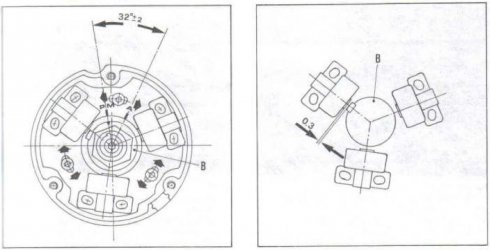
However, you can do a rough check of static timing. Good enough to know that you're somewhere in the ballpark.  Take the cover off the ignition (the round cover with 3 screws on the left end of the crank). There will be 3 pickups on the stator plate and a rotor with a lobe on it on the end of the crankshaft. With the plugs out, wind the engine over by hand with a spanner on the end of the crank (engine rotates the same direction as the wheels). Poke a screwdriver down the plug hole in cylinder 1 (left) to determine roughly when the piston is at TDC. When piston #1 is at TDC, the lobe on the ignition rotor should align with the pickup located at the approximate 10 o'clock position. If you want to get technical, there's a groove mark on the rotor that should align with the PM mark on the stator plate - should look like the diagram below. If it doesn't, then you've found a problem.

If the static timing checks out OK, it still doesn't tell you whether the leads are connected to the right plugs. However, you now know that the pickup for cylinder 1 is at 10 o'clock. The pickups are the variable reluctance type which have a built-in magnet. The ignition signal is generated when the steel lobe on the rotor passes the nose of the pickup. But it doesn't only respond to the rotor lobe. Any ferrous material will do, such as a screwdriver, spanner, bolt.

Attach a spark plug to the HT lead for Cylinder 1 and rest the body of the plug on the engine to get an earth connection and switch the ignition on. Now take a (clean*) screwdriver and put the tip as close as you can to the business end of the pickup (it's OK to touch it) and move it away again. As you move the screwdriver to or from (I forget which way, I think it's away from) you should see a spark at the plug. If not, you may have the wrong plug lead. Try the other pickups and other leads and you'll be able to correlate pickups with HT leads.
* screwdrivers are often slightly magnetised and can pick up iron filings on the tip. If you don't clean them off they will transfer to the stronger magnet in the pickup.

I can't remember which of the other two pickups are which. Maybe someone else here can tell us. Does anyone know the firing order for a 120?? But even if you can only confirm #1, that leaves you with a 50/50 chance for the other two. If you get an attempted start accompanied by backfiring, swap 2 & 3 over.

While you're in there. Check the pickup-lobe gap as shown below (0.3mm)

Cam
 

Attachments

  • ignition pickups.jpg
    ignition pickups.jpg
    182.4 KB · Views: 38
I'll add that on my sfc1000 it simply does not like Champion N2 (or n3)c plugs. So I went to NGK B8ES. Starts fine. The same goes for standard Bosch (3) original ignition boxes, as well as a Witt box.

Anyway, the carbs are absolutely super simple, and you may want to take them off (as a set), and give them a clean and basic adjustment.
As I suppose you now have the workshop manual (tell if not, and I'll make you a papercopy and mail it), follow the simple instructions as per the Laverda workshopmanual.
I will note a few points I've come across over the years:

- floats. Should be aligned, so that each side of (each) float have similar height.

- Floats. should be adjusted on the small fork that engages with the needle valve. Setting is in the middle of what Laverda says. I set them on 18,0mm when the carburettor set is lyeing flat Down, as per Picture on page 77 in Laverda mnaual.

- needle valve. Should be sitting it it's seat. Sometimes they undo, and you'll have way too much fuel entering. Sometimes they are died out, and should be changed. Easy and cheap.

- jets. Should be clean and no scars or alike. Do look into the right size. I've seen some Laverda's with enormous jets over the years, and 108 is RGS type, 112 is SFC1000, and sometimes 118. I'd make sure they are 108 or 112 (main jet).
The smaller jet should be 65.

- Needle. K1 and put the butterfly (clip) in the second notch. No scratches what so ever. And they get that rather quickly. Get an air filter.

- Gas valve. 60/2. the numbers tell how quickly and steep the accelerator pumps come "on". And the height of the rounded cut out in the bottom of the gas valve determines the airspeed. They get worn out quickly and should be okay as well. Some Wear will be okay though.

- Chokes. Be sure that when you undo the Little screw on each, and lift the choke plunger up, that there's an O-ring sealing it. I usually add a tiny dab of silicone grease, so they seal propperly.

- air screw. This is also important. Basic setting is 1,5 turn outwards, from being fully turned it. Minor adjustment is then made, when bike is running. One screw on each carb, and as you have -dd and -ad carbs, one will have the screw on the other side of the carb body. So just turn it in fully, and then outwards 1? turn as a basic setting.

- Atomiser. 265 ab. Should be Sealed too with an oring (I think - can't remember).

- generally three complete sets of seals are rather cheap and maybe think of buying those and store whatever you don't use. Some gaskets will not be of use to you, as they also cover other models.

- big screw on underside of each carb float bowl. Take them off and blow them clean with a brake cleaner spray. They can block slightly to fully because of modern type fuel leaves nasty deposits.

- Fuel. Get the best and highest octane you can. 100 octane is fine. Castrol make a octane boost that Works. I use it allways and it's the type that also protects the valves. They also make one without the valve protection additive.

- rubber pieces (inlet tracts) between carbs and cylinder head. They can split under preasure, and you could take them off and look carefully at them.

- Fuel pipe. Sometimes previous owners mix up the fuel hoses going into the metal fuel distributor pipe, wrongly. That starves one side.

- Common idle screw. Big White plastic nut underneath the carbs. Works all three carbs at a time. Should be turned enough, so that the bike can start and idle. Turn it Down, when bike is started, and idle is too high. 1000 rpm when warm is fine. If too low, the bike won't start or have a hard time doing so.

- Starting. I set the kill switch in "on". Then I open the two fuel tabs, and look if the fuel runs into the carbs freely on both sides.
Turn on the ignition key. One click. Not two (that is parking position).
Turn the choke handle apprx. half way. NEVER use the gas handle. It squirts a lot of petrol into the chambers. actually I found that old 180 engines need a squirt or two. I've never ever seen a 120 that needed that.
Turn engine on starter bottom, and adjust choke. Only use choke as a starting device. Not letting it warm up with raised idle for a minute or more. I use the choke on for say 10 seconds, then off, and keeping the gas raised a bit on the gashandle (gas roll).

Make sure that your choke plungers (metal cylinders of brass) actually slides up and DOWN, when moving the choke. Often they can be stuck or cables are defect, or jumped out of the Little round Black cable splitter. 1 cable from choke lever to splitter, and then 3 cables - 1 for each carb. Need to be in action at the SAME time.

If the battery is fresh, it may still have ever so slightly low voltage. And that can give your starter system a clash, and a bang. Avoid that or rebuild over time.

On my previous RGS I sometimes found that a fresh set of plugs fouled, and after cleaning them, still couldn't start. I had to change them Again. They may give a spark at surface preassure in free air, but under compression, they may not do so.
Buy a 10 piece box of NGK b8ES plugs.

Give us a shout of all of this and all of what the others said, and we'll take it from there.

Cheers,
Jacques.
 
Thank you all very much and especially Dellortoman and Redfox for the excellent step by step problemsolving discription. I hope to find some time next week to start with your solutions.

John
 
Very well explained Jacques about a SFC 1000 bring to life. Can put directly in a Wiki, compliments for that.
Are you not afraid that the B8ES are to hot with risks of holes in pistons? My SFC runs  (and start) perfect on a set of B9ES.
One thing is that I have a 30Amp Exide AGM battery that has about 13.0 V, so with almost a half volt more than a normal "liquid" battery it?s garanteed for a fat spark when starting with no fouling.
grtz,    Ren?
 
Back
Top