G'day Steve,
Great find. Seems the bike hasn't been butchered at all, unlike many examples.
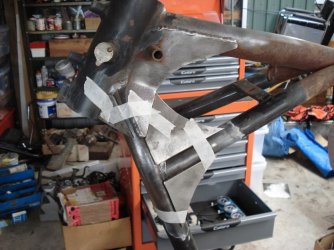
The frames generally hold up pretty well under "normal" use, it's usually the hard-pushed ones that give up. The frame can be welded without stripping, I found my RGS to be cracked a week before I was due to leave for a long vacation trip! I didn't have the time for a total strip-down, so I bared the headstock as well as possible and did it at home in the shed. 12 years on, all is well.
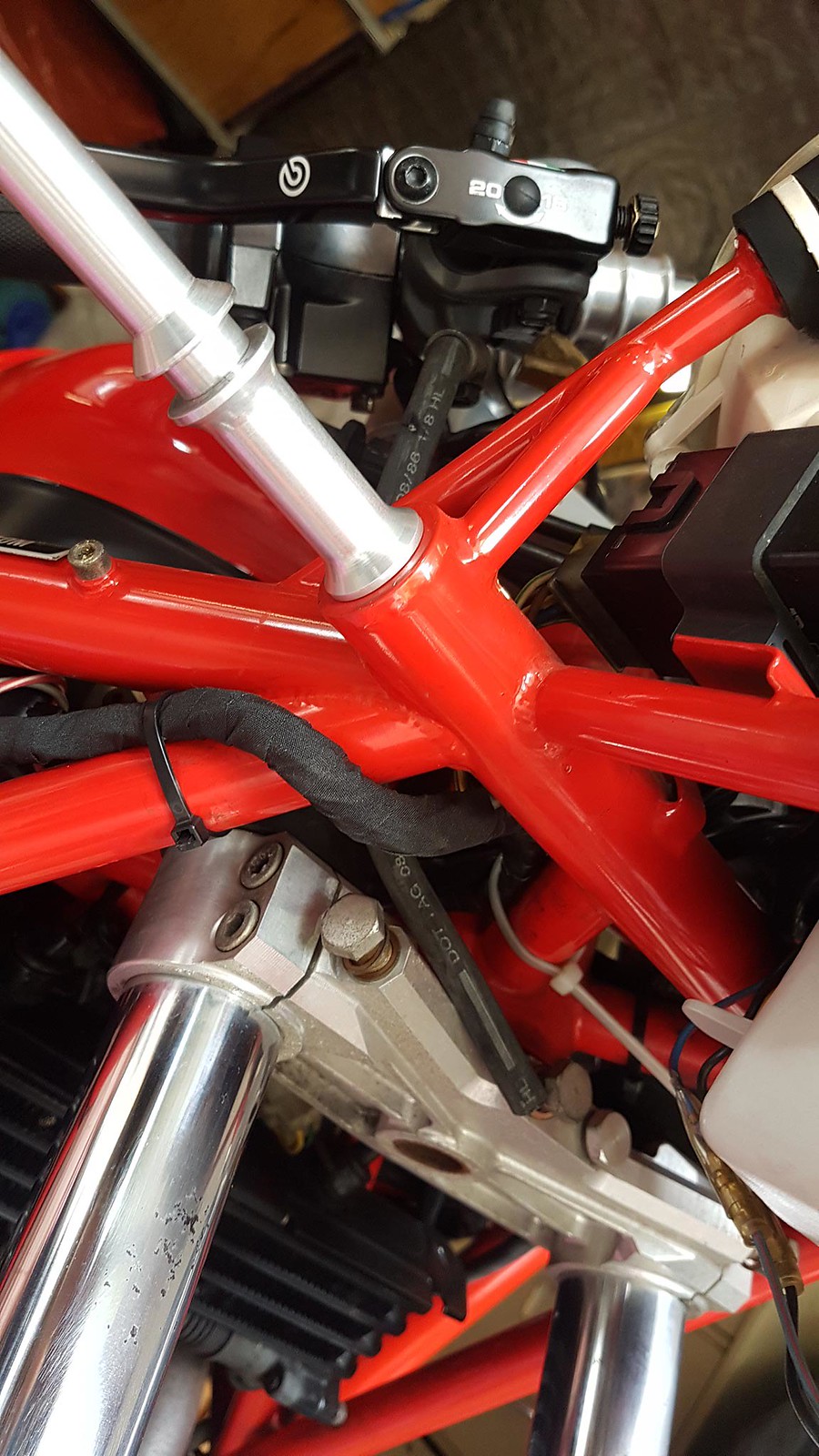
Lots of different opinions regarding frame bracing. The factory gusset kits were meant for REPAIRING cracked frames, and were therefore a lot stronger/thicker and completely differently shaped than the gussets the factory added to the last few SFC1000 to prevent frame cracking. If adding gussets as a preventive measure, I'd have a close look at how the factory did it, I have yet to find one of these to be cracked, despite the stonger front brake and forks that induce greater forces into the headstock. When bracing such a frame, the induced forces don't disappear, they are mostly transferred to a different spot. Strongly bracing one part might over-stress the adjoining. Due to its age and the very basic materials used, I'd suspect the designers calculated to include a certain amount of frame flex. If you do eventually decide to add gussets, I'd suggest you look into lengthening the headstock while you're at it. This unloads both the headstock and fork legs to a degree, stiffening the forks in the process, simply by reducing the length of the stressed part of the stanchions. All depends on your budget/ambitions of course.
I've always regarded the RGS, and especially the RGS Corsa, as the ultimate Gentlemans Express, not the sportsbike it was often promoted as (turned out the japs were far better at that!). It was also built in an era when emissions were beginning to be taken very seriously, especially noise emissions. Laverda went to great lengths to design an efficient intake and exhaust systems, and the bike works very nicely under all conditions with these systems. I have a strong aversion to making more noise than necessary, I prefer to fly under the radar, and not give long-term notice of my arrival by fitting those stupid loud Jota cans. These rarely fit well and throw up a handful of other issues. The stock silencers tend to rust from the inside during use, good ones are rare these days. OCT in Germany once commissioned a batch of replicas in stainless, externally and internally identical, but with a larger exit tube to avoid the extra drillings in the end cap that look just like the afterthought that they were. I'm very happy with mine, they have held up well since fitting them in 2008. Unfortunately, they have been sold out long ago...
Overall build quality of these bikes is head and shoulders above anything Laverda had built before. This doesn't mean they're bullet-proof or there isn't scope for further perfecting though. The silentbloc at the headstock carrying the fairing tends to soften with age, allowing the fairing to flop around excessively, straining the screen, headlamp mounts and the instrument internals. Replacing the silentbloc with a solid alloy bar and renewing the tank mount rubbers holds everything in place nicely. The battery doesn't need to be as big as that fitted by the factory, smaller modern gel-type 18 or 20Ah batteries do the job well. While the red Motoplat coils fitted to some RGSs seem to have a bad reputation, I have found only one failure since I started working on these bikes in 1990. Alternator wiring needs periodic checking, as does the tank over-flow hose and the balance hose connecting the carbs to one another. Check engine mount rubbers, deteriorated ones can cause excessive vibration. The all-rubber intake stubs are usually well past their use-by date, these can be replaced with the stubs used on the prior triple models. At 17000km, carb wear shouldn't yet be a problem, but the carb linkage will be delighted over a drop of oil or 2.
The original ignition system tends to be quite reliable, for a while at least. Main problem is ageing and deteriorating wiring to the pick-ups as Brett has mentioned, this can be easily rectified. But, the system is rather crude, with a definite advance step hitting in at 1800-2200rpm, depending on how well the pick-ups are set up. While not being a problem on long overland hauls, it can be a royal pita cruising in town, with jerking resulting at low throttle openings. A modern system offering proper advance curves transforms the engine, making it completely vice-free in traffic. The quite common plug-fouling at starting usually disappears as well. I'm currently using a development of the DMC II by Moto Witt. This uses low-resistance coils and delivers sparks more than twice as strong as the previos system. Instant starting under all conditions, even with stale fuel, is the result.
Aftermarket California mirrors can easily be adapted, quality isn't as good as the originals though. I've found the internals require a little fettling to provide full adjustability. Rubber gaiters are no problem... indicators are!
After a proper re-commission, your Corsa will surely turn out to be a fantastic bike.

piet

Enjoy