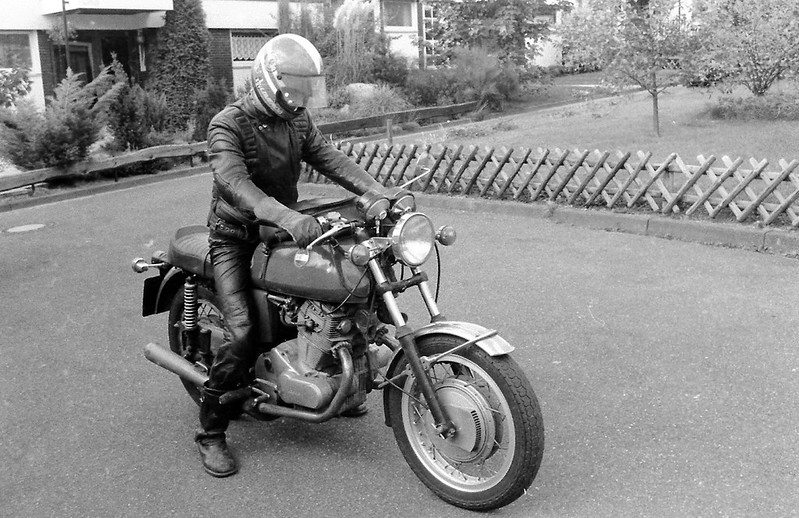
Porsche brake-pads for the Laverda drum-brakes

After several questions to the "Porsche brake-pads" for the Laverda drum-brakes following informations:

Some members of the LCO also drive (semi-) races.
We tested for a long time until we found a solution, with which you can get extremely effective drum brake.
Maximum braking force by little required effort and the brake can be dosed very well.

We take the brake pad-material that is normally used in the old Porsche drum brakes. We let them glue onto the original brake-shoes.
There are also thicker pads with 4.5, 5, or 5.5 mm if you have a twisted brake drum or you want to turn the pads off.
depending on the condition of your drum-brake.

What to do:

1. If necessary we clamp the drum in a rotary table on the milling machine to mill the drum inside round. You although can use a big late for this job.
2. First clean all bearings of the axles / levers and lightly lubricate them with heat-resistant grease.
3. Put your braking plate with the new brake pads into your drum.
4. Instead of the cable use a long thread to bring the pads firmly to the drum.
5. Mark this position on the thread
6. Then the braking plate with the brake pads come even on a rotary table pretensioned, till the marked position on the spanning thread, so that they would normally rest against the drum.
In this position, the pads will be milled round till the diameter of your inner drum.
7. To arrive the maximum we repeat now Step 3-5
8. Each brake-pad must be bevelled slightly on both narrow sides with a file or belt sander.
9. When assembling, do not yet tighten the tension strut to the braking plate. The wheel axle must also not be firmly tightened.
10. In this position, pull the brake lever firmly (let it) or fix it to the throttle with a rubber strap.
11. Only now first tighten the wheel axle and then the brake anchor.
12. Now lift the front wheel slightly and adjust the brake cable so that the wheel just turns.
13. The cable should be remarkable smaller than the inner Diameter of the outer hose and should be well oiled (e.g. with GGV).
14. Don't forget to lubricate the upper nipple at the end of the brake cable in the brake lever (just like with the clutch lever)! = no more broken niple :)
15. Finished - you will no longer recognize your old brake :)

Example for prices including removing the old brake pads:
Quality BK5387
Length 230 mm
Width 30 mm
Thickness 4 mm
Unit price (1 piece) 15.70 EUR + tax + shipping

contact: bremsen-schoebel.de

https://www.laverdaforum.com/gallery/albums/userpics/10086/270/Brake_Pads_Laverda_Backen_PL2012.pdf
https://www.laverdaforum.com/gallery/albums/userpics/10086/270/Bremsen-Schoebel_Imagebroschure.pdf

Best Thomas aus LAU
 

Attachments

Last edited:
Yes Thomas, but that is standard practice. Anybody who knows drum brakes will do that but what, if anything is particular about this pad material for Porsche?

Paul
 
Paul Marx said:
Yes Thomas, but that is standard practice. Anybody who knows drum brakes will do that but was, if anything is particular about this pad material for Porsche?
Paul

It schould be standard practice but it isn?t practice :-(

Which normal dealer has a big mill or late these days? Who has the old mechanic whith lot of experience?
And if you are not consequent on each of this points, you will not reach the maximum result.

My focus in the article was specifically on the Porsche brake pads (quality BK5387), which in our opinion brake significantly better than the normal commercially available pads.

Incidentally, Laverdisti still drive around with riveted covers - not turned off. E.g. originally the brake shoes on my 69 Eagle were still covered with asbestos cords.
Often only 1/3 of the lining is on the drum and the lining is not in all places on the brake beacon.

We don't have to compete for the best solution - there are many roads that lead to Rome ...

Best Thomas aus LAU


Thank you for the information Thomas.
As someone a long way from Europe, is it possible for you to quote the lining manufacturer and their reference number please.

I have customers who race drum braked bikes and we're always on the lookout for better lining materials. But out here "Porsche brake lining" means very little.
For some years now our standard race lining has been the modern non-asbestos "green" lining which replaced Ferodo AM4. It's not bad at all.
 
Thomas aus LAU said:
It schould be standard practice but it isn?t practice :-(

Which normal dealer has a big mill or late these days? Who has the old mechanic whith lot of experience?
And if you are not consequent on each of this points, you will not reach the maximum result.

My focus in the article was specifically on the Porsche brake pads (quality BK5387), which in our opinion brake significantly better than the normal commercially available pads.

Incidentally, Laverdisti still drive around with riveted covers - not turned off. E.g. originally the brake shoes on my 69 Eagle were still covered with asbestos cords.
Often only 1/3 of the lining is on the drum and the lining is not in all places on the brake beacon.

We don't have to compete for the best solution - there are many roads that lead to Rome ...

Best Thomas aus LAU

That's true for all aspects of running an old machine Thomas and will become rapidly crucial with our Laverdas as dealers and suppliers close.

If you run an old machine, you need to know somebody with a lathe that can take wheels. You need to know people good with lathe and milling machine skills. You need to know how to do a lot of things yourself and if you can't do it, you need to know where to go.

Our Laverdas are relatively recent but quite a few people use bikes from the 20s and 30s. You don't see them often on the road because they aren't very numerous.
That is where the Laverda world is going.

Paul

Paul
 
Trouble is, hardly anybody is willing to pay for such a lengthy process.

I perform this type of task regularly for discerning customers that wish for drum brakes that actually live up to their name.  German brake pad and lining manufacturer JURID offers a lining material that works extremely well in motorcycle applications, actually too good in some cases!  I get good-condition shoes (without overly-worn or loose bushes) re-lined with 8mm thick material, finished thickness ends up close to 6mm.  Having them re-lined with 6mm is a bit dodgy, this sometimes doesn't clean up entirely when turning the shoes to drum diametre. It is a pain and a bit of a waste to remove so much material, but the end result is just so much better.  Shoes are machined to a diametre that takes maximum advantage of lever geometry.  Drums often show wear, but are rarely distorted.  If drum condition is acceptable, I tend to leave well alone, instead of unnecessarily removing material.  Slight scoring of the drum surface is no big deal and will have next to no effect on brake performance once the linings have fully bedded in.

What is often over-looked is the condition of the linkages and their bushes.  There is often enough slop to take up half of the cable adjuster range!  The bell crank shafts must be fitted to close tolerances in the bushes, the internal linkages and pins must be as slop-free as possible.

Going to such lengths results in a drum brake that works at its optimum almost from the word go, a bare minimum is required for final bedding-in of the linings, depending lastly on the condition of the drum surface.  Simply replacing the shoes with aftermarket items will result in a mediocre brake at best, with the cable adjusters almost at their limits coupled with lousy lever geometry.

The re-lining guys charge ?35 per shoe for 8mm linings, the labour for re-furbishing works out at around 4-5 hours, depending on condition of bell cranks, etc.  If new parts are required, the bill can easily run up to somewhere around ?550-600 or more per wheel.  If the drum requires extensive work and parts, you're getting close to 4 digits.  When presented with an estimate of this magnitude, the reaction is usually "I don't ride that fast any more", and the wheel is cobbled together with scrap parts and will confirm the established "knowledge" that Laverda drum brakes are crap.  But the flash orange paint job was ?2200, go figure... ::)

piet
 
Thomas - many thanks for posting this really useful information. I have been looking for an informed recommendation for linings that work well on a Laverda drum brake. Riding my 1972 SF is nerve wracking when an emergency stop is demanded!  My experience of materials is redundant because it goes back to the days of asbestos being used...

As you so rightly say, good installation practice seldom happens because of the work involved in matching the linings to the drum. Piet's experience of the time and costs involved explains why!

(goodjob)
 
I can only confirm Piet's point of view.

Especially the Grimeca brakes of the first Laverdas tend to warp as they are definitely undersized. I already had two broken hubs, Brettoni also confirmed to me that it was a weak point at the time.
see: https://www.laverdaforum.com/gallery/thumbnails.php?album=257

Here you can hardly avoid unscrewing the drum but only IN THE SPOKED-IN STATE.

Best Thomas aus LAU
 
I have flogged out bushes on my links for my rear brake on my 3c, you can see them wiggle. do these need custom fitting Piet or can you just buy them? My links are pretty rusty to boot, are they available new as well. My rear brake was dangerously good 30 years ago when I first bought the bike and did the left foot brake conversion, a slight touch would lock it. It was tamed with stronger internal return springs. Its piss-weak now after all those years and a reline maybe 10 years back. It needs a refurb so looking for bushes and links if they're available. There are a few drum front triples about in Oz so this is an interesting topic I bet.
 
The bike had a right side brake when I first bought it, that had an insanely long cable that crossed over to the left side and was not very direct in its application. When I swapped to a left foot application it became way more efficient in any foot force. Fine in the dry, very easy to lock in the wet. Funny enough fitting stronger return springs for more control is a mod used in Husky Dirtbikes as well and started by I forget his name, Kiwi Husky racer and an absolute gun of a rider.
 
Vince,

The bushes are available off the shelf, but easy enough to knock up yourself on the lathe.  Your lever bell crank shafts will probably be worn, these can be reclaimed by grinding (NOS also still available).  That would necessitate undersize bushings.  The internal links are also available new, but the worn bushes in the shoes will most probably require oversize pins to significantly reduce slop.  Although the links are hardened at the bore, they can be (brutally) reamed to size, reamer is scrap afterwards...

I'd go the reclaiming route, the stock shafts and bushes had quite generous clearances from the beginning, the advantage of using new bits is not so great!

Do check if the bushes are still tight in the backing plate.

piet 
 
With my SF1, which I had from 1980 to 1996, I did not manage to bring the brakes above average performance. Probably also because I didn?t
have the knowledge and wasn?t able to proceed as carefully as described above.

49363301573_2532c61d15_c.jpg


I?d really like to experience a Laverda drum brake working at it's optimum performance! Perhaps that would help to dispel my own prejudices ...
8)

Cheers
Jo
 
My SF1 had incredible drum brakes - after I fitted a TZ four-leading-shoe front hub to it  :D. No doubt i could have improved the super freni but never had the skills or money back then. I must say, it was a joy to be able to squeeze that front brake lever with two fingers and make the front tyre shriek and start to lock, but with excellent feel and control. Not so good as things wore - the grabbing you complain of Vince, became pretty bad when new linings were in order. Sevo effect as the angles of the cams operating the shoes became more (or less?) acute with wear.

Always thought it would have been nice to have that std SF setup on both sides of the front wheel. Could have been set up with power and attenuation in spades.
 
Back
Top