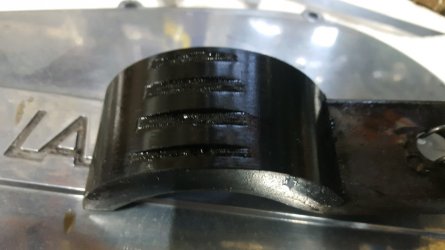
Primary Chain adjuster shoe wear.

3C-Wayne

Hero member
Location
NJ, USA
Pulled the primary side cover for a look see yesterday. Will be replacing clutch rubbers & primary chain while in there but the question I have is, is it possible to estimate the mileage from the Primary Chain adjuster shoe wear?

I have no idea how many miles are on my 3C and was wondering if a ballpark estimation could be made by some of you with much more knowledge than I.

Grooves measure 1 mm deep

Thanks,
Wayne
 

Attachments

  • Tensioner1.jpg
    Tensioner1.jpg
    121 KB · Views: 326
It'll look like that in an hour's running from new and stay looking that way.
You might be able to tell something from the clutch sprocket wear, providing it's the original, but it'd be affected by how often the oil (1,500 mile recommended intervals) and primary chains (15,000 mile recommended intervals) were changed.
 
Condition of the rubber lining depends a lot on how well the chain has been tensioned previously.  Some do service for decades, others are scrap within a couple of weeks... ::)

Lots of life in yours yet!  It would be due for replacement when the rubber between the grooves starts breaking up.

piet
 
If in doubt, or history is unknown, always wise to replace it.  Cheaper than a new primary cover, or crankcases, if it goes really wrong.

piet
 
I concur with the above. You're in there anyway, and the cost/benefit analysis would always favour fitting a new, known quality chainset.

Vince's comment, the first below the 24mm graph,: "The best option is replace the chain with Andy's Mercedes chain kit,Redax has them.And then your using the best bit with a known history."
 
That post about 24mm sag was based on Andy(chain)'s recommendation to not go beyond 1% stretch. I just did the maths to work out the relationship between % chain stretch and sag between the sprockets. I don't know whether 1% is a good recommendation or not, but Andy is a roller chain guru, so it's probably a reasonable limit to apply. You don't need to take everything to the limit though.

I tried telling my brother that, but he's the kind of person who won't replace any part until it's completely knackered. As an example, the headlight lens on his 3C is cracked. I gave him a new one, but he never fitted it. To his mind, the old one is still useable because it hasn't completely shattered and fallen out onto the road.

A while back, I did a bit of work on his 3C (re-commissioning it after a long time off the road). It had already done 100,000km on the original primary chain, so I asked him if he wanted me to replace it. He asked me if it was fucked. I measured the sag and it was well within the 1% limit. Needless to say, he didn't want it replaced. That was 10 years ago and the bike has done a heap of miles since. It must be close to 150,000km on the original Regina chain by now, but it'll stay there until one of 3 things happens - it reaches 1% stretch, it snaps, or he dies of old age. I think the latter outcome is the most likely.  ::)

Based on the experience of many here (including myself) Andy's duplex "Merc" chain is better than any of the triplex options, including the Laverda factory's original Regina chain. 

Cheers,
Cam
 
The factory interval for changing those chains is without doubt very conservative, but you only need it to break once.
And with an unknown history maybe including misaligned sprockets....

Paul
 
Paul Marx said:
The factory interval for changing those chains is without doubt very conservative, but you only need it to break once.
And with an unknown history maybe including misaligned sprockets....

Paul
I have had two let go. One on the road and one on the track, perfectly aligned sprockets and nothing else amiss. Andy Wagners hefty oil pump took a whack but was fine. Twice bitten thrice shy. There are proven quality triplexes available but I won't fit another. I have twin singles from Andy Chain in both bikes now.
 
Tippie said:
I have had two let go.

I suspect the twin cylinder Laverdas are harder on primary chains than the triples. I'd guess that the more frequent power pulses and the heavier crank on the triples would give a smoother power delivery (I presume the triple crank is heavier because it has 50% more flywheels than the twin).

I remember Steve B having primary chain reliability issues on his 750 race bike. He tried a few things including a gear drive. I forget what his eventual solution was (Merc duplex?).

Given its proven reliability over the last few years, I think I'd be more inclined to go with the Merc duplex rather than 2 singles. With 2 separate chains, you can't necessarily assume they're identical lengths. Even if there's a very slight difference, one chain will be taking more load than the other. Maybe the more heavily loaded chain will wear/stretch more than the other so they eventually even out. But by then it might be half knackered. Who knows?

I'm not a fan of chain primary drives. They're a hang-over from separate engine/gearbox arrangements that mostly disappeared 60 years ago.

I think Laverda's chain primary drive is a design weakness that could have been avoided with a different gearbox layout (also incidentally eliminating the troublesome gearbox main shaft sleeve gear). The later generation of the Laverda 3 cylinder engine that ended up in Benelli triples has a gear primary drive and no sleeve gear.

 
500 has gear primary as well. developed early 70s.

I don't like the twin single chains. I have the feeling that you can't really get them tensioned correctly with the slipper. They need quite a bit of slop so as not to be noisy.

Paul
 
No downside at all according to Andy Chain. RGS had two singles as standard. Other race twins I know of have also had no trouble with two singles. No noise issues I can detect. The slipper doesn't tension them at all and they have the same amount of slack. Some have gone the duplex route so that they could machine off the excess weight from the sprockets.
 
Tippie said:
No downside at all according to Andy Chain. RGS had two singles as standard. Other race twins I know of have also had no trouble with two singles. No noise issues I can detect. The slipper doesn't tension them at all and they have the same amount of slack. Some have gone the duplex route so that they could machine off the excess weight from the sprockets.

Racing and road use have tenuous links.

Paul
 
I have seen several broken twin simplex chains (the same chain x1 is used in a BSA Bantam!) two of them here, of which one included a recovery and another at a rally, in all cases the drive was lost, but the question I had to think about at the time is this.

Those two chains did not break simultaneously, so how far and how long was the bike running one  single chain, and what damage was the debris from the broken one causing without the owners knowing?
CLEM
 
Haven't come across any issues concerning the twin simplex set up.

Had a triplex let go at the Bikers Classics a few years ago, luckily, in the final run on the Sunday.  Also luckily, not much damage done, the multiple-fractured primary cover was a quick repair.  Replaced the chain with a duplex, first and foremost for the weight saving.  I was pleasantly surprised how quietly it runs.

There were issues with rollers breaking up, think this was limited to the original Regina items.

piet
 
I discovered a Regina cam chain with a couple of broken rollers when I pulled the 1200 apart for a rebuild. Replaced with Andy's Merc chain and a duplex on the primary.
 
At one point I found one of the single type primary chains lots looser than its partner, both fitted at the same time, not impressed. One of the best things I have used is Andys Merc duplex chain, impressive gadget.
 
Back
Top