Re: What did you do to or for or with your Laverda today?

Didn't do much Laverda related today, but I took my Kawasaki 1300 sidecar outfit in for a roadworthy test. It just had its 30th birthday last month, so it's now eligible for "Special Interest" registration at very much reduced rates (about 40% of normal rego).

Inspector looks at the bike, and asks for the engineer's certificate for the modifications (sidecar and leading link front end). I tell him I don't have one. He says it has to have a certification by a mechanical engineer, or it's not road legal. So I tell him I'm a mechanical engineer and will sign any bit of paper he wants to certify that it's properly engineered. I also ask how come it's been road legal up til now, and show him the current registration papers. He scratches his head does a but of thinking, and says OK.

He didn't notice that the rear wheel has been cut down and had a car rim fitted so I can run car tyres on it. I thought it best not to enlighten him as to this most recent bit of re-engineering.

Then he has a problem with seating capacity. On the form he has to fill in, it says "manufactured" seating capacity. When the bike was manufactured, its seating capacity was two. But now with a sidecar it's 3, so he reckons it needs to be re-classified ... 

FFS - I point to where it says 3 on the current rego.  More umming and aahing, then he eventually concedes that point too.

Next problem is the indicators. The left side indicators are mounted on the sidecar, not the left side of the bike. He reckons that doesn't comply with rules for a motorcycle. So I ask him what would he think if he was following this rig at night, and an indicator came on between the two tail lights (there is a tail and brake light on the sidecar as well as the bike). He says "hmm... yes, I can see that would be confusing", and concedes that point too.

After nearly an hour of arguing the point on endless pedantic details, he finally passes the bike as roadworthy, albeit rather grudgingly.

It's the longest roadworthy session I've ever had with a bike. Usually it's only 5 minutes and a rubber stamp. This bloke is usually pretty easy to get on with, but he'd just been audited by the transport commission two days ago, so was a bit paranoid.

Anyway. it's all good, It's now re-registered as a special interest vehicle. So I can continue towing Laverdas on the trailer behind the Kawasaki  :D
 
answered Cam's question;
Dellortoman said:
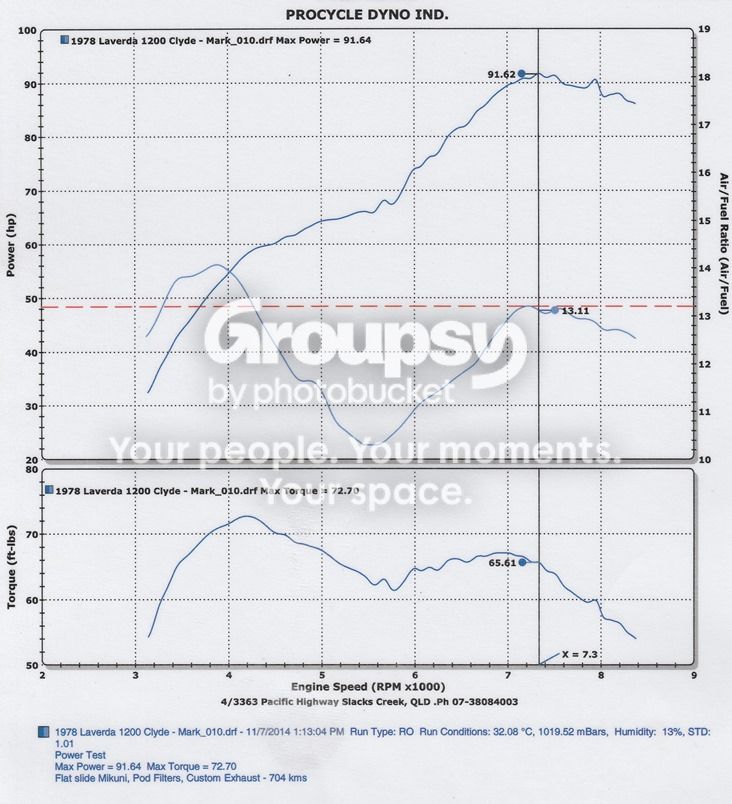
I know Mark in Queensland has a set on Clyde (1200cc, 180?). Did you ever get around to putting it on a Dyno, Mark?
http://www.laverdaforum.com/forum/index.php/topic,82154.msg254252.html#msg254252

just took me a while.  8)
Clyde-dyno-20141107-cr.jpg

main objective was to check the rev limit setting and the old ND tacho.
both are good.  happy days.
cheers,  Mark
 
Hi Mark,
Just follow the graph line at approx. 5500 rpm the motor is being flooded.I reckon if you leaned off the jetting in the mid-range you'd end up with more torque and power.

Surely the Dyno people pointed this out at the time?
Also you running 3 into 1?

Andy
 
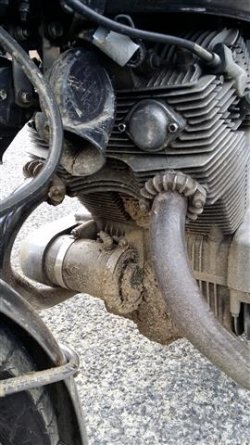
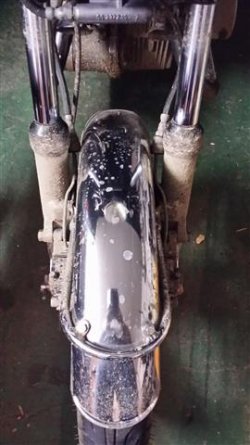
Rode to work and back in heavy traffic and in pouring rain.
Washed off a bit of the mud accumulated a  couple of weeks back.
Haven't had time to clean the bike, will do so this weekend.
Paul
 

Attachments

  • 20141026_101622 (Small).jpg
    20141026_101622 (Small).jpg
    73.9 KB · Views: 15
  • 20141027_180355 (Small).jpg
    20141027_180355 (Small).jpg
    25.4 KB · Views: 14
Dellortoman said:
How do you lean out the mixture at 5500 rpm while leaving it the same at 7500?

the dyno charts are really interesting, especially the air/fuel ratio. Obviously a very healthy motor. When I program the fuel injection map on my Kawasaki ZX 14 at most places in the map I shoot for around 13.0:1 to around 13.2:1, but on my mapping I can also dial in a bit of enrichment when the throttle is cracked as the mapping is tied to the TPS as well.

on Mark's map I am assuming the dyno operator just rolled the throttle wide open and held it there, so the "jetting" isn't anything more sophisticated than the engine drawing through the main jet, with the slides all the way up and the needle clear of the needle jet. I t would appear that around 6,500 where the afr goes way rich that the engine pressure differential resulting in way too much fuel, I have to wonder why the afr then stabilizes at just about perfect by 9,200 rpm where it also makes peak power before dropping off.

the afr obviously needs to be leaned out from about 5,800 rpm to about 9,000 rpm, but with the carbs consistently held wide open the only thing I can think of that might accomplish that might be an adjustable main jet, if there is such a thing. The slides are up out of the way, the needle is up out of the way, changing the needle jet to a smaller diameter would reduce the flow all across the rev range, and could be used to richen up the mid range but would way lean out the top rpm, same with changing the main jet to something smaller. Or, I have been wondering about attempting to control the pressure differential maybe by variable venting of the float bowl....?

However, I would probably start by reducing the main jet size somewhat, without changing anything else, and run on the dyno again, if it were mine.

As Mark notes, the afr chart is on wide open throttle only, not all that applicable most of the time to the real world.

I had quite a learning curve when I first started figuring out how to properly map fuel injection systems, now I would just go to the wide open throttle TPS settings, then the rpm settings, and dial the injectors way back in the overly rich area, shooting for say 13.0 on an air cooled motor right across the board. I don't know how this could be solved with carb tuning? Anyone?

Paul LeClair
 
Paul LeClair said:
I don't know how this could be solved with carb tuning? Anyone?

It can't.  At least not with a typical slide carb.  A CV carb might be slightly better, but that would compromise max. performance somewhat.

That's why we now have injection systems with all the electronic wizardry.

piet
 
Mark has one of the Laverda Corse 3-1 exhaust systems on his bike
nice looking system, sounds great
but had to be cut into 7 pieces and rewelded back together to make it fit

 
sfcpiet said:
It can't.  At least not with a typical slide carb.  A CV carb might be slightly better, but that would compromise max. performance somewhat.

That's why we now have injection systems with all the electronic wizardry.

piet

Hi Piet, Mark, and all

while I suppose the problem in the mid range at wide open throttle could well be arising, at least to some degree, from a three into one pipe, I am wondering if fiddling the ignition timing could improve things somewhat. I am guessing Mark's bike may have the Ignitech ignition on it. As the ignition advance/retard is probably the only fully controllable aspect of the situation, it would seem a worthwhile exercise to do some experimenting with the so called ignition "advance curve" to see how much affect could be achieved on the excessively rich mid range.

Probably simpler to put a proper exhaust system on the bike first, but hey, I have a factory Laverda three into one at the back of the garage I am planning to fit to my 79 1200 eventually, so we can work with what we have......

for many engine tuners the goal to be achieved between ignition timing and air/fuel mixture is usually to try and reach actual maximum cylinder pressure at about 12 degrees After Top Dead Center. Changing the amount of fuel is one way to try to do that. Another way, or together with, is to alter ignition timing to try and fire whatever the particular mixture is at a specific time Before top Dead Center so that the increasing cylinder pressure reaches maximum when needed. On my ZX 14 I have the equipment to alter not just injector pulse to determine amount of fuel, but I can also minutely control ignition timing. What I wish I had would be access to equipment that could measure maximum cylinder pressure and the timing of max cylinder pressure achieved, but no such luck, I have to observe real world results on a dyno.

To me anyway, in my limited knowledge, it makes sense that the exact moment of when the fuel/air mixture is ignited (say 32 degrees Before top Dead Center at a particular rpm) determines the moment when maximum cylinder pressure is achieved at the same particular rpm, (in a perfect world, say 12 degrees After Top Dead Center). We fiddle with that all the time without even thinking about it when we set base ignition timing and fiddle with advance curves. But, if maximum cylinder pressure is not occurring exactly when optimum for an engine, while the engine will still run, and maybe fairly well, it will not be most efficiently using the maximum energy otherwise available to force the piston down the bore and will have to use more fuel to try and compensate. Maybe to get max cylinder pressure at 12 degrees After Top Dead Center the spark plug needs to fire at 28 degrees BTDC, or 36 degrees BTDC, or whatever? Maybe to compensate for the three into 1 exhaust, the ignition timing needs to be advanced or retarded JUST in the rpm range where the mixture is going way rich? I am guessing that must be being made to happen in current ignition/fuel injection systems from the car manufacturers, as well as the variable cam timing systems, etc.?

Paul LeClair
 
Paul,

The problem with carbs is that too many parameters are fixed, variations can usually only be considered a compromise.  Having said that, I reckon it is a really well-performing instrument that is up to its job, within its limits. 

The infinite variations that electronic mapping offers allows modern motor management systems to fully exploit the capabilities of modern engines... and then some!  A modern system on our old clunkers would open a whole new world for them (as well as a few major melt-downs I would imagine :o)!

piet
 
you are correct Paul, Mark has an Ignitech ignition on his triple
that is good theory you make there, is worth trying different mapping to see if we can achieve better fuel burn in the mid range

track bike also went to the dyno yesterday with the 3rd version of a 3-1 system on it
first version went flat at 6,200 rpm, did not make any power at all past that point but made 107 hp at 6,200 rpm
we blamed the pipe so sold it to Cam

second version pulled 111.7hp but we lost 13hp at 6,200 rpm
we blamed the pipe so it went back to the maker and was modified

yesterday, bike pulled 111.5hp, flat spot at 6,200 rpm was better but the dip was moved up to just above 7,000 rpm
we blamed the pipe so is going back to the maker next week for further work

dyno's are addictive

 
posted off another of the Serb's this morning, Matt's 81 Jota heading his way
that is 5 of the Serb's gone, only another 14 to finish now  :(

 
"dynos are addictive"...... laughing out loud, Red.  8)

Right now I have to pay for my dyno time by the half hour, and put up with dyno operators of various levels of skill and knowledge. I swear that if I can figure a way to move out of the City to the country in retirement, a dyno is going to be on my shopping list, as well as sound proofing an outbuilding..... ;)

Paul LeClair
 
  Back in the eighties there was a clever bloke called Leon Moss (LEDAR) who developed an air jet corrector kit that could alter the shape of the fuel slope so that you could richen or weaken it at (almost) chosen revs. To try and make the  simple D/O's into an air bleeding type of carb I started  similar work on the D/O's using a proper emulsion tube rather than a needle jet and a threaded jet in air inlet to the emulsion tube - initial results were promising, but the fire at Motodd ended the work prematurely. We did do a successful "powerjet" system - but only useable on the dyno.!  I have got a pair of D/O's that Brettoni was working on (allegedly) and it looks like he had a similar idea to mine. - I'll try them on my 860 soon. - That 107BHp @6,200 Rpm must be a great motor - I'd like to gear it right up and have a lovely "lazy" ride. - regards - Phil
 
Back
Top