Redax Generator and Ignition upgrade to Laverda Jota 180 series 1

SimonR501 said:
To throw you a lifeline I think I have found the article you are referring to Joe:

http://www.allaboutcircuits.com/vol_1/chpt_1/7.html

The good news is you are right, electron (negative) flow is reverse to electron charge flow (+ to -).
The bad news is that the world talks in the latter. It may be incorrect, but that's how it works!

Thank you Simon : ) I have read most of the web based stuff. Funnily enough the one fact I did remember from my skooldays is that electon flow is in the opposite direction to conventional current direction...cheers
 
jotajoe said:
The secondary coil is in series with earth...I'm not making it up  :LOL:
I'm a bit confused Joe, but I'll have a stab so don't shoot me.

Referring to your diagram the secondary coil is not connected directly to the frame 'earth', only the primary.
This makes sense as the primary induces a voltage into the secondary, because the secondary has many more turns the voltage is much higher and can jump the gap and get back to where it came from. The current flow from the primary finds it's own way back through the frame or similar. If this path was disconnected then the coil would cease to work as no electron flow.

EDIT: I put 'earth' in inverted commas because it doesn't go to earth, it goes back to the battery.
 
I'm confused too Simon ...ha ha

There's a common ground on the primary and secondary...follow it through on the left side of the diagram. 

We must have an electrical guru on the forum who can short circuit this  ;)

joe
 
ffs,,  i'm happy to just 'av a good farken spark !!

& don't give a fuck where all the farken electrons farken come from, & where they all farken go to !!

yea,,  i need another rum.  cheers
 
SimonR501 said:
Referring to your diagram the secondary coil is not connected directly to the frame 'earth', only the primary.

I watched Davo's Youtube feed. It was very good but missed out on some issues. I'll hopefully clarify some of the terms I've scanned in the last 8 pages but I haven't read every post.

Coils:

Come in a variety of styles and resistances. The resistance refers to the value across the primary winding connections. Normally 1.4 ohms have a R in their number to designate their use with a ballast resistor. 3 ohm and 5 ohm are the usual bike options.

What's the difference? V=IR. Voltage = current x resistance so if you increase the ohms a coil has you reduce the current and lower the amount of "charge" in the primary winding. This in turn reduces the spark but increases coil life as the primary winding doesn't get as hot.

If you measure between either the +ve or -ve terminal and the HT outlet you will get several thousand ohms. Usually 4k or above so it isn't a completeley open circuit.

Ballast resistor:


These are usually in the vicinity of 1.4 - 1.5 ohms. They are designed to help prolong the coil's life in vehicles designed and fitted. Our bangers aren't. When the starter circuit is activated the resistor is bypassed so the 1.4 ohm coil gives maximum spark to help start the motor. When it has and the key is released the resistor is then in series, increases the total resistance to about 3 ohms thus reducing the feed current and prolonging the coil's life by reducing heat.

They can be installed on a bike if you wish to turn a 3 ohm coil into a 5ish ohm one. Just put it in series to the coil feed.

Dwell:

This is the arc of rotation, in degrees, that the current is allowed to flow to charge the primary winding. In multi cylinder cars the dwell is less as it must create a spark per plug but in many bikes there is a coil per spark plug so there is scope to increase the dwell thus increasing the charge in the primary winding and thus increasing spark. This leads on to electronic ignition....

Electronic Ignition:

Is just a solid state representation of the points system but it is often linked to a more sophisticated advance system. It also usually has a much increased dwell to improve spark. This is where the contradictions come in. The dwell has been increased to increase the spark but the paranoia hits the owner so they often fit higher ohm coils to prolong life.  ::) You may only get a decade out of the originals.  :P

Guzzis fitted with points came with 3 ohm coils but if fitted with a dyna there is a thought that 5 ohm coils should be fitted unless racing (More discharges per minute due to the higher revs). The electric feed doesn't know how many revs you are doing. It just flows at the same rate so with all else being equal the primary winding will get less charge per discharge at higher revs. Increasing the resitance just compromises the positive effect that the designer had included. Coils just aren't that expensive and they will still last a long time if properly cooled.

Collapsing Field:

The EMF (Electro magnetic field sometimes referred to as EMR, radiation, or just plain old radio waves) goes in all directions which is why most coils have a metal body to act as a shield. Plastic ones usually come with a steel sleeve and this can get too hot to touch in normal use. Heat sinks such as on the Laverda are also a field shield. The main reason to inhibit the field is sound suystems and communication devices. If you have ever driven under HV power lines with the radio on you will have almost certainly heard the 50hz buzz.

HT Circuit.

There is usually resistance in the HT circuit between the coil and plug's earth to engine. Resistor plugs (5k ohm), resistor caps 1 or 5k, silicone leads (ohm per metre, usually about 700ohm for a bike), platinums (1.3-1.5k ohm) are the usual means. This is also to help prolong coil life but to also reduce EMF for the same reasons as above.

Conclusion:

If you are racing then use the lowest ohm coils available and use standard plugs and copper HT leads. Renew components as needed.  :D

I find it amusing the amount of money owners will go to to dual plug an old banger without optimising what they have. You can buy an awful lot of 3 ohm coils for the cost of fitting a dual plug system.

Have a look at your spark. If it is weak and feeble then help it. If it is fat, blue and healthy then leave it alone or you can hinder it if you are in love with your current coils. Its all just a compromise between sopark and component life.

Hope this helps

Rod

Added later:

Should have mentioned coil voltage. In our older bikes the ignition power often runs up through the key switch then the kill switch before heading back to the coils. If a poor spark is occurring then you want to make sure you are getting very nearly the battery voltage there. If well down try and clean the connections but if still a reasonable loss then a relay may be advantageous. A fat fused wire feed directly from the +ve battery terminal to the relay to feed the coils. Don?t do this if you intend to increase the coil?s primary resistance as you are just contradicting yourself.  :LOL:

There is a loss in a relay too. IME about 0.2V so if your coil voltage is very nearly your battery voltage then don?t bother.

The other side is just as important too. The weakest point of the circuit can be on either the +ve or -ve side. Where the points earth, clean points contacts and effective condensors. If EFI the earths need to be clean and allow good flow.

You can fit relays to the earth side but this isn?t normal for auto/moto applications. It is usually a marine issue to reduce celectrolysis currents.

Again, hope this helps.


This is what forums are all about. Look forward to buying all you farken fockers a pint lf/when in the states. Joe-got the electrons flowing yet?
 
I'm in the States this January...In the realm of the " Red Sox"   It is winter time and beer is definitely your friend  ;) So come to Boston and I'll buy you a Sam Adams  ;)

Elektrons..Hmm nope there is no circuit yet as the battery has been removed and is in the naughty battery corner of the garage..Don't want any new lessons in electrical theory ..Well not expensive ones anyway  :LOL:

Oh well, Out to the garage now to take off the old amplifiers..

Cheers

Joe
 
Alpino said:
I watched Davo's Youtube feed. It was very good but missed out on some issues. I'll hopefully clarify some of the terms I've scanned in the last 8 pages but I haven't read every post.

Coils:

Come in a variety of styles and resistances. The resistance refers to the value across the primary winding connections. Normally 1.4 ohms have a R in their number to designate their use with a ballast resistor. 3 ohm and 5 ohm are the usual bike options.

What's the difference? V=IR. Voltage = current x resistance so if you increase the ohms a coil has you reduce the current and lower the amount of "charge" in the primary winding. This in turn reduces the spark but increases coil life as the primary winding doesn't get as hot.

If you measure between either the +ve or -ve terminal and the HT outlet you will get several thousand ohms. Usually 4k or above so it isn't a completeley open circuit.

Ballast resistor:


These are usually in the vicinity of 1.4 - 1.5 ohms. They are designed to help prolong the coil's life in vehicles designed and fitted. Our bangers aren't. When the starter circuit is activated the resistor is bypassed so the 1.4 ohm coil gives maximum spark to help start the motor. When it has and the key is released the resistor is then in series, increases the total resistance to about 3 ohms thus reducing the feed current and prolonging the coil's life by reducing heat.

They can be installed on a bike if you wish to turn a 3 ohm coil into a 5ish ohm one. Just put it in series to the coil feed.

Dwell:

This is the arc of rotation, in degrees, that the current is allowed to flow to charge the primary winding. In multi cylinder cars the dwell is less as it must create a spark per plug but in many bikes there is a coil per spark plug so there is scope to increase the dwell thus increasing the charge in the primary winding and thus increasing spark. This leads on to electronic ignition....

Electronic Ignition:

Is just a solid state representation of the points system but it is often linked to a more sophisticated advance system. It also usually has a much increased dwell to improve spark. This is where the contradictions come in. The dwell has been increased to increase the spark but the paranoia hits the owner so they often fit higher ohm coils to prolong life.  ::) You may only get a decade out of the originals.  :P

Guzzis fitted with points came with 3 ohm coils but if fitted with a dyna there is a thought that 5 ohm coils should be fitted unless racing (More discharges per minute due to the higher revs). The electric feed doesn't know how many revs you are doing. It just flows at the same rate so with all else being equal the primary winding will get less charge per discharge at higher revs. Increasing the resitance just compromises the positive effect that the designer had included. Coils just aren't that expensive and they will still last a long time if properly cooled.

Collapsing Field:

The EMF (Electro magnetic field sometimes referred to as EMR, radiation, or just plain old radio waves) goes in all directions which is why most coils have a metal body to act as a shield. Plastic ones usually come with a steel sleeve and this can get too hot to touch in normal use. Heat sinks such as on the Laverda are also a field shield. The main reason to inhibit the field is sound suystems and communication devices. If you have ever driven under HV power lines with the radio on you will have almost certainly heard the 50hz buzz.

HT Circuit.

There is usually resistance in the HT circuit between the coil and plug's earth to engine. Resistor plugs (5k ohm), resistor caps 1 or 5k, silicone leads (ohm per metre, usually about 700ohm for a bike), platinums (1.3-1.5k ohm) are the usual means. This is also to help prolong coil life but to also reduce EMF for the same reasons as above.

Conclusion:

If you are racing then use the lowest ohm coils available and use standard plugs and copper HT leads. Renew components as needed.  :D

I find it amusing the amount of money owners will go to to dual plug an old banger without optimising what they have. You can buy an awful lot of 3 ohm coils for the cost of fitting a dual plug system.

Have a look at your spark. If it is weak and feeble then help it. If it is fat, blue and healthy then leave it alone or you can hinder it if you are in love with your current coils. Its all just a compromise between sopark and component life.

Hope this helps

Rod

Added later:

Should have mentioned coil voltage. In our older bikes the ignition power often runs up through the key switch then the kill switch before heading back to the coils. If a poor spark is occurring then you want to make sure you are getting very nearly the battery voltage there. If well down try and clean the connections but if still a reasonable loss then a relay may be advantageous. A fat fused wire feed directly from the +ve battery terminal to the relay to feed the coils. Don?t do this if you intend to increase the coil?s primary resistance as you are just contradicting yourself.  :LOL:

There is a loss in a relay too. IME about 0.2V so if your coil voltage is very nearly your battery voltage then don?t bother.

The other side is just as important too. The weakest point of the circuit can be on either the +ve or -ve side. Where the points earth, clean points contacts and effective condensors. If EFI the earths need to be clean and allow good flow.

You can fit relays to the earth side but this isn?t normal for auto/moto applications. It is usually a marine issue to reduce celectrolysis currents.

Again, hope this helps.


Thank you Rodney..Very informative and helpful..

cheers

joe
 
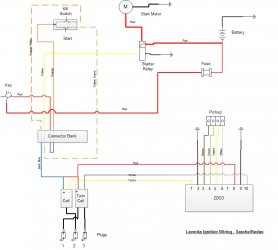
If it is of interest this is how I wired in the Sasche box using existing wiring loom. Cut a slot in the sheath near the steering head and pulled the dark blue wire out and shortened it so it ran direct to the +ve on the closest coil.
 

Attachments

  • Laverda 180 Ignition Wiring.jpg
    Laverda 180 Ignition Wiring.jpg
    88.9 KB · Views: 119
Davo said:
If it is of interest this is how I wired in the Sasche box using existing wiring loom. Cut a slot in the sheath near the steering head and pulled the dark blue wire out and shortened it so it ran direct to the +ve on the closest coil.

Did you use a scalpel?
 
Your not still fitting this kit are you Joe? :o

                                  Dave
 
dja981 said:
Your not still fitting this kit are you Joe? :o

                                  Dave


Well it ain't fitting itself is it !  :D

I am having to fit it in between work, going the pub, digging the alotment,  sitting in the airfield cafe, going for a ride out , and errrm doing nothing ha ha...I need some me time too...

I need to work outside and it hasn't stopped raining either.

I have completely removed the old system now and fitted the new coils ( and tested them with a multimeter ) ..I've also fitted the ignition  back plate and new regulator...So there isn't alot to do.....Most importantly I have read and re read the instructions...

joe

ps I haven't actually got an alotment : )
 
Back
Top