regulator rectifier series 1 Laverda 1200 180

Shuggie

Full member
Location
Scottish islands
I've got a Witt DMC 2 to fit, my bike is running the two standard big charging coils and was thinking of fitting an Electrex RR10...my 150w btz type alternator has got only two outputs yellow and yellow black.. the RR10 has got the three yellow connectors for the alternator wires, is it ok to connect up my two alternator outputs to any of the three RR10 inputs?

AFAIK the RR10 is a MOSFET is there a better MOSFET unit out there, Shindegen FH020AA comes to mind?!
 
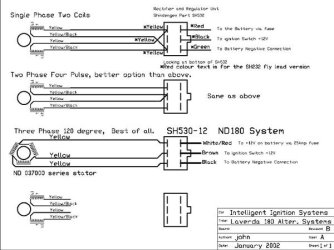
I'm also running the 2 large charging coils and have a charging issue 12.9 volts. The document for wiring 2 phase into a 3 phase R/R is well covered by John ( iis) and I've attached his drawing below.

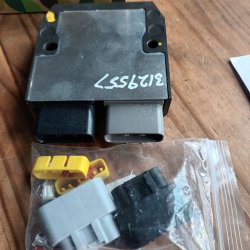
I've just bought a BMW Shindengen FH027AB MOSFET with high hopes. 2023 model. Metal-Oxide-Semiconductor Field-Effect Transistor (MOSFET)


As an aside, my bike runs on an AGM battery for a few hundred miles but can't be charging properly.
The old 3 phase electrex regulator tested out correctly to my abilities, the coils check out OK but I can't get more than 12.9 volts so I have high hopes that this will solve the issue ( this week).

You're possibly aware, many of the pattern RR'S are not mosfet despite inference that they are and I would avoid them all. I paid £42

Rob
 

Attachments

  • Alternator_RR_Connections.jpg
    Alternator_RR_Connections.jpg
    45.1 KB · Views: 52
  • 20250907_174805.jpg
    20250907_174805.jpg
    166.4 KB · Views: 39
  • 20250907_174759.jpg
    20250907_174759.jpg
    158.7 KB · Views: 22
  • Screenshot_20250907_180759_Chrome.jpg
    Screenshot_20250907_180759_Chrome.jpg
    68.8 KB · Views: 39
Last edited:
Rob, cheers for that, the wiring diagram is a great help and I'll print it out for future use.
I read somewhere that the older shunt type of rectifier is like having a permanent 60w load/drain on an alternator of an already low 150w.
Agree with you, it pays to buy the genuine Shindegen or Electrex item , the eBay clones are rubbish.
Let me know how you get on, my testing time is a way off as it's a bare frame and Keith Nairn engine at the moment....just getting all the ancillaries sorted prior to build.

Cheers Hubert
 
Hubert, I'm a little out of my depth, I research all this stuff, but holding on to what I learn is challenging.

I believe these mosfet RR's are still shunt types, just more efficient than the diode based RR's.

I did contemplate getting a series RR, Mosfet controlled but whether it was cost alone or a technical reason as well, I can't tell you.

Better stick to what I know which is, it's going on and I'll publish my results.

I run a 22w ( equivalent 55/60w) led headlight bulbs and 2007 ignitech. The upgraded ignition/alternator kit by Redax is a no brainer for most folk I do believe.
Since I remove my rotor so often for the track ( with a alternative chamfered cover) I find this setup works for me, if I can just get a better charging voltage.

I also run a lithium battery for the track but it needs 14-15v to work. 3.8kg vs 0.8. Quite astounding.

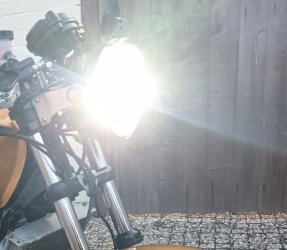
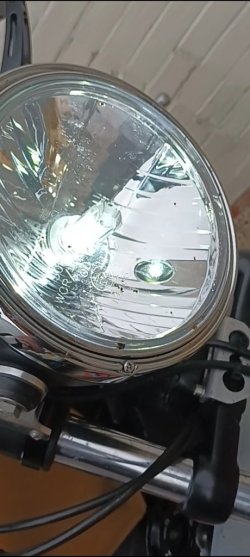
The led bulb, I really like, it's super white light but the depth on dipped is not as strong as an H4 via relay I run on another bike ( both with excellent reflectors).

I'm going to see if the extra voltage 1 volt improves the led lighting too ( night time riding on motorway speeds).
 

Attachments

  • 20250907_193950.jpg
    20250907_193950.jpg
    110.3 KB · Views: 6
Last edited:
I didn't know you could buy an Ignitec ignition, Rob without going for the Redax/Nairn one which combined an alternator upgrade...anyway I've got the DMC 2 which by all accounts is a solidly built one which lasts...
I'm like you all I want is a good solid charging system on the back of a good performance ignition...if you're racing your Jota then it's performing well ignition wise just the charge issue with yours...
Good luck 🤞 with your mods with the Shindegen rectifier, I'll be all ears to hear how you go on.

I have a FH020AA on the way from Dacarmo eBay shop to fit to my generation 3 vfr 750 but thats an altogether a much simpler fitting issue, it's three phase with a new stator already fitted.

Hubert
 
I didn't know you could buy an Ignitec ignition, Rob without going for the Redax/Nairn one which combined an alternator upgrade...anyway I've got the DMC 2 which by all accounts is a solidly built one which lasts...
I'm like you all I want is a good solid charging system on the back of a good performance ignition...if you're racing your Jota then it's performing well ignition wise just the charge issue with yours...
Good luck 🤞 with your mods with the Shindegen rectifier, I'll be all ears to hear how you go on.

I have a FH020AA on the way from Dacarmo eBay shop to fit to my generation 3 vfr 750 but thats an altogether a much simpler fitting issue, it's three phase with a new stator already fitted.

Hubert
I fitted an Ignitech reg/rec to my wife's 500. Ordered directly from them.
Paul
 
Been covered prior at length, perhaps a search on here or the "never" forget notables can provide links, impressive recall/memories on this forum, doffs me Arai. "Mosfet" RR, in best form, synchronous rectification ie there are no rectifying diodes, there is very good efficiency ( disregard the external comments on the "losses" they are incorrect ).

The obstacle for charging system on a HKZ or BTZ single or dual coil charge, is rpm to coil voltage output dependence, unless you can obtain at least 14,2V on the battery terminals, engine running from 1000rpm upwards, , slow death of the battery is assured, chronic undercharging. Additional is the voltage to current equation, P=E squared on R it is a square law transfer, for every volt reduced you lose half of your charging current. Hence Rob's situation, which works for you as you raise the voltage, current can double, though a battery is not a static resistance, becomes complicated..... sure 10 paragraphs would be welcome here...wry smile.

Mosfets are series RR's as a general guide, most assured for the better spec'ed variants. Shunt RR's on a series 1 single or dual coil will hardly do a shunt of charging current as a given, and will by consequence, also be efficient. Broad statement, allowing.

Worst of all, your beaten at the battery posts, by installing an inductive discharge ignition system, requires at least 3 amps, at moderate rpm, could go as high as 6-9Amps, on usual riding velocities. "CDI" is very efficient, my IIS long box, drew no more than 1,5Amps from idle to redline, was designed as a modern replacement for the zero battery demand HKZ. Not sure all this helps, just a little would be good, j.
 
You are probably not getting anyway near 150 watts out of the factory alternator. Even with an additional charging coil, it is doubtful.

My 3Cl back when it had the factory alternator with an additional coil, it would not charge the battery with the lights on unless you were turning 4000 RPM. So riding at night was an issue as 4000 RPM is pretty fast in top gear.

The only fix for the problem is a bigger alternator. My 3Cl has had for 25 years one of John's ignition systems with a ND alternator. All ignition and charging problems were solved and still working perfectly many years later.

As for the Shindengen regulators, they are a very good choice and cheap from the breakers.

John, if you want to explain what happens in the alternator windings when they get shunted by the regulator, be my guest. I have a feeling it will get way to technical for most to understand.
 
Last edited:
As Bruce indicates, actual current from a single alternator coil on a standard oem bosch magnetic flywheel with fixed TEAG ( total effective air gap ) coil pole to magnets, at best 7amps. Confirmed by actual measurement on several series 1 180. That is best, actual normal engine rpm is markedly less. Really with a battery cost at some $200 what will any owner save in time, afraid to turn on the headlight, forget the option of heated grips, socks, vest, underseat warmer, demister on the rear view mirrors, spot lights for deer spotting, you never know what option is in the back of the mind, seeing is believing, when you have the power, that is not 90watts from a single coil....
 
Well, remember the gradual happy increases in battery charging ability while John updated my 3c over the years. Before that, I was replacing the old 32-amp mega wet cell batteries every couple of years back then. I think the first go was adding his Ignion system, allowing the original Ignion coil to be rejigged to charging, then some regulator experiments, and finally the Kawasaki Altinator. Well, happy then.
 
You are probably not getting anyway near 150 watts out of the factory alternator. Even with an additional charging coil, it is doubtful.

My 3Cl back when it had the factory alternator with an additional coil, it would not charge the battery with the lights on unless you were turning 4000 RPM. So riding at night was an issue as 4000 RPM is pretty fast in top gear.

The only fix for the problem is a bigger alternator. My 3Cl has had for 25 years one of John's ignition systems with a ND alternator. All ignition and charging problems were solved and still working perfectly many years later.

As for the Shindengen regulators, they are a very good choice and cheap from the breakers.

John, if you want to explain what happens in the alternator windings when they get shunted by the regulator, be my guest. I have a feeling it will get way to technical for most to understand...
Great reply. Do take into context my headlight plus sidelight consumption of 22w + 1w vs 55 + 4w that is significant.

I lost John at the ignition consumption, I really don't know , its easiest to just fit the RR and see what's going on.

Rob
 
Last edited:
Rob, for what it is worth, HKZ ( one large aluminium box with 3 small coils, no insult intended on knowledge there ) is a zero demand on the charging system for the battery, self generating in the advanced form of a magneto work-a-like. BTZ are in the 3-6to9 amp demand on the charging system. HKZ ( early at the minimum ) allowed for only a bridge rectifier setup and no actual active RR, rather the smaller 4 tap coil on top of the single HKZ high voltage exciter coil is the actual "regulator" a bucking anti voltage producer as the rpm rises, ie it opposes the actual voltage being produced by the main alternator coil at elevated rpm, to prevent battery boiling in the day, should the system ever reach that exalted power surge, a pious hope with as Vince mentioned, a massive 11plate 32ah battery that blocked out daylight to the rear of the engine...

Any diodes in the series connection to the battery will have a loss of 0,6V per diode, a diode bridge rectifier will have a loss of 1.2Vdc minimum alternator coil to battery, plus I/R losses in the fuses, wiring and switches. On the test i suggest you connect the sense wire to the 12V output wire connection at the RR. May need to move the sense connection to post ignition switch however, to mitigate parasitic current drain when stationary or stored. Should you have the two BTZ modules then there will be a much reduced capacity to provide a proper charge to the battery, HTH j.
 
Last edited:
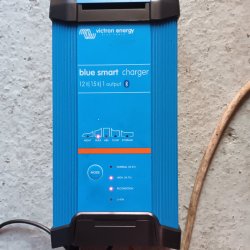
It's worth keeping in mind that an AGM battery works best with an agm specific battery charger. A charger capable of hitting 14.6/8 volts.
Notwithstanding the RR output, most claimed AGM chargers that don't have a specific agm switchover option don't charge any different to a regular charger. This means the agm doesn't get fully charged ( more like 80%)

That applies to leisure batteries too, so I do use a decent Victron 3 profile charger to maintain batteries, they are very good. These are the graphs for the last 3 charge profiles, agm 2 types and lithium ion x 1
 

Attachments

  • Screenshot_20250908_090022.jpg
    Screenshot_20250908_090022.jpg
    61.2 KB · Views: 9
  • 20250908_085557.jpg
    20250908_085557.jpg
    151.2 KB · Views: 8
  • Screenshot_20250908_085519.jpg
    Screenshot_20250908_085519.jpg
    54.1 KB · Views: 6
  • Screenshot_20220722-011309.jpg
    Screenshot_20220722-011309.jpg
    177.8 KB · Views: 8
Rob , John and other posters...

Much appreciation for your comments folks, from your information and that passed on by Keith Nairn, the inductive ignition system including the Witt upgrade is quite alternator output consuming, so much so there has to be over 3000 rpm on the clock to charge the battery even with lights off. Which is going quite quick for me on the minor roads here 😜

I'll spend the minimum on a replacement RR, probably a second hand Shindegen FH020AA or similar necessitated by a need to renew a 45 year old Laverda RR, overcharging and blowing the new Witt box. Just to see if I can get away with shelling out for the Redax kit..

RR options for me are Electrex RR60 shunt type £75, RR451 MOSFET type with charge warning light output £144 and the Shindegen variants £40 used and £82 upwards new ( Tourmax badged Shindegen)

Keep me posted Rob, I would be well pleased to hear that you're getting a charging voltage circa 14v at low rpm <3000rpm.

Cheers for your help 👍

Hubert

Hubert
 
Hubert

It took me couple of half days. After wiring up with proper connectors, the results were poor.
I made up some fly leads to see if I could figure out where the problem was. Polarity matters regarding charging coils, once I swapped one around it came good.
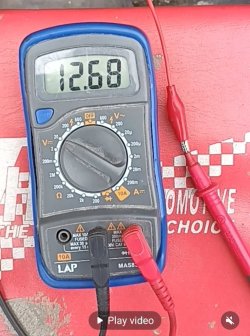
12.6v engine off.

Gets up to peak voltage around 2750 rpm " guaranteed accurate" 14.27v with lights ( led front 22w) on, 14.3v lights off. I didn't rev it over 4000 and it made no difference, those were the regulated figures.

My wiring is non standard for better or worse, maximum age 2007.

I explained why I use this set up, it's a compromise for track use ( to pull the rotor off several times/year), not a substitute for the 3 phase upgrade . Hope that helps you.

Rob
 

Attachments

  • Screenshot_20250909_164357_Gallery.jpg
    Screenshot_20250909_164357_Gallery.jpg
    139.4 KB · Views: 10
  • Screenshot_20250909_164445_Video Player.jpg
    Screenshot_20250909_164445_Video Player.jpg
    112.5 KB · Views: 7
  • Screenshot_20250909_164419_Video Player.jpg
    Screenshot_20250909_164419_Video Player.jpg
    83.2 KB · Views: 9
  • Screenshot_20250909_164414_Video Player.jpg
    Screenshot_20250909_164414_Video Player.jpg
    75.8 KB · Views: 10
Last edited:
Rob

Absolutely great 👍 👍 your information has helped me greatly, I had been chasing my tail researching it and was losing the plot! Half thinking I'd have to stump up for the alternator upgrade kit.

The difference between my set up and yours would be primarily my Witt ignition as opposed to the Ignitec.. I'll be sourcing the same Shindegen unit as yours.

I could be wrong but gathered that the Witt draws about 6 to 9 A , 72 to 108 W appreciable on a 150W alternator output at best. I'll check this with Uwe Witt and if true I'll switch to the Ignitec pickups and box if it's power draw is much less.

On the connections to the Shindegen FH027 what were your connection combination to the three alternator inputs? I understand both yellows go to the extreme left terminal and both yellow black tracer go to the extreme right terminal.

Good man for passing the info on 👍

Cheers 🍻 😉

Hubert
 
I'm not aware of any Ignitech pickups made for a Laverda ( i could be out of date), that's part of the wider issue, the wiring on the Bosch pickups breaks down which is another reason why the full kit covers so many faults and reliability gremlins.

In the end I wired the RR in the 4 pulse drawing of John's ( not as you see in tye temp setup below). I had to swap one of the charging coil polarities but that's easily done, otherwise there was no charge.

In hindsight its better to test with fly leads, spade connectors and crocodile clips so you don't ruin the Mofset connector crimps ( they are a bit special )

I don't know the power consumption of the Ignitech TCIP4 or the suzuki coils so can't comment on that.
Note: the mockup leads show 2 pulse connection working but I'd already wired up the proper plug 4 pulse which is possibly why I had to swap polarity of one coil. Yes I know its AC, I can't answer that , perhaps it's charge coil phasing and they cancel each other out, ( out of my pay grade).

The positive runs through a fuseway then indirectly to battery via starter solenoid ( I like to swap batteries about -Skyrich)
 

Attachments

  • 20250909_154837.jpg
    20250909_154837.jpg
    203.2 KB · Views: 20
Last edited:
Rob did well, results count. Several scenarios can come in to play, a rapid cold crank start on a fully precharged battery will have best engine run charging regime, conversely a hard start on lower ambient temperatures will deplete a battery which requires a longer re-charge phase.

Most of the oem bosch alternator energy transfer occurs across the air gap between the alternator coil pole face(s) and the magnet surface area, fixed as a given due to mechanical design. While you may achieve a purposeful RR output voltage, when higher currents are required this desired proper voltage will fall due to the teag ( total effective air gap ) unable to support higher current at higher voltage production. Rare you get something for nothing in electrical and electronics.

Post this information in order that when a certain outcome happens the background will give a reason in place of a mysterious outcome.

Inductive discharge ignition can use minimum ignition coil saturation time, much depends on the design and programming, as i understand it, ignitech has a variable saturation time facility, as i did in the iis, though not user programmable, this technique can lower the operational current demand for an inductive discharge ignition. Been covered at length in previous topics here HTH j.
 
Back
Top