Resurrecting a 750.....Advance/Retard unit

kainsworth

New member
Hi, my advance and retard unit was seized, it isn't anymore but what appears to have once a long time ago been a fibre washer under a normal washer under the circlip on the end of the cam is in many pieces, I can't figure out why this isn't just a metal washer, are they available or can I use anything to take up the float as long as the action isn't impeded?
 
I don't remember any fiber washer being on the advance unit, just a steel washer.

As for yours seizing, by the time that happens from years of no maintenance, it is usually completely worn out. If the internal shaft to cam clearance is excessive, it will make setting the timing impossible. It is supposed to periodically be taken off, cleaned and greased which no one ever did.

Your options are to get a new advance unit (not cheap) or switch to electronic ignition.
 
I can only recommend the Sachse electronic ignition.
You won't recognize your engine !

or

Developed by Volker Sachse and later improved by Marco Patzer who took over the business after Volker's death.
I've been using it for almost 15 years
No regrets
Definitely worth every euro

S.
 
I had a Sachse box fail after about 10,000 kays on my Motodd, brought another, 4000 kays so far so good.
Brought a Redax Ignitech system for my 750SFC, haven't fitted it yet but a nice piece of kit
 
Hi, my advance and retard unit was seized, it isn't anymore but what appears to have once a long time ago been a fibre washer under a normal washer under the circlip on the end of the cam is in many pieces, I can't figure out why this isn't just a metal washer, are they available or can I use anything to take up the float as long as the action isn't impeded?
I suggest that an attempt to find a serviceable used advance mechanism would be a worthwhile endeavour - here's my tuppence worth:

With all due respect to the opinions that the only solution is with an electronic ignition system replacing the breakers, advance mechanism, etc. (and donning my flame-proof suit!), it's my opinion after running numerous 750 twins for many decades that the original system is very reliable and for road use I have not found the need for other advance curve options.

The only 750 twin I have that has an electronic system is the one that causes me greatest concern when far out and about as the full set of replacement parts doesn't travel with me. It seems unlikely that should it fail then without ability to switch out sensor and control box - a complete replacement - I'd be able to get going again and a roadside determination of which bit has failed may need more tools than practical to carry. True it hasn't failed yet even though more than 20 years old but it's always the nagging worry.

The points system is simple and robust and, since it is two entirely separate and parallel systems only sharing the power supply and advance mechanism, then if there is a mishap it'll likely only affect one cylinder allowing limp along and most likely can be diagnosed and fixed enough roadside to continue with only basic tools.
(and I can check or set static timing with only a bit of wire and a light bulb that I do carry in my travel toolkit!!)
 
I suggest that an attempt to find a serviceable used advance mechanism would be a worthwhile endeavour -
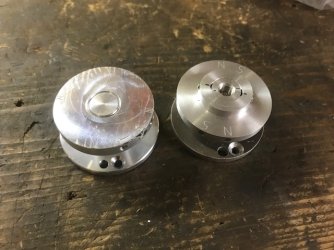
I mostly agree with you on this, but finding useable parts is problematic. I converted a '74 750 mostly because I couldn't find what I needed. The advance was worn out, the points were worn out, and the cost of just points and condensors was about half the cost of Sachse unit. And I'd still have a worn out advance unit. I went with the Sachse, and it works beautifully, but there were quality issues; the Sachse rotor/adapter plate is a two-piece affair, and in my case it didn't run true. I bought one of Red's single piece rotor/adapters for the Sachse, which is beautifully made and works as one would expect. That's Red's one-piece on the left and the Sachse two-piece on the right in the pics below. I've never worried about the box failing. The Witt on my RGS is what, at least 30 years old and has seen tens of thousands of miles.
 

Attachments

  • IMG_6824.jpg
    IMG_6824.jpg
    103.1 KB · Views: 26
  • IMG_6825.jpg
    IMG_6825.jpg
    92.4 KB · Views: 26
I mostly agree with you on this, but finding useable parts is problematic.
There are probably less expensive sources but Andy Wagner's Laverda Paradies site today shows a used advance unit for 94.25 Euros, a lot less than a complete new electronic ignition system, worth an enquiry of actual availability and cost in hand.

https://www.laverda-paradies.de/article-5-21-en.html

Even though many of the bikes being dismantled for parts are 50 years old, it seems many of them did few miles before being abandonned, particularly so in USA, and low-mileage parts can be found.

As noted before I'm running an old Boyer system that has done good service for many years so far on a bike that did some major trips this summer and I also have an unused DMC system awaiting installation to allow advance curve experiments on a race bike but my feeling for long trip road bikes is KISS to the max!

I'm away from home at the moment but when back will dig into the used parts stash and see if I might find a serviceable or restorable unit - perhaps others might pop up and tell us they have one just looking for a new home?

I guess my point to new members of our community is that there are still parts suppliers that we should support if we want them to stay in business. I'm not promoting Andy Wagner, just using an example who happens to have a comprehensive website, there are several others. Look here for example as a starting point List of Laverda parts and service suppliers thank you Steve B. It's terrific that there are manufacturers of replacement parts like Sachse, Ignitech and Redax and I'll to be an ongoing customer but the buyer must balance the cost and increase in complexity against the robust simplicity and serviceability of the original equipment.
 
My ideal upgrade in the late 70s was to retain the simple but very effective Bosch advance unit and incorporate the ND trigger, pickups and small CDI unit from a GS or similar Suzuki. Piss easy conversion and ran faultlessly for 100s of thousands of km ... and no points to wear out and condensers to mistrust. I figured if the Japs were willing to use that system and retain their reputation for reliabilty, it was good enough for me.
 
.. the Sachse rotor/adapter plate is a two-piece affair, and in my case it didn't run true ..
It was a two-piece item ..
It isn't anymore .. hopefully ..
This rotor disk (with radial screws and magnets) has been improved for a long time.
Same for the P2H pickup.

Dead simple to install.
Plug and forget.

.. everyone does as they please ..

S.
 
Last edited:
Another option if the advance unit is worn out and you don't want to use an electronic ignition, If you have a local machine shop, the id of the advance cam can be honed out and the shaft turned down a little bit and it can be sleeved with bushing. Although this may cost more than a new advance unit?????

Both my twins are still running the points and it works perfectly. I have never felt the need to fit an electronic ignition to a 750 twin. The points on my GT are still the ones it left the factory with 56 years ago.

On the twins, 99% of the time ignition problems are caused by lack of maintenance to the advance unit and points.
 
Have to wonder whether the advance mechanism wasn't a commodity Bosch item used in other applications.
Some cross number checking research to be done based on the number in the early 750 parts book 1 237 120 006 which looks very Bosch-like.
 
Both my twins are still running the points and it works perfectly. I have never felt the need to fit an electronic ignition to a 750 twin. The points on my GT are still the ones it left the factory with 56 years ago.

👏 👏 👏

An electronic ignition will transform your 750 engine however.
Just my two cents

:)

S.
 
👏 👏 👏

An electronic ignition will transform your 750 engine however.
Just my two cents

:)

S.
Yes, if you have a worn out advance unit and bad points, it will run better with an electronic ignition. If all the parts were taken care of and not allowed to rust and seize, it will not run any better on electronic ignition.

Now most 750's I have ever worked on, the advance unit was never lubed and is worn out, so yes it does run better with electronic ignition. Luckily my 750's were very low mileage bikes when I got them and the factory ignition was in perfect condition. Every couple thousand miles I take the advance unit apart and clean and lube it.

If the points ignition was not a good idea, why did Laverda keep using points on the 750 SFC until the last series?
 
Yes, if you have a worn out advance unit and bad points, it will run better with an electronic ignition. If all the parts were taken care of and not allowed to rust and seize, it will not run any better on electronic ignition.

Now most 750's I have ever worked on, the advance unit was never lubed and is worn out, so yes it does run better with electronic ignition. Luckily my 750's were very low mileage bikes when I got them and the factory ignition was in perfect condition. Every couple thousand miles I take the advance unit apart and clean and lube it.

If the points ignition was not a good idea, why did Laverda keep using points on the 750 SFC until the last series?
Not many proprietry CDI/transistor ignition systems on the market back then. Laverda certainly didn't have the means to develop one themselves, so they were dependant on outside suppliers. They switched to the Bosch BTZ system for the SFC at the same time it was introduced on the triples (seems to me the SFC was regarded as somewhat of a halo model by then). The writing was on the wall for the road-going 750s so no further development was invested there, which is absolutely understandable.

piet
 
Yes, if you have a worn out advance unit and bad points, it will run better with an electronic ignition. If all the parts were taken care of and not allowed to rust and seize, it will not run any better on electronic ignition.

whatever the state of your contact breakers and/or your ignition advance mechanism ..
at low revs and (faster) engine response, (EI) it's just a world of difference :)

S.
 
Last edited:
I'm looking forward to ridding my SFC once the Redax/Ignitech is fitted. been playing with points on my 750 for 50 years.
Points on the SFC are now 43 years old, time for an upgrade. I'm into set and forget.
 
Hi, my advance and retard unit was seized, it isn't anymore but what appears to have once a long time ago been a fibre washer under a normal washer under the circlip on the end of the cam is in many pieces, I can't figure out why this isn't just a metal washer, are they available or can I use anything to take up the float as long as the action isn't impeded?
Back to the original question here, if the poster is still thinking about renovating his advance mechanism, I've gone through my stash of advance mechanism parts and found one that may have been undisturbed till I just took its clip off.

You can see in the picture that under the e-clip there is a thin steel washer, a broken fiber type washer and then another thin steel washer. I imagine the combination of all these was to control end float and to try to keep dirt out.

With close to an inch of overlap of the spindle and the cam, if it was seized but removable then perhaps a little clean up with a mildly abrasive pad and something like a pipe cleaner would leave them operable with minimal side play?

Lav 750 points cam clip.jpg
 
Back
Top