RGS Headache File

Yes, the coils are connected directly to the battery with a fuse in between. Same problem. Sachse ignition: 2 earth connections, 1 directly to the battery, 1 to the frame. Sachse themselves often say that 1 is enough but 2 is better. Cable: 1mm².

I had the same problem with the DMC.

I’ve now realised that as soon as the oil temperature gauge starts moving, the problem begins… 🤔
As I said, all the bits and pieces I’ve fiddled with so far have brought some improvement. At first it would cut out completely; now one cylinder cuts out partially, and if I give it a good rev, it runs fine again for a while…
But what did I actually end up doing?🫣🥴
 
This has poor connection written all over it. Your job is to find it!
coils are connected directly to the battery with a fuse in between
Junk the fuse for test purposes (presumably an inline item?) - you need a clean direct connection to the battery. Ideally the same one that supplies the Sasche box.

Did you connect the battery direct to the Sasche box +12v terminal for the bypass of ignition/kill switch test?

I stress that the above is a temporary lashup purely to rule out poor connections - either cabling, connectors or ignition/kill switches. The direct battery connection should be removed after a test ride.

I'm not a fan of duplicating neutral connections - one clean connection direct to battery -ve is preferred (noting that there is a ground loop on the Sasche between terminals 2&9)
 
Yes, I’d connected everything directly to the battery – just a separate fuse for safety’s sake, right next to the positive terminal.

In the end, it’ll probably turn out to be something silly or simple.
I’m getting better and better at taking it apart and putting it back together.

I’m definitely going to beat her, but she’s really putting up a good fight.😅
 
The earth connection that is fixed to the RGS coil bracket has nothing to do with the coils themselves. Guess the fixing point just came in handy...

piet
Many times the case, save for the dreaded Motoplat one of the identical ( visually ) variants had the secondary winding low side terminated through the coil centre soft iron pole. Rare example found on RGS era factory fitted coils, usually did the decent thing and fail long ago. Barn finds notwithstanding. That Green "earth" had something to do with the enigmatic BTZ from what remains of memory. j
 
I’ve almost certainly found the problem…
I did end up calling in some outside help to take a fresh look at it.
We’ve come to the conclusion that the oil consumption must be causing the spark plugs to get fouled.
It is cylinder 1 that is causing the problem.
I don’t have any history of the RGS, other than the fact that it’s done well over 90,000 km and has been left to fall into disrepair in a shed for the past 10 years…
So it could well be (in the best-case scenario for me) the valve seals.
Can these be replaced whilst the engine is still in the frame?
It might be wishful thinking on my part, but I’m already starting to reckon that I’ll have to remove the engine after all and carry out a cylinder head overhaul, and perhaps replace the piston rings and pistons.

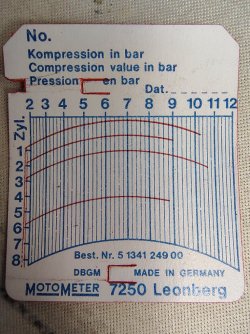
I also carried out a compression test straight away and the second cylinder has significantly less compression...
 

Attachments

  • IMG_20260805_115656838_HDR.jpg
    IMG_20260805_115656838_HDR.jpg
    250.6 KB · Views: 8
So it could well be (in the best-case scenario for me) the valve seals.
Can these be replaced whilst the engine is still in the frame?
It might be wishful thinking on my part, but I’m already starting to reckon that I’ll have to remove the engine after all and carry out a cylinder head overhaul, and perhaps replace the piston rings and pistons.

I also carried out a compression test straight away and the second cylinder has significantly less compression...
They can, using the 'Indian rope trick', but given the other findings, I'd say it makes sense to open it up and take a look.
 
They can, using the 'Indian rope trick', but given the other findings, I'd say it makes sense to open it up and take a look.
I’m familiar with the ‘Indian rope trick’, but is there actually enough space to replace the valve seals?
It would save me a lot of extra work – not that I mind, but it would mean I’d be sorted ‘for the time being’ for the rest of the motorcycling season.
The engine will then be taken out of action this winter.
 
Last edited:
The problem has finally been found… So it’s not an electrical fault after all.🤪

All three exhaust valve guides are worn out anyway. Cylinder 1 was even leaking black sludge from the port… but that should all be repairable.

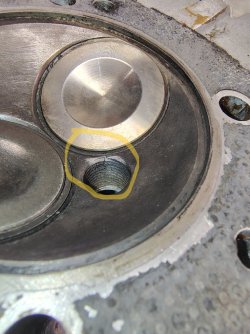
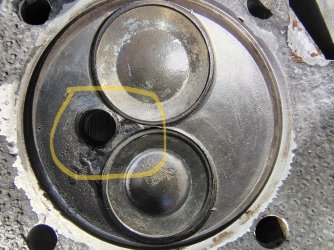
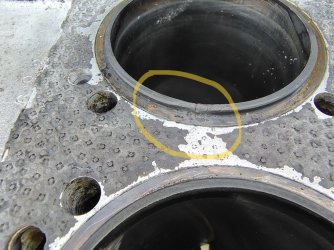
It turns out the cylinder head has already been ‘rebuilt’ once, and that ‘repair’ has cracked again. Cylinder 3 also has a small crack between the spark plug and the exhaust valve. The engine block also has a burn mark on the middle cylinder…

Unfortunately, I’m having no luck with the RGS…😔

So now I’m looking for a better engine block and a good cylinder head.

Any suggestions??

I don’t want to give her up, because everything else is now in excellent condition.
 

Attachments

  • cil 3.JPG
    cil 3.JPG
    177.6 KB · Views: 45
  • cil 2.JPG
    cil 2.JPG
    261.2 KB · Views: 45
  • cilinderwand 2.JPG
    cilinderwand 2.JPG
    201.7 KB · Views: 46
Last edited:
I found a couple of cracks in the iron skulls of the original head on my RGA, it was a one-owner (effectively, my Dad, then me) bike with ~60k km and had always been well cared for. So don't despair immediately. In my case I just got another head because it as 1992 and they were plentiful and "cheap" (although didn't feel that way on my salary then). RGS heads are the best iteration of them, so worth trying to save it.

The skulls are cast into the head and even I think the original inserts were cast into the skulls, so it's vanishingly unlikely that a seat will fall out due to the cracks. Just normal head restoration with new guides etc, and I believe Red tends to ceramic coat the combustion chambers to give a little more heat protection for the cracks, he has stated here before that he doesn't attempt to repair them, leave well enough alone.

What's weird on your photos is the second one which looks somewhat like damage from dropping a valve at some time? Or is it die grinder marks, a weld repair, or something else? Weird. The damage to the barrel liner looks like flame erosion from a blown head gasket left way too long, or does that have a crack too? Bear in mind that the weird head sealing arrangement on a Laverda means that the sealing face is actually the slightly recessed annulus outside of that raised step, so other than being a potential hot spot which could bring on pinging, the eroded part might not matter.

The liner damage is almost certainly from a blown gasket left too long. In my experience, the annulus (new one for me!) will probably show a dip in that burnt area as well, so it's more or less curtains for that liner. Just as certain, there will be a pretty large dip in the alloy casting between the adjoining cylinders, so the cylinder block would require a skim as well.

The valve seat inserts in these heads are conventionally shrunk in, nothing trick there. Thankfully, the skulls in the RGS heads seem to be quite a bit thicker than the earlier iterations. Looks like a not-so-tidy weld repair to me, can't detect a crack on the photo. Sadly, I still have not found anybody willing to tackle cast iron with laser welding, the repair of the other chamber would otherwise be a doddle.

piet
 
I was watching Jay Leno's Garage a good while back, and they repaired a cast iron 100-year-old steam car, which was sent out to be stitch welded. This isn't the stitch weld, but it's cast
 
Dont know if this has any potential, but worth a look.
 
That's good for big holes or long cracks in thin-walled components Vince.

We're looking at a 3mm deep crack in a 10mm thick part of a threaded cast-in component. The crack needs to be stopped/contained in order to preserve clamping pressure on the neighbouring seat insert. You could fit an insert with the required oversize as is but it wouldn't stay put for long! If the crack expands, all pressure on the seat is lost, the seat starts ot move around and cants, bends the valve, the head of the valve cries enough and drops into the cellar... oops.:rolleyes:

VW actually states 3mm deep cracks between valve seats in some of their alloy diesel heads are of no concern! But where these heads have inserts that are 10-12mm deep into the head casting, Laverda seat inserts cannot be much more than 4-5mm thick due to the counterbore depth that the skull allows before breaking through into the alloy.

What works in one engine can be totally worthless in another.

piet
Has anyone ever tried shot peening the skulls as a preventative measure? I know shot peening has limited effectivness on cast iron but given that it's in an aluminum head we can't really thermally relieve any stress in the cast iron. Asking for a friend ;)
 
Back
Top