RGS rear wheel bearing spacers

murphus

Senior member
Replacing the rear wheel bearings on my RGS. The drive side had a thin cupped spacer under the bearing. No such spacer on the caliper side. The parts diagram shows a spacer (#11) on both sides. No apparent issues from its absence, but the obvious question is, is this an issue?
 
Yes! The two spacers and the spacer tube are designed to remove side-loading on the wheel bearings, without one you run the risk of stuffing a bearing quick-time.
 
I assume you mean the spacers behind each bearing in the middle of the wheel? If one in missing the bearing will go in to the hub a little farther than it should and the bearing assembly will be a not as wide as it should be. So when you tighten the axle, the swing arm is going to bend in to make up for the difference. So yes you need the spacers on both sides! Also always replace the sprocket bearings at the same time as they are usually the first to fail.

Now more importantly the top hat spacer that goes between the right side bearing and the sprocket hub, don't put in in the wrong way! I have seen a number of Laverda's where this was done and the left side wheel bearing will only last a few miles before failing and sometimes destroying the wheel in the process.
 
Bending of the swingarm is nowhere near as critical as the side loading of the wheel bearings with one or both spacers missing as Legs points out. The cupped shape also acts to locate the spacer between the bearings so you can more easily slide the spindle into place.
And yes, good point by 1200ts re cush drive/sprocket assembly bearing replacement
 
It's apparently been this way for ages. Bike had something like 36,000 miles on it when i bought it, which has since been more than doubled. I did front bearings a little while back, this is the first time I've replaced the rears. Are the spacers catalog parts, e.g., Timken, SKF, etc., or Laverda only?
 
Laverda only AFAIK. But you could make up something providing you use sheet steel with similar thickness. Wolfgang and others can supply.
Given your bike has survived with only one spacer, you could risk it again. But I wouldn't without taking some accurate measurements first! Or you could check whether the bearings are being side-loaded by tightening up the wheel assembly with some additional spacers to make up for the missing swing arm and brake torque arm. If the spindle doesn't rotate as freely after tightening the nuts then you know you have a problem...
 
Last edited:
It'll go back together as designed, but I think I'll try fashioning a spacer on my own as Wolfgang is out for at least another week, which means at least two weeks to acquire.
 
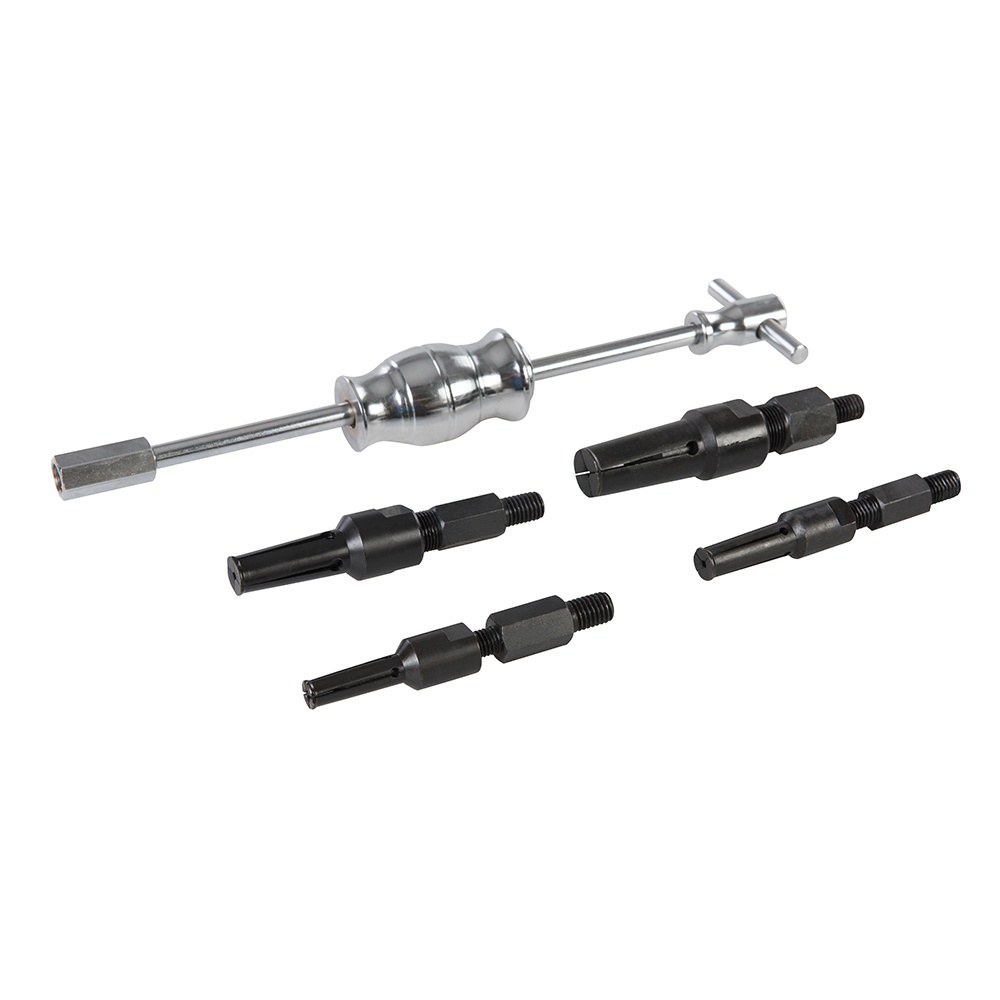
Not quite sure how you'd use a puller to remove a wheel bearing??!! Never seen a puller that can connect between the spacer and the bearing inner race.
The centering spacers sound to me like they only centre the spacer (radially) so it contacts the inner race of the bearings adequately when tightened. They aren't used to space the bearings laterally. I've used o-rings to centre the spacer. If the axle is in place when the bearings and spacer are fitted even without the centering washers, the spacer will be in the correct position unless its ID is larger than the ID of the bearing.
 
Not quite sure how you'd use a puller to remove a wheel bearing??!!

Blind bearing puller. Slidehammer and a collet that gets expanded inside the bearing. You think there's nothing to grab on but I have never had one let me down. Saves beating on it with a punch unsuccessfully from the other side.

Jim

GGTS44114-3.JPG
 
Or you could use one of these.
Push it in so the edge of the expanding section just exceeds the full depth of the inner race, tighten the bolt so it grabs the inner race and tap the bearing out from the other side using a suitable drift.
Cheap as chips.
RAWLBOLTS.jpg
 
Top tool Jim. I've used them in bicycle shops but never thought they'd grip the inner edge of an installed bearing with spacer. Slide hammer sets are fantastic tools all round and sometimes they cope up at good prices.

The coach bolt solution is a ripper as well - won't forget that one.
 
Or you could use one of these.
Push it in so the edge of the expanding section just exceeds the full depth of the inner race, tighten the bolt so it grabs the inner race and tap the bearing out from the other side using a suitable drift.
Cheap as chips.
View attachment 81819
Now that’s a good idea. M16 would probably be just right for the wheels?

Still, new proper tools are exciting… 🤔
 
Any bearing puller to remove the wheel bearings is a very bad idea! Just heat the center of the wheel and the bearings will fall out.

Removing the bearing with a puller will remove a little bit of aluminum so eventually the bearings are no longer tight in the wheel. When you press the new bearings back in you are also removing more aluminum.

The next post in years from now will be, I had the wheel off to replace the tyre and the wheel bearings fell out. The fix will be red Loctite.

Put the wheel on the gas cooker so the flame touches where the brake disc mounts. Open a beer and sit down and wait a few minutes until the bearing falls out. Also use the same method to fit the new bearings. You don't need to get the wheel very hot to do this so the paint will be OK.

If you need a puller or a press or any other type of tool to replace the bearings, you are doing it wrong.

If you look at the bearing bore of a wheel that has not been bodged yet, there are no marks in the aluminum as the bearings were not pressed in but were dropped in with the wheel hot.
 
Last edited:
  • Like
Reactions: Rob
Back
Top