Sacrilege,...According to Some....

Nah, standard forks. Measured against Ian's standard 81 Jota.
Way too long in my opinion.
Red supplied me with a new front end complete with custom made fork brace.
Problems only surfaced when riding through sweepers at 130 Kmh + or 150 in a straight line.
Don't believe it's a design fault; the forks on the RGS are longer than the Jota's and an RGS doesn't have a steel front mudguard. The Yellow Peril is rock steady at 160+ in a straight line and tracks well through sweepers.
Think there is a component fault or something wrong with the setup. (Just my opinion).
 
RGS forks are longer but I think that extra length is pulled up through the yokes by the same amount as that's where the clip ons attach.
 
RGS forks are 30mm longer.
The amount protruding above the top yoke is 30mm.
 
Terry Dymond said:
Don't believe it's a design fault; Think there is a component fault or something wrong with the setup. (Just my opinion).

Nah, those series II Jotas just don't handle well: :D Peter Elms (Shajota) is always telling me that.. I thought it might be the Marzocchi Vs Ceriani thing as my early 3Cs  both track/ handle well whereas the Series II Jota  was all over the place going over a rough bridge on a bend at speed (130kph) out towards Abbot Point and chasing him on the drummer. Didn't actually feel dangerous though was certainly shaking it's head. I recall Peter said he felt it was more likely the shocks needed replacing.
 
AndyW said:
Nah, those series II Jotas just don't handle well: :D Peter Elms (Shajota) is always telling me that.. I thought it might be the Marzocchi Vs Ceriani thing as my early 3Cs  both track/ handle well whereas the Series II Jota  was all over the place going over a rough bridge on a bend at speed (130kph) out towards Abbot Point and chasing him on the drummer. Didn't actually feel dangerous though was certainly shaking it's head. I recall Peter said he felt it was more likely the shocks needed replacing.
WHAT :o I have never had an issue with the handling on my bike although at various times it can be less than ideal due to normal variations in set up - (you know tyre wear, tired suspension). If you remember I told you the main reason (I felt) it was moving around at the time was a worn rear tyre, however I also said I was looking to upgrade the rear shocks (& in fact have been going to do this for ages :-[) I have since then replaced rear tyre and all is good again. I will say that the worn rear was a BT45 and I was never really happy with it from the start - even from new I felt it was a bit squirmy (I know not consensus on here). Went back to a Pirelli Sport Demon and feels way better.
I still must replace those rear shocks, but life moves slowly up here ;)
Anyway, I know you were looking for a bite but always glad to prod your alzheimers Andy :P
ps - you blokes are always having a go at the series 2, if its not the because its Orange its the fairing, or its the Marzocchi forks etc etc - I have finally worked out its pure envy :-*
 
My 81 aging Jota has her original sliders and staunchions she's getting pretty soggy in the front end but there's no way does she weave at all seems to be getting better with age you know like a good single malt.
Blab blow your tyres up a bit more and hang on tight and give her heaps if she still weaves you have something else going on there mate have you  checked your wheel alignment????????
 
I have measured the Jota fork length against the 4 bevel ducatis I own.
Same 38mm Marzo forks.
Bottom of the bottom triple tree to top of the slider-
ducatis--150mm
laverda--230mm
Thats a huge difference.
I am struggling with a way to align the wheels.
 
Terry Dymond said:
Don't believe it's a design fault; the forks on the RGS are longer than the Jota's and an RGS doesn't have a steel front mudguard. The Yellow Peril is rock steady at 160+ in a straight line and tracks well through sweepers.
Think there is a component fault or something wrong with the setup. (Just my opinion).


Terry,

The RGS frame is a lot stiffer, especially around the headstock and top spine than the 180? frame.  "Active" length of the forks is much the same as the later MkIIs.  Because the RGS generally tracks like it's on rails, more or less confirms my notion that the forks are not to blame, but it is the frame itself causing the weave that is so common with the 180s.  On top of that, the RGS is quite a bit heavier, stressing the forks even further.  Under hard use, especially with up-graded brakes, they do reach their limitations though.

With the RGS having only a flimsy plastic guard without seriously effecting handling, also confirms my view of fork braces being basically superfluous. :D

piet
 
The most accurate way I have found is with a couple of sheets of custom wood,16mm thick and about 600mm wide and 2m long layed each side of the bike with a section cut out to clear the centre stand. pack them up as high as you can hard against the rear wheel and it becomes obvious seeing if the front wheel is offset or out of parallel. I also made a pair of dividers out of 2x1 with a nail in each end  and use them like a tramil  to see if the rear wheel is equidistantly back from the swingarm pivot each side.Hard to measure this with the mufflers in the way. This is a lot better than string lines and lasers.Once you sure its ok then string lines work fine. Done a far bit of surveying so trust me on this. BTW you can always send it to Cessnock for a Comutrack measure $500.
 
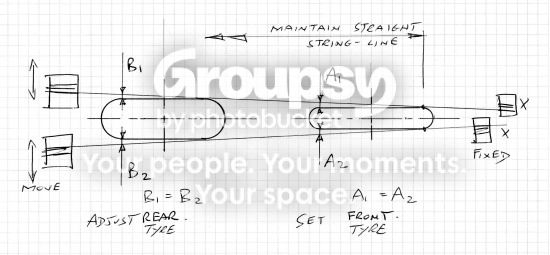
I use 2 string-lines, 4 bricks, and a bit of trigonometry.
string-line-tyres_01.jpg

Not hi-tech and not fool-proof, it's just trigonometry.
 
You have to start somewhere. What your trying to measure is if the wheels are centred to each other and square to the swingarm centerline and this bit is harder the centre line of the steering head is plumb above this top and bottom.My method removes any touching of the string and deflection,missing the centrestand,asorted bits in the way ect. BTW you need a reasonably flat surface and the bike plumb, shims under the centre stand,small spirit level on the brake discs helps.This isn't perfect,its as good as you can do without going nuts. The Computrack system uses a Theodolite and a track and models these 3d dimensions to multiple decimal points.Kinda handy if you crash your GP bike a couple of times a day and need to find out if its pointing right at race time.I guess those Cloud type scanning gear do this as well these days.
 
You don't.
Unless the frame or forks are bent you have to make that assumption.
It will find the straight ahead position when you ride it (check then that the bars are not skewed to one side).
Then you assume it's straight ahead.
 
You start with the rear wheel line projected ahead,straight edges as said and turn the front to where its best aligned  and see how that rates against the rear.
 
I pivot the front tyre to maintain A1=A2.
I am only concerned with aligning the rear wheel with the front wheel.  i.e. rear axle adjustment.

(as Grant has just said)
Having the front wheel pivot with my input on the bars is always preferable.  no?
You say how do I know if it's straight.  I say 'straight to what?'  It goes where I point it,, hopefully.
 
Back
Top