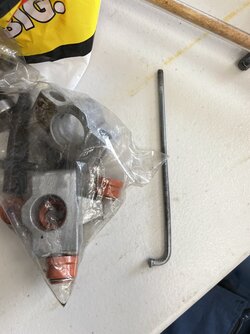
Sf2/3C rear wheel spoke diameter

In my ebike days I recall a gentleman who kept breaking spokes and going up on the size to no avail. It was only when he went to one size down from the original that the problem went away, it seems there was a need for a certain springiness or stretch. The spokes were able to absorb the shock load and dissipate it by flexing. There is probably a happy medium between rigidity and flex.
 
Why? Nobody wants a flexible wheel. Not even on a wheelbarrow. The only flexible part of the bike should be the suspension. Cast alloy wheels were invented to improve rigidity and make them more reliably circular.

It was the late, great, motorcycle racer and engineer Peter Williams who is credited with inventing solid cast alloy wheels for motorcycles. His wheels made their public debut on the race track in 1970, fitted to his Arter Matchless dubbed "Wagonwheels". The reason he did so was to create a stiffer wheel with less run-out than the spoked wheels of the day. He wanted greater wheel rigidity because his wire spoked wheels were flexing when heeled over in the undulating corners of the Isle of Man TT course, sending the bike off-line. With the stiffer mag wheels, he could hold full throttle through corners where he couldn't previously.

It was rigidity rather than weight reduction that he was trying to achieve initially, although I'm sure he was aware of the potential for light weight from the outset. I remember seeing a photo of his first set of prototype solid wheels in a bike magazine many years ago. I have a vague recollection that they were fitted to a Norton in 1968. I can't find that article or picture now, but the wheels were quite chunky with 6 massively thick spokes like flanged beams. I think the article said they were actually heavier than the wire spoked wheels they replaced, but a whole lot stiffer. It was only through design refinement in subsequent years that they became lighter than spoked wheels.
Perhaps the flex of the chassis in those days compensated for the stiff wheels. Don’t motogp bike have designed in chassis flex to deal with shock loads when leaned over in corners where the suspension is experiencing side loads and is unable to smoothly respond?
 
Early cast wheels were far heavier than wire wheels, certainly on road bikes. Those that weren't were fragile. Laverda ones were super soft, Ducati ones cracked up. Yamaha ones needed two men to lift them. It took a while before they were sorted.
Wire wheels are strong and light, only when bikes start getting towards 100 hp do they seem to reach limits. Classic racing bikes don't have trouble with them.
 
Perhaps the flex of the chassis in those days compensated for the stiff wheels. Don’t motogp bike have designed in chassis flex to deal with shock loads when leaned over in corners where the suspension is experiencing side loads and is unable to smoothly respond?
I don't think the introduce the type of flex that some '70s bikes had 😱. They went from no flex frames to a little bit of flex.
 
Wow. Interesting old Froggy bikes.

I think the problem of too much stiffness in race bikes relates to the tyre compounds being so much stickier than they used to be, so they can achieve lean angles in excess of 60°. The bike is closer to horizontal than vertical in corners, so the suspension has to work sideways when it hits a bump. I'm not sure what the answer is to that problem (someone here might know), but I don't think it's making the wheel less rigid. I don't reckon the riders would be too keen on doing up to 340kph along the straights on wobbly wheels.
 
The bend at the hub is where I'd expect them to break. If not done right it's just a break waiting to happen. The Laverda factory didn't get it right. They used a single "L" shaped bend rather than the more complex bend you describe Vince. So they were prone to spoke breakages at the hub as many owners will attest. It's a fatigue failure caused by a slight flex in the spoke on every wheel rotation, so tends to happen more frequently on bikes that have done a lot of miles.

With the best of intentions, I upset a fellow forum member a while back commenting on a 3C rear wheel that he'd just had re-spoked the way the factory did it, which (in my opinion) is less than ideal. Although with spokes that are thicker than original, or made from a stronger steel alloy, it would probably be OK. Especially on a bike that doesn't do high mileage.
In the day i built push bike racing wheels for track and road, completely different process, the track wheels had copper wire wrapped around where the spokes crossed and soldered, "single" tyres ( tube is enclosed by stitched outer material ) pumped to 120 to 140 psi. Road Wheels were less tensioned in the spokes, around 80 psi for the "single" road tyres. Did many wheels in the day, my kettle with spoke wheels, rebuilt many times. Came the rear drum brake Laverda wheel i had, noticed the spokes were bent to clear the hub centre flanges, when tensioned, noted the offset of hub to rim, ( wrote it down somewhere ). That lower L bend is critical, to clear the flange ( spoke hole ) seen a few hubs with incorrect spokes stressing the flange and fatigue cracks between flange and main body of the hub, pro wheel builders that missed the critical clearance bend angle in the spokes. There were no broken spokes in the wheel i used with a trick 100hp ( had lots of grunt..HP a guess ) bored 1200 ( Jota eater i called it )..HTH j
 
Gack, had to replace a couple of spokes on the rear of my 3C years ago. Now I'm going to have a close inspection to see if I can spot the replacements and compare bends. FFFF

bazzee
 
I’ve got a spare set of spokes for the 3c in the shed ….
After reading through this thread
I’m thinking if going out there, sharpening up a couple and sticking them in my eyes so I don’t have to read any more about spokes ……😂😂😂

Marty’s got his answers two pages ago
🙄
 
Last edited:
Maybe it's similar to cable tieing spokes where they cross to either hold them in place if they broke or extra structural support. Habit even.


The clear bit is so Tom can rest his eyes. Even the non-relevant posts add colour and light here, better than lots of forums with cricket noises.
 
What was the idea behind the copper wire soldering thing? I'm guessing it wasn't for structural purposes. Perhaps to stop noise from spokes rattling against each other?
According to Jobst Brandt, on page 81 of his book 'The Bicycle Wheel', tying and soldering spokes provides no increase in stiffness and strength compared to un-tied wheels. It's only benefit is to prevent broken spokes from lashing around after they break.

cheers,

bazzee
 
So sorry to jump in but not sure bicycle wheels relate to a modern motor cycle wheel
Interesting is that my 3C that has a controversial spoke pattern for a LAVERDA doesn’t brake spokes and it’s even been tested by the pro type tester from the northern states

Now there are other uses for spokes apart from poking eyeballs out as we have some poor sod down here contemplating either poking out his eye or cutting his wristsB8CC55B6-5503-4B2C-AB1A-EACE1E2F1F3B.jpeg
 
Talking to a gifted engineer this morning at PI about an engine building related topic he said ” it’s just like building a wheel you don’t need a book “
Which seemed very fitting for this post 😂😂
 
  • Like
Reactions: T.C
Years ago I recall a speedway solo bike came to the track with a solid aluminium rear wheel (similar to HD Fatboys)

It looked great, but was shedded pretty quickly and replaced by a spoked wheel again. I’m sure it was ‘no flex’ related.
 
Back
Top