SF2 brake upgrade?

"Floating discs of the same diametre and material of the originals will not improve brake performance. They even often have the disadvantage of inferior heat transfer."

Er, why are they fitted to nearly all modern bikes then?
The switch to a floating disc with no other changes on my old Triumph improved FEEL massively.
The actual down side (pads being potentially knocked back creating longer lever travel) has never been a problem even on my ex race Harley (yes, really 😁) which didn't even have anti rattle spring washers on the discs. Heat transfer just isn't an issue.
Standard, rebuilt twin brembos on my Mirage with stainless lines and modern pads had loads of power but would lock the front end frequently on greasy London streets, a horrible experience.

Upgrading the single F08 on the original BMW R80/100GS to the caliper in the photo above is/was a standard upgrade to the horribly underbraked original. I did it on a friend's and it was a huge improvement.
Which Harley racer did you have? I've had and currently own a a couple.
 
"Floating discs of the same diametre and material of the originals will not improve brake performance. They even often have the disadvantage of inferior heat transfer."

Er, why are they fitted to nearly all modern bikes then?
The switch to a floating disc with no other changes on my old Triumph improved FEEL massively.
The actual down side (pads being potentially knocked back creating longer lever travel) has never been a problem even on my ex race Harley (yes, really 😁) which didn't even have anti rattle spring washers on the discs. Heat transfer just isn't an issue.
Standard, rebuilt twin brembos on my Mirage with stainless lines and modern pads had loads of power but would lock the front end frequently on greasy London streets, a horrible experience.

Upgrading the single F08 on the original BMW R80/100GS to the caliper in the photo above is/was a standard upgrade to the horribly underbraked original. I did it on a friend's and it was a huge improvement.
As discs became larger and thinner, warping became a very common issue. Imo, mounting the disc on floaters is intended to cater for a certain amount of warping without transmitting this into the caliper and forks. Even this did not prevent early floating Brembos (and others of course) to warp and distort beyond being servicable, see 90's Ducatis and Zane Laverdas with their 320mm discs.

There is no advantage of floating discs that can be related to physics, given same size and material, unless the brake set-up isn't up to scratch from the onset. If your Triumph brakes improved markedly with floating discs, they must have been pretty shite before... the pad/disc material pairing is a major factor in brake set-up.

Never had any issues with the discs on the race Sportsters (German Harley Cup, 95-96) I built either, despite them being solidly mounted. But then, they were more akin to manhole covers. ;)

A prime example of floating discs not being up to the job were the 340mm items on early Buells. They were paired with a 6-piston caliper and started warping 100 metres before the corner you were braking for. They distorted to the point of jamming within the caliper, I replaced dozens on warranty. A conversion to double 320 discs and 4-pot calipers cured all braking issues on our championship-winning "production":rolleyes: racer.

Floating discs are a selling point these days, reckon many bikes could do quite well without them.

piet
 
As discs became larger and thinner, warping became a very common issue. Imo, mounting the disc on floaters is intended to cater for a certain amount of warping without transmitting this into the caliper and forks. Even this did not prevent early floating Brembos (and others of course) to warp and distort beyond being servicable, see 90's Ducatis and Zane Laverdas with their 320mm discs.

There is no advantage of floating discs that can be related to physics, given same size and material, unless the brake set-up isn't up to scratch from the onset. If your Triumph brakes improved markedly with floating discs, they must have been pretty shite before... the pad/disc material pairing is a major factor in brake set-up.

Never had any issues with the discs on the race Sportsters (German Harley Cup, 95-96) I built either, despite them being solidly mounted. But then, they were more akin to manhole covers. ;)

A prime example of floating discs not being up to the job were the 340mm items on early Buells. They were paired with a 6-piston caliper and started warping 100 metres before the corner you were braking for. They distorted to the point of jamming within the caliper, I replaced dozens on warranty. A conversion to double 320 discs and 4-pot calipers cured all braking issues on our championship-winning "production":rolleyes: racer.

Floating discs are a selling point these days, reckon many bikes could do quite well without them.

piet

Lots of steep roads coming out of the foothills into town in my area. An auto mechanic advised me that permanent rotor warp comes from keeping brakes applied when the rotors are hot. once I throwing the car into park while waiting to merge into traffic I stopped having to replace warped rotors, though I suppose that's a different problem than the one you've mentioned.
 
I also agree with Piet. Don‘t spend loads of money on upgrades. Original PO8 calipers are are more than up to it in my opinion. Decent modern pads (carbon ceramic in my case from Ducati Paddy), decent hoses and bin the original master cylinder. I’ve fitted one (Nissan) complete with dog leg adjustable span lever off a Triumph Sprint ST 955i. Cost me 22 quid off eBay ( 27.72 dollars ). Transformed the braking on my Jarama. When I say “bin it” actually keep it in a biscuit tin for the next owner who may be an originality freak.
 
What sort of racing are those for?
Paul
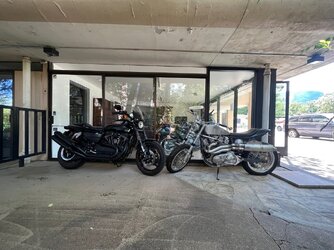
The black one is an XR1200X. The model was used in cup racing both in Europe and Stateside. Likely (Buell not included) the best handling bike Harley had yet made, but kind of a turd at 573lbs dry weight and 90HP. 90 little shetland ponies more likely.

The silver one is an chromoly-framed XR flat tracker that I've converted into a street bike with XR1000 lower end (for e-start), one-off cylinders, brakes, lights, etc.
 
Race bikes aside- the only warped discs I have seen have been due to a seized caliper,corroded/seized buttons or they were worn so thin they distorted. Did lots of work on Ken Harrison Billet Six with different pad/ micro bore hoses and full floating discs- micro bore hose made them two finger sensitive but tended to lag On after full application.
People want and are used to aggressive brakes and front tyres are grippier than they were in the ‘70s- you’d go arse over tit long before a stoppie! Bikes never did go hydraulic drums the way cars did ( Munch did..) but that may well have been down to front tyre grip As well.
 
Race bikes aside- the only warped discs I have seen have been due to a seized caliper,corroded/seized buttons or they were worn so thin they distorted. Did lots of work on Ken Harrison Billet Six with different pad/ micro bore hoses and full floating discs- micro bore hose made them two finger sensitive but tended to lag On after full application.
People want and are used to aggressive brakes and front tyres are grippier than they were in the ‘70s- you’d go arse over tit long before a stoppie! Bikes never did go hydraulic drums the way cars did ( Munch did..) but that may well have been down to front tyre grip As well.
About 50% of the disc-braked Laverdas that come through the shop have juddering front brakes. Often it a case of cleaning up the mating surfaces of the disc carrier to disc, or carrier to wheel hub. Don't know how many cast wheels I've removed fresh powder coating from, why the carriers need to be coated is beyond me... :rolleyes: I achieve about an 80% success rate just by cleaning the surfaces, quite often the carrier and/or disc are severely warped and require re-working. As most cast iron rotors are worn anyway, they are replaced with stainless items. The carriers require carefull truing on the lathe which often results in a slight offset of the disc within the caliper.

Sure, modern tyre technology allows brake systems that are able to twist and buckle our weedy chassis like spaghetti. Using state-of-the-art pads, discs and hoses unleashes the full potential of our ancient brakes, but they're still miles behind comtemporary systems. But, well set up, the stock brakes are still quite useful for general road riding.

piet
 
Reducing unsprung weight was the impetus for thin disks et al, as i recall, the braking power of my recall is however well advanced, thin or thick of mind, the recall is becoming poor.... pithy and true, j.
 
All I was saying was I have upgraded brakes, a very powerful 2 finger application puts it on its nose to tyre shredding effect, and they probably do overwhelm the 38mm Cer forks, BUT 99% of the time I never activate them anywhere near that maximum capacity so there is no danger in overwhelming anything if it's not used in that way. That's why I linked that THE PACE thing. That doesn't mean they are not handy to have, I spent enough time riding a 64 Bonnie with that Conic hub Triumph front drum brake off a 72 model including sailing through red lights 2 up and not having enough stopping power, It Eventually was replaced with a 35mm Maz front end with double discs off a Parallel twin 500 Ducati, much improved from the horrible drum nightmare.
 
The black one is an XR1200X. The model was used in cup racing both in Europe and Stateside. Likely (Buell not included) the best handling bike Harley had yet made, but kind of a turd at 573lbs dry weight and 90HP. 90 little shetland ponies more likely.

The silver one is an chromoly-framed XR flat tracker that I've converted into a street bike with XR1000 lower end (for e-start), one-off cylinders, brakes, lights, etc.
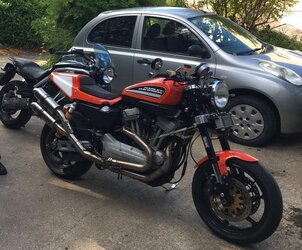
Lovely Harleys. Here's mine, came third in the UK XR1200 race series (with those new-fangled floating discs as standard :)). Just over 90bhp (they were all dynoed) and around 520lb with the allowable weight reductions, like truck racing but fun!
 

Attachments

  • Harris_xr1200.jpg
    Harris_xr1200.jpg
    140.6 KB · Views: 9
I agree that the standard Brembo brakes were state of the art in the seventies, and if you're happy with them, fair enough., and they can be improved with a few cheaper mods as well. But modern brakes ARE better AND lighter of course.

I just did a track day on the Laverda with these (Ducati 996) brakes, and was glad of them, no issues with frame flex (at the pace I was going anyway), just the usual frame brace mods by the headstock.
 

Attachments

  • 996_brakes.jpg
    996_brakes.jpg
    179.4 KB · Views: 25
Lovely bridge over the River Clun in Clun, South Shropshire. Enjoyed our spirited ride to the Laverda meet at Willersey recently. My brakes coped !
I agree that the standard Brembo brakes were state of the art in the seventies, and if you're happy with them, fair enough., and they can be improved with a few cheaper mods as well. But modern brakes ARE better AND lighter of course.

I just did a track day on the Laverda with these (Ducati 996) brakes, and was glad of them, no issues with frame flex (at the pace I was going anyway), just the usual frame brace mods by the headstock.
 
Back
Top