
You are using an out of date browser. It may not display this or other websites correctly.
You should upgrade or use an alternative browser.
You should upgrade or use an alternative browser.
Some words, and photo lower V6, crankcase.
- Thread starter iis_iis
- Start date

Andy
Hero member
- Location
- Auckland, roughly
Surely you were too young for drugs in the 70s..?

breganzane
Hero member
- Location
- NSW Australia
Nothing to do with ai. The reason the finishes look "too good to be real" is that the parts were made by the great Cor Dees, and that's just how he rolled. 
The layout is pretty straightforward, think motoguzzi, boxer bm or whatever, but with a counter-rotating and offset clutch. No different to other longitudinal bikes, to get to the clutch you have to separate the engine and gearbox, but not split the halves apart.
The photo below might help, you can see the joint where the gearbox and crankcase housings join in the first photo if you know where it is. As others have noted, there's some sort of additional plate on the back of the engine block in the photo posted by Lothar. Normally there is a small stub of crankshaft sticking out with the drive gear that meshes with the clutch gear on it. As for worrying about straight cut gears, what do you think is in the rest of every gearbox?
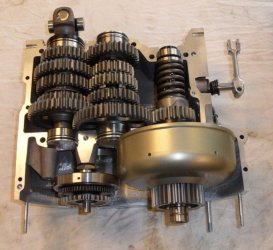
The BMW k100 came a few years after the v6 and bears more than a few similarities in the layout! It had a counter-rotating clutch but it was central and the crank instead offset.
The layout is pretty straightforward, think motoguzzi, boxer bm or whatever, but with a counter-rotating and offset clutch. No different to other longitudinal bikes, to get to the clutch you have to separate the engine and gearbox, but not split the halves apart.
The photo below might help, you can see the joint where the gearbox and crankcase housings join in the first photo if you know where it is. As others have noted, there's some sort of additional plate on the back of the engine block in the photo posted by Lothar. Normally there is a small stub of crankshaft sticking out with the drive gear that meshes with the clutch gear on it. As for worrying about straight cut gears, what do you think is in the rest of every gearbox?
The BMW k100 came a few years after the v6 and bears more than a few similarities in the layout! It had a counter-rotating clutch but it was central and the crank instead offset.
Well looks like I was wrong!Although I would be happy to have my suspicions proven wrong.
cheers,
bazzee
Although the crank throws do like like they're at 90 degrees, I assume that's an optical illusion. It makes sense to me that the crank throws would be 120 degrees to ensure each cylinder bank is balanced.
bazzee

That makes it a lot clearer Steve! Thanks.
Yep, typical Laverda fashion using stuff they had on the shelf where they could.
So, just fantastic photo quality, just a not-so-good angle of view. Still looks a bit surreal to me...
piet
Yep, typical Laverda fashion using stuff they had on the shelf where they could.
So, just fantastic photo quality, just a not-so-good angle of view. Still looks a bit surreal to me...
Not in a 90° Vee. 'twas a specialty of the designer Alfieri, his Maserati/Citroen V6 was also 90°.Although the crank throws do like like they're at 90 degrees, I assume that's an optical illusion. It makes sense to me that the crank throws would be 120 degrees to ensure each cylinder bank is balanced.
bazzee
piet
breganzane
Hero member
- Location
- NSW Australia
Crank is definitely 120deg. I agree that first photo looks odd but if you consider the middle crank throw is vertical, the front and back throw angled bob weight edges are about even and vertical in opposite directions, confirming symmetry.
Pic angle playing tricks... front pin being visible would make it easier.Crank is definitely 120deg. I agree that first photo looks odd but if you consider the middle crank throw is vertical, the front and back throw angled bob weight edges are about even and vertical in opposite directions, confirming symmetry.
piet

Alan
Senior member
- Location
- Northern Ireland
Here ya go Vince, sounds grand to me. Straight cut primary.You hear, PUN people loving the sound of straight-cut gears, really. Worse than Dry Clutches to me. Horrable howling sound, handleable for racing, but not a pleasant sound.

Attachments

1200ts
Hero member
- Location
- USA - Riverside CA
It looks like I owe John Wilson an apology. It is a real picture of a Laverda V6 engine. I thought it was a fake picture.
As for the mention of some parts looking BMW K bike, well I read many years ago that Laverda designed the K bike engine cases as they owned a aluminum foundry and knew what could be cast and BMW liked the design of the V6. Don't know how much of this story is true.
I still think the clutch being where it is on the V6 is a bad design. Clutches on race bikes have a very hard life and having to split the bike apart to get to it is not a great design.
But..................................... on a BMW K bike, getting to the clutch is not a fun job either.
If Cor Dees made all the parts for this engine, well he has my respect!
As for the mention of some parts looking BMW K bike, well I read many years ago that Laverda designed the K bike engine cases as they owned a aluminum foundry and knew what could be cast and BMW liked the design of the V6. Don't know how much of this story is true.
I still think the clutch being where it is on the V6 is a bad design. Clutches on race bikes have a very hard life and having to split the bike apart to get to it is not a great design.
But..................................... on a BMW K bike, getting to the clutch is not a fun job either.
If Cor Dees made all the parts for this engine, well he has my respect!

chrisk
Hero member
- Location
- Brisbane, Australia
That’s just a typical friendly competitor relationship behaviour ……… chances are, in return BMW came good with the RGS, BMW type, handlebar covers.but BMW K engine cases, that's a new one on me.

Massimo was reportedly a big fan of BMW and good mates with Hans Günther v.d. Marwitz, a BMW designer and technician at the time.That’s just a typical friendly competitor relationship behaviour ……… chances are, in return BMW came good with the RGS, BMW type, handlebar covers.
piet

Tippie
Hero member
- Location
- Dr?bak, Norway
What other options are there for the clutch on an inline crank engine?

piranha-bro2
Hero member
- Location
- Melbourne
Indeed. Even air head Beemers and I'd guess CX500s required gearbox removal to access the clutch or a crank main seal.What other options are there for the clutch on an inline crank engine?

MarnixSFC
Hero member
Those had a traditional type car clutch.Where was the clutch in those Maserati engines?
Marnix
The Maserati Merak with the 2.0-3.0l Alfieri V6 was a classic mid-engine, RWD layout. As Maserati was under Citroen ownership at the time, this engine also found its way into the Citroen SM, albeit in FWD configuration. Dry clutch between engine and gearbox, basically the same as BMW and Guzzi.
AfaIk, Honda fitted a counter-rotating clutch to counter the torque effect of the in-line configuration of both Goldwing and CX models. IIrc, the Goldwing even had a contra-rotating alternator, futher enhancing the torque balancing.
Clutch replacement on either Guzzi or BMW requires engine and/or gearbox removal, a royal pita any way you look at it. The CX clutch is accessable from the front of the engine, the Goldwing wet clutch is buried under the rear of the gearbox, but seems to be accessable without pulling the drive train.
piet
AfaIk, Honda fitted a counter-rotating clutch to counter the torque effect of the in-line configuration of both Goldwing and CX models. IIrc, the Goldwing even had a contra-rotating alternator, futher enhancing the torque balancing.
Clutch replacement on either Guzzi or BMW requires engine and/or gearbox removal, a royal pita any way you look at it. The CX clutch is accessable from the front of the engine, the Goldwing wet clutch is buried under the rear of the gearbox, but seems to be accessable without pulling the drive train.
piet

Ian Short
Full member
- Location
- Cambridge Ontario
The Alfa 155 V6 TI used in the mid '90's German DTM touring series is an excellent comparison of a 60*v6 vs a 90*v6; both utilized a crank with 120* journal spacing/separation. The earlier 60* version was loosely based on the Busso engine and the sound could be descibed as a "screamer". The later 90* v6 was based on the PRV engine that had been out since the mid '70's and its sound could be descibed as a "growler".
I had a '99 BMW R1100s Sport and you had to split the bike in half in order to get to the clutch...... that clutch must have been made from gingerbread, if the clutch slave cylinder let go or the rear main seal started to weep you were screwed. Without exageration I could install a 103ci engine kit in a Harley bagger in less time than it takes to change a clutch on an oil head boxer. It was a vague handling toilet as well. I can't say that I've ever been impressed by the BMW maintenance experience.
I had a '99 BMW R1100s Sport and you had to split the bike in half in order to get to the clutch...... that clutch must have been made from gingerbread, if the clutch slave cylinder let go or the rear main seal started to weep you were screwed. Without exageration I could install a 103ci engine kit in a Harley bagger in less time than it takes to change a clutch on an oil head boxer. It was a vague handling toilet as well. I can't say that I've ever been impressed by the BMW maintenance experience.
Last edited:
breganzane
Hero member
- Location
- NSW Australia
So I guess the big difference to older type longitudinal arranged bikes like a guzzi or old BM is that the V6 clutch is wet. Interesting hearing Honda's solutions, I knew the CX had the clutch at the front and gearbox under, but it never clicked that the gold wing did too. But that puts the engine weight up high, manageable on the CX or the gold wing flat four but worse if you'd try it with a V6.
Marnix' tale of working on the V6 reminds me of Gerry Burgess' culture shock when going from the easy to work on Yamaha to the early desmosedici with the frameless design when Rossi did his disasterous switch in 11/12. You have to split the whole bike to do certain tasks. Even Christiane's small block guzzi was similar.. very hard to access the gearbox, given (like the V6) the swingarm pivoted off it. Had to lift the entire top of the bike off it and wheel it away like a wheelbarrow, then split and remove the engine, then support the lower frame rails and remove the swingarm and rear wheel, only then can you get the gearbox out, by which time the only thing holding the remains of the bike from falling into a pile on the bench is the centrestand! Actually fairly quick and easy when you get your head around it but it was certainly odd.
Re 60 vs 90 vees, I can only assume the 60 degree often used by V6 and V12 engines was done for packaging and/or just to have an even fire arrangement which made spark easier in the early days and makes the tone more agreeable. The Lav V6 sounds great but it's small and revvy, and most engines like that sound good to some degree. I know the old V6 Holdens of the 90's which used the buick 90deg V6 sound absolutely terrible. Don't know about the Maserati/citroen ones. I've seen an SM a few times in canberra with that engine, but it's silent.
The advantage of 90deg is secondary balance, which is perfect whereas 60deg is really bad. All you have with a 90deg V6 is a bit of primary rocking couple from the 120 crank, and in the case of the V6 with it being longitudinal and with small/light rotating parts and long/heavy overall bike, it is presumably negligible.
Marnix' tale of working on the V6 reminds me of Gerry Burgess' culture shock when going from the easy to work on Yamaha to the early desmosedici with the frameless design when Rossi did his disasterous switch in 11/12. You have to split the whole bike to do certain tasks. Even Christiane's small block guzzi was similar.. very hard to access the gearbox, given (like the V6) the swingarm pivoted off it. Had to lift the entire top of the bike off it and wheel it away like a wheelbarrow, then split and remove the engine, then support the lower frame rails and remove the swingarm and rear wheel, only then can you get the gearbox out, by which time the only thing holding the remains of the bike from falling into a pile on the bench is the centrestand! Actually fairly quick and easy when you get your head around it but it was certainly odd.
Re 60 vs 90 vees, I can only assume the 60 degree often used by V6 and V12 engines was done for packaging and/or just to have an even fire arrangement which made spark easier in the early days and makes the tone more agreeable. The Lav V6 sounds great but it's small and revvy, and most engines like that sound good to some degree. I know the old V6 Holdens of the 90's which used the buick 90deg V6 sound absolutely terrible. Don't know about the Maserati/citroen ones. I've seen an SM a few times in canberra with that engine, but it's silent.
The advantage of 90deg is secondary balance, which is perfect whereas 60deg is really bad. All you have with a 90deg V6 is a bit of primary rocking couple from the 120 crank, and in the case of the V6 with it being longitudinal and with small/light rotating parts and long/heavy overall bike, it is presumably negligible.
1200ts
Hero member
- Location
- USA - Riverside CA
BMW is moving away from dry clutches. The R bikes, their best selling models started getting wet clutches in 2013 and the clutch is at the front of the motor so can be serviced without splitting the bike in half. They now only make two models with a dry clutch, the R12 and R18. And the R18 probably won't be around for much longer as no one will buy one. In a few years they probably won't have any bikes with a dry clutch.
Everything else now has a wet clutch. I have had to split the bikes apart on a number of BMW's due to the main seal leaking and it making the clutch now wet. It is not a fun job. The BMW manual I think says it will take a BMW trained mechanic 10 hours for the job on a K1200. It takes me a few days for the job as you will find more than the clutch needs to be repaired.
Everything else now has a wet clutch. I have had to split the bikes apart on a number of BMW's due to the main seal leaking and it making the clutch now wet. It is not a fun job. The BMW manual I think says it will take a BMW trained mechanic 10 hours for the job on a K1200. It takes me a few days for the job as you will find more than the clutch needs to be repaired.
Last edited: