Steering head bearings

Vince said:
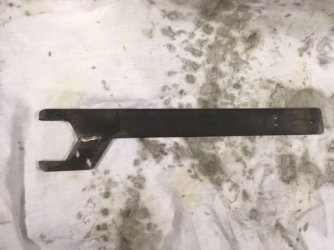
The biggest issue I had was finding a thin enough 32mm openender to hold the lower nut on my Cer frontend, you need to hold the lower nut so it doesn't move when the upper nut is tightened. Ever holding it doesn't stop it becoming to tight when tightening the upper nut. I have said it before, it's more art than science. Takes a few goes to get it close to perfect. I ground down an old spanner first and then I heard on here about pushbike spanners and bought one that works great. BTW it's a 32mm hex on Cer and a Castellated nut, like rear shock adjusters on Maz forks.

Pretty sure it was me who posted about 32mm bicycle headset spanners. True, modern bicycles have done away with the threaded headset, but there's no way a threadless type sys would work with the loads exerted on a moto. They rely on a single top nut to eliminate play (so works as an adjuster only) and then the clamping of the assembly to fix it all where it's 'just right'. Works great on a 7.5kg bicycle and 50+kg rider, but with 250+kg loads and braking and suspension forces up to 320kph? I don't think so!
 
Re thin spanner availability......

A little tip that may be of use... Years ago I bought a wide range of large flat spanners at an auto jumble. The were all Whitworth, or other odd sizes, also a little bit buggered at the working faces. They were super cheap.

5 minutes with a file/grinder turns them into a precisely made metric spanner of whatever size you need.

Another benefit - Often made of proper metal rather than cheese.
 
You have to be really quick to score stuffed spanners at the few spring flea markets here, and anything bicycle is best ordered online so I had to improvise. Five minutes with a hacksaw, grinder and welder on a bit of 3mm 1" steel and send in the patent application. Unless you have forgotten to loosen the locknut it will never be tight.
 

Attachments

  • Ceriani special tool patented.JPG
    Ceriani special tool patented.JPG
    95.9 KB · Views: 140
Didn't need to, there is virtually no torque on that nut, the problem is just to get at it, so an on the spot improvisation so I could get it done. Besides I am a shit welder and the longer the weld the more I need to angle grind. I have done perfect textbook welds, but veering away from the joint I thought I was following (gggrrr....), have tried different strength glass in the welding mask and wear glasses etc but just can't see properly past that arcing light any more.
 
Most of the modern 'reactolite' welding masks have an adjustment for light strength and incorporation of a magnifying lens - which I sadly need now!
You will see the molten weld pool so much clearer.

I struggled for far too long with the old-fashioned mask.
 
I HATE that thing where you're trying to get the stick to contact while not looking at it, then it does the grrrrrrr thing and sticks to the job and bits of it go flying everywhere as you madly try to separate the stuck stick and the job!!  never tried a MIG - must do that one day! TIG? Just not steady enough in the hand dep't. I have great admit=ration for top notch TIG welders (the people, not the machines).
 
To stop a new rod sticking, flick it sideways slightly across where you intend to weld and then move quickly to slightly above the desired location once the arc is established. Some rod manufacturers dip the end in carbon to make ignition easy.

With a half used rod, the same process is used, but break off the slag from the end otherwise no arc. Can stick though!

TIG is nice and controllable like gas welding, but without the bangs. It is slow, but a lovely finish usually. Minimal distortion of the parent metal.

MIG is all about the setup, once right it's like using a mastic gun. MIG traditionally suffers from lack of penetration, but is very popular for production engineering because it is very quick! For making a steel frame it would be ideal.
 
Ducati singles from the 60s had a top bearing that sat on the steerer tube but the only locknut was on top of the top triple clamp. They didn't even have a pinch bolt on the top triple clamp, nothing to pinch. Which meant that if you loosened off the nut on the steerer tube a couple of turns, tiny little ball bearings started falling out and bouncing all over the floor. They were buggars of things to adjust unless you took the forks out, and they had rigid shrouds surrounding the fork that meant you had to unscrew the fork caps and stick a Rawlplug into the top of the fork and fish the fork up with that (yes, there was a special tool that made it easy, I even saw one once).
I guess it kept the cost and weight down a bit, but there's a reason it's not done this way any more.

Ken
 
Back
Top