
Hey guys, now wrangling the spacing for the front wheel. Bolted up the old wheel with the speedo drive - but bolts of the disc carrier hitting the speedo drive. Put my one and only thinspacer in and it worked but wheel still binding (even after loosening the lower fork clamps and bouncing). Tried it without speedo drive and using spacer from other wheel but no joy, discs out of whack so Brembos wouldn’t even slide on on one side. So question is - does stock wheel and speedo drive use a space normally?

You are using an out of date browser. It may not display this or other websites correctly.
You should upgrade or use an alternative browser.
You should upgrade or use an alternative browser.
Stock wheel & speedo drive
- Thread starter cbertozz
- Start date

Andy
Hero member
- Location
- Auckland, roughly
No one else seems to be awake...
My RGS has about 5mm clearance, as per the photo, if that’s any help. Also the spacer goes on the left side, the speedo drive is the spacer on the right.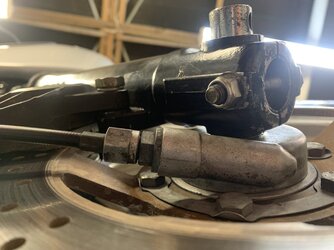
My RGS has about 5mm clearance, as per the photo, if that’s any help. Also the spacer goes on the left side, the speedo drive is the spacer on the right.


Ernesto
Hero member
- Location
- Hamburg, Germany
Isn't there a thick washer inside the speedo drive housing?
Yes. 33 115 780
Attachments


The Sock
Hero member
- Location
- London, England
Hope this helps, Bert:
I know my own, (1976, wire wheeled, 180° triple. Ceriani forks) well, but am shaky on other models.
I have no washer between the fork leg and the speedometer gearbox housing, never had one since new.
It is possible, on mine, to get the bottom speedo cable securing nut to kiss the disc carrier.
I avoid this by only tightening until a flat face is against the disc carrier (arrowed).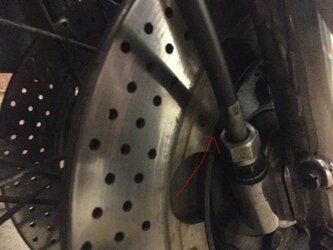
I know my own, (1976, wire wheeled, 180° triple. Ceriani forks) well, but am shaky on other models.
I have no washer between the fork leg and the speedometer gearbox housing, never had one since new.
It is possible, on mine, to get the bottom speedo cable securing nut to kiss the disc carrier.
I avoid this by only tightening until a flat face is against the disc carrier (arrowed).
treoleileagh
Full member
- Location
- Australia
I've just been through this too and I figured it out this way: There are fixed and variable constraints in getting the wheel centered correctly. The calipers are fixed in relation to the forks and they must allow the disks (that are fixed to the wheel) to run through their centers. The axle must slide freely through both forks and the wheel. Once this much is right, everything else is a variable and you can shim each side for a good locating between forks and wheel as you need to, so long as you don't splay or load the forks up laterally. If you then have a problem with bolts of the disk carrier striking the speedo gbox, check how you have fed the bolts through the disk carriers or/and you have not reversed the wheel by accident. The bolt heads (not the nuts) should be on the speedo side of the wheel. If that is correct too, the easy fix is to use thinner washers or bolts with thinner heads, or grind a tad off their tops. If you still have a problem, then go back and check the alignment of the forks.
My wheels are non std and to get the disks centered in the calipers, I had to fit the wheel without a shim between the fork and the speedo gbox.
My wheels are non std and to get the disks centered in the calipers, I had to fit the wheel without a shim between the fork and the speedo gbox.
Last edited:

piranha-bro2
Hero member
- Location
- Melbourne
We've been through pages on this.
The shoulder on the thick portion of the axle butts up against the speedo drive and the centre position of the wheel is determined by the width of the spacer on the non-speedo side. It shouldn't need a spacer or washer between fork leg and speedo drive (no idea why one is shown in the parts diagram - can't hurt unless it's the wrong thickness, but it is redundant - Cerianis never had one). The fork lower is is free to move laterally on the thick part of the axle until the pinch bolt is tightened. Once the correct spacer is fitted to the other side - which should perfectly centre the hub - the axle nut is tightened and then and only then the pinch bolts are tightened.
If you visualise it, you could theoretically take the speedo drive side fork leg off and the axle nut would hold the wheel hard up against the spacer, which is hard up against the remaining fork leg. If the spacer is the correct width, the hub will be centered. The speedo side fork leg can 'float' to find its unbound position and then the pinch bolt is tightened to secure it. Bouncing the front end before tightening everything helps find this unbound pos.
The shoulder on the thick portion of the axle butts up against the speedo drive and the centre position of the wheel is determined by the width of the spacer on the non-speedo side. It shouldn't need a spacer or washer between fork leg and speedo drive (no idea why one is shown in the parts diagram - can't hurt unless it's the wrong thickness, but it is redundant - Cerianis never had one). The fork lower is is free to move laterally on the thick part of the axle until the pinch bolt is tightened. Once the correct spacer is fitted to the other side - which should perfectly centre the hub - the axle nut is tightened and then and only then the pinch bolts are tightened.
If you visualise it, you could theoretically take the speedo drive side fork leg off and the axle nut would hold the wheel hard up against the spacer, which is hard up against the remaining fork leg. If the spacer is the correct width, the hub will be centered. The speedo side fork leg can 'float' to find its unbound position and then the pinch bolt is tightened to secure it. Bouncing the front end before tightening everything helps find this unbound pos.
piranha-bro2
Hero member
- Location
- Melbourne
Carlo, those discs don't look original and if you have spacers under them then the bolts are going to protrude further out toward the speedo drive housing/cable mount.

CLEMTOG
Hero member
"I have no washer between the fork leg and the speedometer gearbox housing, never had one since new"
I beg to differ McStrap, the washer is sunk into the alloy speedo housing and takes the end load of the shouldered spindle, spreading the clamping effect, without it the speedo gearbox would become damaged rapidly, there should be a gap of about 2 or 3 mm between the fork leg and the speedo gearbox if your legs are parallel and straight, the last thing to tighten when assembling this area is the two pinch clamps on the right hand leg (stock caliper set up) and only once the legs have been settled, the disc caliper can often influence this especially if callipper adapters are used, so best done with the right calliper off its mount and clear of the disc.
CLEM
I beg to differ McStrap, the washer is sunk into the alloy speedo housing and takes the end load of the shouldered spindle, spreading the clamping effect, without it the speedo gearbox would become damaged rapidly, there should be a gap of about 2 or 3 mm between the fork leg and the speedo gearbox if your legs are parallel and straight, the last thing to tighten when assembling this area is the two pinch clamps on the right hand leg (stock caliper set up) and only once the legs have been settled, the disc caliper can often influence this especially if callipper adapters are used, so best done with the right calliper off its mount and clear of the disc.
CLEM

Tippie
Hero member
- Location
- Dr?bak, Norway
Clem, does that washer generally fall loose from the speedo drive housing? They have always seemed to be one piece."I have no washer between the fork leg and the speedometer gearbox housing, never had one since new"
I beg to differ McStrap, the washer is sunk into the alloy speedo housing and takes the end load of the shouldered spindle, spreading the clamping effect, without it the speedo gearbox would become damaged rapidly, there should be a gap of about 2 or 3 mm between the fork leg and the speedo gearbox if your legs are parallel and straight, the last thing to tighten when assembling this area is the two pinch clamps on the right hand leg (stock caliper set up) and only once the legs have been settled, the disc caliper can often influence this especially if callipper adapters are used, so best done with the right calliper off its mount and clear of the disc.
CLEM

As Clem has stated, the speedo drive housing needs the washer to prevent it crushing under the spindle pressure when the axle nut is done up. It is recessed into the housing and usually not noticable at a casual glance.
Again, for STOCK bikes with FORWARD mounted calipers; the entire wheel assembly is bolted to the LH slider via the axle, the clamp bolt can be tightened. If feeling really anal, the bike can be taken from its stand and the forks depressed several times, a small space, 1-2mm should result between RH slider and speedo drive. RH slider clamp can be tightened, finished. If all is correct, calipers should line up nicely with the discs, +/- 0.5mm.
If the sliders have been reversed, or you're dealing with one of the very early "reversed" bikes from the factory (axle inserted from the LH side), the assembly is bolted to the RH slider, the LH spacer can be shortened a bit to give the space that the speedo drive would normally offer, and the speedo drive needs to be shimmed to centre the discs in the calipers. Later factory bikes recieved reviewed sliders, the axle was again inserted from the RH side and the previous set-up applies.
With correct discs, fasteners and un-molested speedo drive, there should be ample clearance.
piet
Again, for STOCK bikes with FORWARD mounted calipers; the entire wheel assembly is bolted to the LH slider via the axle, the clamp bolt can be tightened. If feeling really anal, the bike can be taken from its stand and the forks depressed several times, a small space, 1-2mm should result between RH slider and speedo drive. RH slider clamp can be tightened, finished. If all is correct, calipers should line up nicely with the discs, +/- 0.5mm.
If the sliders have been reversed, or you're dealing with one of the very early "reversed" bikes from the factory (axle inserted from the LH side), the assembly is bolted to the RH slider, the LH spacer can be shortened a bit to give the space that the speedo drive would normally offer, and the speedo drive needs to be shimmed to centre the discs in the calipers. Later factory bikes recieved reviewed sliders, the axle was again inserted from the RH side and the previous set-up applies.
With correct discs, fasteners and un-molested speedo drive, there should be ample clearance.
piet

Sir Sidney Ruffdiamond
Hero member
- Location
- Cotwolds
Piet you were very clear about the standard wheels Above - having just put the Suzuki ones back there was no washer in the speedo side - there is a large spacer on the other side - I hope that is correct - everything seems to be in the correct place
Adam,
You should/will find a recessed steel washer/spacer/disc in the speedo drive housing. At least it was in there when I performed that conversion...
It normally stays in place when the caboodle is disassembled and is often not recognised as such.
piet
You should/will find a recessed steel washer/spacer/disc in the speedo drive housing. At least it was in there when I performed that conversion...
It normally stays in place when the caboodle is disassembled and is often not recognised as such.
piet
CLEMTOG
Hero member
the washer does fall out of the recess in the alloy housing , sometimes, but rarely, this was listed as a spare part and until very recently Slaters had them in stock for about a quid, I know because Simon Y bought a few and gave me one which I lost in the distance, from the pub in Tunbridge Wells to my home 30 minutes away, fortunatley he is such a good chap that he gave me another one!
CLEM
CLEM
CLEMTOG
Hero member
and Hamish you must recall the pumping of your forks up against my garage wall and the resultant small gap between the fork and the speedo gearbox, we didn't remove the front wheel (if I remember correctly) when we adjusted your (too tight, new bearings) head stock so I didnt look at the washer, but you must have felt a sweet steering thing after putting both those (very easy) adjustments right.
CLEM
CLEM
The Sock
Hero member
- Location
- London, England
I consider that steel part of the speedo gear-case and have seen various people squeezing washers/packers/shims between the case and the fork leg in the belief that the gap must be filled.
We were aways in agreement on how to line up the forks.
We were aways in agreement on how to line up the forks.

Rob
Hero member
- Location
- Midlands, UK
We've been through pages on this.

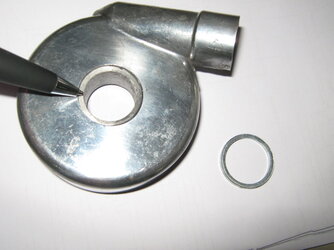
Once more for the parts book worriers... I particularly enjoyed Wolfgang Haerter's brief explanation when I was pestering him for the missing washer many moons ago. He was right of course.
"The washer you are missing is IN 99% OF ALL CASES NOT LOST. Only very late 180 and 120 use the larger washer which is shown in the parts diagram. Check what housing you have on your bike . The small ring presses in the housing and never comes loose unless you pry it out. Check attached picture of the earlier housing This housing will fit on any bike with disc brake old or new."
Attachments
First of all thank you to everyone who took the time to reply, its been a while and I'd sort of forgotten how cool you lot are! (and knowledgeable).
I actually think its possible that a replacement set of bolts holding the disc carrier onto the wheel were added whilst I was running the other set of wheels which were for racing and didn't have the speedo gubbins on (someone machined a spacer for me to replace it). I can't be 100% sure but I reckon without the tiny thin spacer I used inside the housing to clear the bolts it might actually work, as the binding was not terrible.
Will see if I can get thinner washers or perhaps just shallower head bolts - does everyone run the two washer setup?
Interesting about the spacer shown in the parts diagram, pretty sure mine never had it but who knows.

(ps. love the fact that I can upload photos direct now, so good!)
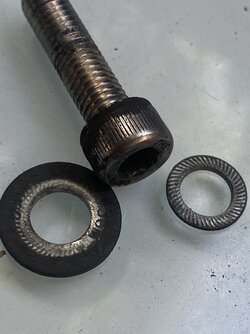
I actually think its possible that a replacement set of bolts holding the disc carrier onto the wheel were added whilst I was running the other set of wheels which were for racing and didn't have the speedo gubbins on (someone machined a spacer for me to replace it). I can't be 100% sure but I reckon without the tiny thin spacer I used inside the housing to clear the bolts it might actually work, as the binding was not terrible.
Will see if I can get thinner washers or perhaps just shallower head bolts - does everyone run the two washer setup?
Interesting about the spacer shown in the parts diagram, pretty sure mine never had it but who knows.
(ps. love the fact that I can upload photos direct now, so good!)
Rob
Hero member
- Location
- Midlands, UK
Def not! Can't see why you'd want to run a Schnorr and flat washer together...kinda negates the locking effect of the former! If space remains an issue I'd go with Loctite threadlock instead.does everyone run the two washer setup
Last edited:
great, that sounds like an easy plan!Def not! Can't see why you'd want to run a Schorr and flat washer together...kinda negates the locking effect of the former! If space remains an issue I'd go with Loctite threadlock instead.