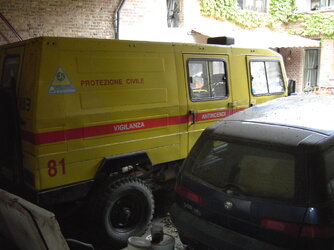
The 4-wheel drive project

Ventodue

Hero member
Location
France
In another thread, Lothar recently posted this. To avoid contaminating that thread, I thought I'd open a new one ...

<snip> ... a 10 Million investment into a 4-wheel car that never really took off

Good grief, Lothar, is that really how much was sunk into that project?! Was it all Laverda family money, do you know?
 
Dunno Craig, but it certainly wasn't tuppence!

I had the opportunity to drive this one (ex-forestry fire volunteers) while it was in OCT ownership, sadly, nothing to write home about...

It no doupt posessed great off-road capabilities, but it was a nightmare getting there! The car badly lacked proper road gears, maxxing out at 80kmh, revving its nuts off.

piet


PICT0824.JPGPICT0831.JPGPICT0829.JPG
 
probably, maybe some miltary assistance as that is where it was aimed, at that time I was heavilly into 4x4's and built from scratch a 109 land Rover for my work and family usage, it had a Perkins 4.182 engine, (actually made in Japan by Mazda) GM Torqueflite 8 autotrans, Range Rover high ration transfer box, 109V8 front and rear axles (3.54 diffs) and brakes and military one ton springs all round, she did 385,000 miles since building till selling on (to an enthusiast who is totally rebuilding it) only last year a time scale of close to 40 years, many early members will remember that Land Rover. The Laverda project was out of date from the begginning, leaf springs, 4 cylinder gutless diesel, 4 speed gearbox, no power steering etc etc, at that time coil springs, disc brakes, 6 cylinder (and V8) engines, 5 and 6 speed gearboxes axle diff locks etc etc, where usuual, the Laverda had none of them, I bet Fiat were laughing for weeks having sold on several thousand obsolete 4 cylinder diesel engines, I wonder where they went? I think about 70 trucks were competed, mostly flat bed/tipper format but a few with enclosed rear bodies, maybe ambulance intended.

I mean sliding windows, tractor headlamp clusters, flat windscreen, externaly bolted door hinges, grill pressed into sheet metal front panel, lamp guards with not needed squares (from something else?) compare that to a Hum Vee, if you want a miltary vehicle.
CLEM
 
Last edited:
You'll find a fair few of them are still in service Clem. Mainly in remote mountainous areas, performing all sorts of communal duties. I saw 2 during my 2015 Milano-Taranto ride.

IIrc, it had a 4-speed box with reduction and distribution gearboxes. Front drive could be switched off and differential locks could be deployed. Power steering would certainly have helped, as well as decent brakes. A bit of interior sound-proofing would have been great! :rolleyes:

piet
 
In another thread, Lothar recently posted this. To avoid contaminating that thread, I thought I'd open a new one ...


Good grief, Lothar, is that really how much was sunk into that project?! Was it all Laverda family money, do you know?
That was the number I think to remember having heard several times, yes, and think it was also mentioned in some books. But keep in mind - that was Deutschmarks at that time (which at the end does not make any difference to 10 Million Euro, as inflation of 40 years would eat up the factor 2 easily...).

Same is for the V6 and the 2 Million. Piero - joking for sure - offered me to buy the V6 "for what it cost to build it, which was the equivilent of 2 Million Deutschmarks". As the Deutschmark was around 1.000 Lire end of the 70's, I assume this means 2.000.000.000 Lire production cost...
 
Thanks guys. Your insights are much appreciated (y).

(I admit this whole period of Laverda history leaves me very confused - and sad. Agricultural machinery, motorcycles, caravans, aeroplanes, off-road vehicles, good grief - what else? Diversification is all very well, but there has to be some kind of business focus, no? )
 
Thanks guys. Your insights are much appreciated (y).

(I admit this whole period of Laverda history leaves me very confused - and sad. Agricultural machinery, motorcycles, caravans, aeroplanes, off-road vehicles, good grief - what else? Diversification is all very well, but there has to be some kind of business focus, no? )
Look at Honda, Suzuki or Yamaha. They seem to make anything that has a combustion engine. Sure worked for them!

piet
 
Thanks guys. Your insights are much appreciated (y).

(I admit this whole period of Laverda history leaves me very confused - and sad. Agricultural machinery, motorcycles, caravans, aeroplanes, off-road vehicles, good grief - what else? Diversification is all very well, but there has to be some kind of business focus, no? )
The agricultural dept. was sold off to Fiat Agri in 81, motorcycle production continued.
There were certainly some expensive dead ends, the 4x4 and the V6 and no doubt a market that they didn't adapt to. Not strong enough to go with the big boys, not enough of a following to survive "à la Moto Guzzi" and no doubt a very frail financial base going back to the mid 70s.
Paul
 
Look at Honda, Suzuki or Yamaha. They seem to make anything that has a combustion engine. Sure worked for them!

piet
I think though they were already FAR bigger than Laverda ever was when they started diversification while Laverda actually CAME from diversification... Main business was casting (church bells and other parts, made of alloy etc.) and agrecultural (mechanic) machines. Pedro Laverda was a bike enthusiast and his contribution was to motorize the agrecultural machines. He build a business out of his passion for bike racing, never intended really to build a bike factory, while Honda built engines long before they started building bikes or cars.

On Honda, everything was under the control of one man while Laverda Family business was devided already into several companies and not let/controlled centrally. Remember the interview with Massimo beginning of the 80's where he clearly said that Moto Laverda was in financial problems and that the family did not agree to invest more money into it (after these costy experiments of the 4-wheel and V6 disasters), which clearly did not help to further develop the already started projects (600ccm and 900ccm water cooled 4-valve engines). Emission rules got tighter, the japs built better frames (Deltabox etc.), Brembo wasn't the only brake company to build good brakes anymore and Laverda was not able to answer to it at the speed needed, especially as it was a company in a socialistic country. Government took over and you know what allways happens when government takes control... :cry: People come in that have no clue of the business to make decissions for a company they have no sense for.
 
I think though they were already FAR bigger than Laverda ever was when they started diversification while Laverda actually CAME from diversification... Main business was casting (church bells and other parts, made of alloy etc.) and agrecultural (mechanic) machines. Pedro Laverda was a bike enthusiast and his contribution was to motorize the agrecultural machines. He build a business out of his passion for bike racing, never intended really to build a bike factory, while Honda built engines long before they started building bikes or cars.

On Honda, everything was under the control of one man while Laverda Family business was devided already into several companies and not let/controlled centrally. Remember the interview with Massimo beginning of the 80's where he clearly said that Moto Laverda was in financial problems and that the family did not agree to invest more money into it (after these costy experiments of the 4-wheel and V6 disasters), which clearly did not help to further develop the already started projects (600ccm and 900ccm water cooled 4-valve engines). Emission rules got tighter, the japs built better frames (Deltabox etc.), Brembo wasn't the only brake company to build good brakes anymore and Laverda was not able to answer to it at the speed needed, especially as it was a company in a socialistic country. Government took over and you know what allways happens when government takes control... :cry: People come in that have no clue of the business to make decissions for a company they have no sense for.
Ducati survived thanks to government control.
Guzzi survived without trying to be a direct competitor of the Japanese manufacturers.
Laverda simply got it wrong.
Paul
 
when they stopped fitting points?
CLEM
In a way, yes.
When they built the V6 which was banned the following year in competition.
When they became punk and went No Future with the 4 x 4.
One could even argue, when they went the triple way, not to mention the 500, their reputation in the larger capacity market was built on twins.
They might have become a second Guzzi, instead they became just another defunct Italian marque.
Paul
 
well on the V6 they stopped fitting plug leads, V12 distributor with only 6 of the 12 "ways" used.
not entirely going with your post Paul, the Jota (a triple with no points) was all conquering, all singing, and all dancing in the late 70's and early 80's, Moto Laverda must have made good money from UK sales alone, it what they did with it after that which is the ruination, the 500's was a mismatch of some modern stuff but not enough of it, not water cooled, not injected, but six speed, 4 valve and DOHC. when it became the 750 to incorporate those thing it was by then already left behind, it was the one four stroke that realy did ride like a two stroke! amd a race one at that (says ex TZ350 and 500/700/750 mechanic) well I never knew a four stroke that rode even in similar fashion to it, nothing at all at low RPM, building very slowly and needing coaxing, and then (right at the last bit) BANG and its away.
CLEM
 
Clem,
Racing improves the breed, and sells.
Moto Laverda made it's name in endurance racing. First on the Italian peninsula with its singles, then in mainland Europe with its 750 twins.
The marque then tried to counter the all conquering Godier Genoud and Honda RCB in Endurance racing with its V6, only to be outlawed by regulations after 1 season. I believe the V6 project was a mistake, I doubt that the finances could have kept up. Guzzi survived the outlawing of its V8 by selling Falcones and developing the twins. Laverda got it wrong. Laverda was not selling by then as it had with its 750, bolstered by competition success. By then, 1978, to survive, they should have done what Guzzi did, rely on a proven image with a "new model" every few years to keep enthusiasts happy. Guzzi could also rely on a decades old heritage, which Laverda couldn't. Guzzi won the Bol d'Argent, 6 hours race for production machines with it's Le Mans. That sold in France at least.

There was certainly financial mismanagement at Moto Laverda following Francesco's death and rumour has it that there existed dissensions, to say the least, within the family on strategy.

I bought my first Laverda because of the Jotas success in the Avon championship because of my close links to the UK but let's not wax lyrical; no all conquering, all singing Jota. Only wins in a production championship in a group of islands off the coast of Europe, sponsored by a tyre maker that only owners of classic British machines using Avon Speedmaster ribbed tyres or sidecar tyres had heard of. And yes, I know, the Jota did win other local championships.
The 500 is a nice little machine, too late, too expensive, too many teething troubles.

Ducati survived thanks to the Italian state, inspired engineers such as Taglioni and Bordi, and then foreign capital making it all conquering in Battle of the twins and World Superbike.

Maybe Aprilia and Piaggio could have done to Laverda what others did to Ducati, but too late and the catastrophic reputation of the Zane products bearing the Laverda name no doubt put the last nails in the coffin lid.

Paul
 
When you think about how good the Zanes could actually have been with the right development and powerplant, maybe things could have been different. Everyone seems to be forgetting that regs regarding noise were forcing virtually all manufacturers to go watercooling (a good idea in itself). That would have required a considerable change of direction and financial investment. Hindsight is 20/20 - as always.
 
Not all business fails are due to mismanagement, but a lack of forethought is a major contributor.

I had recently returned from a business trip to the good old USA. And on my return the directors of our company had an extraordinary directors meeting, to come up something that we could diversify into.

We manufactured heat shrink packaging equipment, our hot air tunnels worked magnificently and was a great seller. But the future seemed uncertain because we had market share, but in a small market like Australia and the reduced local manufacturering, sales were flatlining.

So in the beer and wine swilling meeting I brought up the experience I had in American rest rooms, something that never happened in Australia.

Which is when I suggested we utilise our experience in high volume hot air, and manufacture them in Australia.

One of the more vocal directors blew it out of the water when he said:

“What a stupid idea, typical Yanks. Who the fuck would use a hot air blower to dry their fucken hands in a public toilet” 🙄
 
Back
Top