
You are using an out of date browser. It may not display this or other websites correctly.
You should upgrade or use an alternative browser.
You should upgrade or use an alternative browser.
Tubeless tires?
- Thread starter TeddyG
- Start date

chrisk
Hero member
- Location
- Brisbane, Australia
The attached photo, somewhere in Bolivia in 1980: I was very happy that I had tubes in the Borrani rim; it took me many miles. Barum (Czechoslovakia) $12 US front tire; it was 1000% better on the dirt roads than the Metzeler it replaced
This is what happens when you drive on flat tyres in my game.
Attachments

Shajota
Hero member
- Location
- Whitsundays Qld
Yep! I offer no opinion on tubed or tubeless because clearly many have run tubeless successfully on tube type rims for a long time, obviously ensuring the valve stem can seat correctly etc but I was also happy that I was running tubes when I bent and cracked my front wheel last year otherwise little doubt I would have been stuck in the back of woop woop for quite a while. (Rim was bent and so seal broken and crack was right through) Of course running on rough roads like that is not recommended as the norm.........I own 2 1978 triples. I know I'm showing masochistic tendencies, but what Laverda owners of the 21st century aren't: there are easier ways to get your highway thrills.
One bike has thin-web cast wheels with tubes; the other has thick-web wheels tubeless. I have easy access to mountain roads and "on a dark desert highway"; see how I placed 'Eagles' lyrics there, aha! Both bikes have seen their upper limits on those desert highways, and if either one of the bikes "experiences a sudden loss of cabin pressure' at those speeds, I'm very sure an Oxygen mask or a bead lock is not going to be my savior. You take your chances and enjoy the ride.
The attached photo, somewhere in Bolivia in 1980: I was very happy that I had tubes in the Borrani rim; it took me many miles. Barum (Czechoslovakia) $12 US front tire; it was 1000% better on the dirt roads than the Metzeler it replaced
chrisk
Hero member
- Location
- Brisbane, Australia
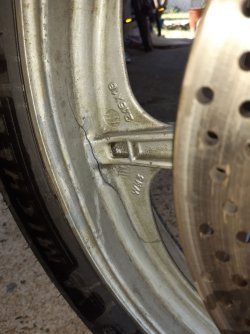
Yep! I offer no opinion on tubed or tubeless because clearly many have run tubeless successfully on tube type rims for a long time, obviously ensuring the valve stem can seat correctly etc but I was also happy that I was running tubes when I bent and cracked my front wheel last year otherwise little doubt I would have been stuck in the back of woop woop for quite a while. (Rim was bent and so seal broken and crack was right through) Of course running on rough roads like that is not recommended as the norm.........
View attachment 107818
Lucky you had to tougher thick webs over thin. Could have been the Late Peter, over Peter being late.
Edit: Must’ve been a hell of a whack for that to happen!
Shajota
Hero member
- Location
- Whitsundays Qld
Happened in my trip out through Einasleigh, up the gulf country and and tablelands last year - my report was here... https://laverdaforum.com/threads/tablelands-via-the-gulf-savannah.106487/Lucky you had to tougher thick webs over thin. Could have been the Late Peter, over Peter being late.
Edit: Must’ve been a hell of a whack for that to happen!
I hit a few spots pretty hard but this happened on a section of dirt where they put concrete culverts in some of the dips. Unfortunately the dirt was washed away at the front of the culvert, I didn't see it till too late and slammed into the hard square front edge of the culvert. There was a warning sign but it was basically right at the scene!!! (Wasn't the only time I was lucky to not have a lie down in the dirt, always on the lookout for the softest landing area
 )
Knew I had bent my rim and ran through my head that lucky I had tubes, but I didn't find till late that wheel was badly cracked. (Dirt had covered the evidence)
chrisk
Hero member
- Location
- Brisbane, Australia
Happened in my trip out through Einasleigh, up the gulf country and and tablelands last year - my report was here... https://laverdaforum.com/threads/tablelands-via-the-gulf-savannah.106487/
I hit a few spots pretty hard but this happened on a section of dirt where they put concrete culverts in some of the dips. Unfortunately the dirt was washed away at the front of the culvert, I didn't see it till too late and slammed into the hard square front edge of the culvert. There was a warning sign but it was basically right at the scene!!! (Wasn't the only time I was lucky to not have a lie down in the dirt, always on the lookout for the softest landing area
Knew I had bent my rim and ran through my head that lucky I had tubes, but I didn't find till late that wheel was badly cracked. (Dirt had covered the evidence)
I remember reading about your trip, just not you bashing the front rim.

Exmoor beast
Hero member
- Location
- Minehead,Somerset, ENGLAND OF COURSE
You’ve got to ask yourself why would every motorcycle, wheel & tyre manafacturer go to the effort of redesigning the wheel when they didn’t need to? I’ve been fitting tyres & repairing punctures commercially for thirty five years - seen it all ! Found tyre levers in a tyre, scooter tyre packed with rag, 5 patches on a single tube. Front punctures I can count on one hand, nearly always rear. Only real odd one was a mechanic fitted tubed tyres and valves to an old R80 with tube tyre rims- both tyres went down simultaneously on the M4 after about half an hour riding.That could have been really bad but he noticed it getting stodgy. Had a lot of 916 Ducatis with porous cast wheels that went down on their own, had to pressure treat them with a resin. I wouldn’t run tubless on non tubless rims.
Possibly the mechanic got a some kind of very minor damage on the tubes when fitting them both with similar method? I guess most usual mistake may be turning the lever over 90 degrees when fitting.You’ve got to ask yourself why would every motorcycle, wheel & tyre manafacturer go to the effort of redesigning the wheel when they didn’t need to? I’ve been fitting tyres & repairing punctures commercially for thirty five years - seen it all ! Found tyre levers in a tyre, scooter tyre packed with rag, 5 patches on a single tube. Front punctures I can count on one hand, nearly always rear. Only real odd one was a mechanic fitted tubed tyres and valves to an old R80 with tube tyre rims- both tyres went down simultaneously on the M4 after about half an hour riding.That could have been really bad but he noticed it getting stodgy. Had a lot of 916 Ducatis with porous cast wheels that went down on their own, had to pressure treat them with a resin. I wouldn’t run tubless on non tubless rims.
I never use patched tubes or tyres on motorcycles. Can be done to get nicely home, but then I just replace them. I consider a patch on a tube will cause more stress on the patched area anyway.
With the tubes recently manufactured I select them very strictly as some current manufacturers seem to be seriously poor, reason for this is possibly the legislation to force using synthetic rubbers. Worst ones this far have been Michelin Airstops holding the exact air pressure for three days in average.
Secondly I replace all tubes after every 10 years, if they were not replaced earlier already.
-Jouni
My experience is exactly the same in some limited number of cases. I was talking on the message what happens if there is a small hole on a tyre that is not blocked, the unblocked hole in tubeless is less probable, but seem to still happen, just repaired one for a car yesterday by replacing both tyres for the axle. Modern tubeless tyres are generally stronger than the old tubed tyres, and the air pressure is also supporting the tubeless tyre better than a pressurized tube and this is how the tyres are designed to work. The failure modes and their probabilities seem to be different for tubed and tubeless tyres.I believe the opposite is true. A nail in a tubed tyre will waggle around and tear a larger hole in the tube quickly. In the tubeless situation the nail will sit in the hole and wiggle around but not make the hole in the tyre larger.
However, I'm a bit still thinking about this some people making conclusions more or less by random forum answers that represent a bounded set to bypass a safety feature. How about those possibly rare cases in where the tyre dropped off the rim? Is this something that just don't happen or are they just not with us anymore telling how did the used solution performed? Just asking.
-Jouni
Exmoor beast
Hero member
- Location
- Minehead,Somerset, ENGLAND OF COURSE
Should have read tubeless tyres on tubed rim- sack the editor!Possibly the mechanic got a some kind of very minor damage on the tubes when fitting them both with similar method? I guess most usual mistake may be turning the lever over 90 degrees when fitting.
I never use patched tubes or tyres on motorcycles. Can be done to get nicely home, but then I just replace them. I consider a patch on a tube will cause more stress on the patched area anyway.
With the tubes recently manufactured I select them very strictly as some current manufacturers seem to be seriously poor, reason for this is possibly the legislation to force using synthetic rubbers. Worst ones this far have been Michelin Airstops holding the exact air pressure for three days in average.
Secondly I replace all tubes after every 10 years, if they were not replaced earlier already.
-Jouni

piranha-bro2
Hero member
- Location
- Melbourne
I'd be very surprised if any moto tyre would actually come completely off the rim if deflated - the bead is highly likely to drop into the rim well but to find its way over the rim edge i fond highly unlikely. Anyone familiar with removing and fitting tyres by hand will know why!
Back when tubeless became available there were warnings NOT to use tubes with them. About 20 tubeless tyres later, with tubes, never had a problem.
Back when tubeless became available there were warnings NOT to use tubes with them. About 20 tubeless tyres later, with tubes, never had a problem.
When radial tyres first appeared, I wanted to try them. My local, highly experienced tyre shop insisted their incredible grip and performance would result in my 3c ending up with a broken frame. They suggested Avon Roadruns were all I needed. That was 20 years ago, and after a bunch of great tyres, no broken frame yet, I would be more worried about potholes. People make up rules all the time about this stuff. The biggest drama I had was finding tyres that fit the rims.
piranha-bro2
Hero member
- Location
- Melbourne
20 years? You sure Vince? Last time I had an Avon Roadrunner on my bike was about 1978!! Time is passing way more quickly than we realise at our age!!They suggested Avon Roadruns were all I needed. That was 20 years ago


motoddrob
Hero member
- Location
- S/W Australia
About the only good thing about those old Roadrunners is they'd get you from Perth to Melbourne and back.
piranha-bro2
Hero member
- Location
- Melbourne
About the only good thing about those old Roadrunners is they'd get you from Perth to Melbourne and back.

1200ts
Hero member
- Location
- USA - Riverside CA
So what I am reading.
A 1976 Jota with thin web wheels and running tubeless gets a puncture = tire comes off the rim and you are dead!
A 1976 Jota with thin web wheels and running tubes gets a puncture = tire stays on the rim and you get to ride another day.
No one has yet explained how the tube with no air in it is safer than no tube? It sounds like we all need to sell our Laverda's especially the thin web wheel version as they are dangerous.
One of my triples has been running tubeless for 30 years with no issues.
And I completely agree about a screw or nail tearing up the tube and making it go flat faster than tubeless. I have seen it multiple times.

Andy J
Hero member
- Location
- Isle of Man
Having experienced similar issues as Dave with dented spoked wheels or cracked wheels like Peter’s I tend to agree that in those type of situations tubed tyres will probably get you home where as running tubeless you’re going to be mostly in a recovery situation.

Quentin,I'd be very surprised if any moto tyre would actually come completely off the rim if deflated - the bead is highly likely to drop into the rim well but to find its way over the rim edge i fond highly unlikely. Anyone familiar with removing and fitting tyres by hand will know why!
Back when tubeless became available there were warnings NOT to use tubes with them. About 20 tubeless tyres later, with tubes, never had a problem.
The against running tubes in tubeless tyres argument back then was that too much internal friction might be caused between the two which in turn could cause excessive heat. I remember many tubeless tyres being textured on the inside, maybe that is where the fear is founded. I reckon we can put that down as another myth that never truely materialised. But, as the industry is still producing tubeless alongside the tube-type in most not-so-modern dimensions, there must be a legitimate reason against this pratice.
As long as there is a tube, or remains of one, slopping around inside a deflated tyre, it is indeed highly unlikely a tyre would actually thread itself completely off the rim. Given the dimensions of both the Laverda cast and wire wheels, it's probably just as unlikely for that to happen if no tube is present. But I can well imagine this to happen with wider rims as they are in use today. The more space the rim centre offers the easier it is to pass over the tyre bead when fitting, logically it is also far easier for it to come off. That is where the safety bead would come into play, holding the bead tight to the rim edge.
Another factor against converting old Borrani rims to suit tubeless tyres are the serrations along the inside of the rim edge. These are to allow air that might be trapped between tube and tyre to escape as well as offering an anti-slip feature to prevent the tyre slipping and valve being torn out of the tube at lower tyre pressures, present on almost all alloy and steel rims. Without exception, tubeless tyres will have smooth beads while tube-type can have mould seams placed around the bead, perhaps also to aid air extraction.
piet

Tippie
Hero member
- Location
- Dr?bak, Norway
All the guys in classic racing here with wire wheels running them tubeless polished away the anti slip ribs around the inside of the rim to get them to hold air properly.Quentin,
The against running tubes in tubeless tyres argument back then was that too much internal friction might be caused between the two which in turn could cause excessive heat. I remember many tubeless tyres being textured on the inside, maybe that is where the fear is founded. I reckon we can put that down as another myth that never truely materialised. But, as the industry is still producing tubeless alongside the tube-type in most not-so-modern dimensions, there must be a legitimate reason against this pratice.
As long as there is a tube, or remains of one, slopping around inside a deflated tyre, it is indeed highly unlikely a tyre would actually thread itself completely off the rim. Given the dimensions of both the Laverda cast and wire wheels, it's probably just as unlikely for that to happen if no tube is present. But I can well imagine this to happen with wider rims as they are in use today. The more space the rim centre offers the easier it is to pass over the tyre bead when fitting, logically it is also far easier for it to come off. That is where the safety bead would come into play, holding the bead tight to the rim edge.
Another factor against converting old Borrani rims to suit tubeless tyres are the serrations along the inside of the rim edge. These are to allow air that might be trapped between tube and tyre to escape as well as offering an anti-slip feature to prevent the tyre slipping and valve being torn out of the tube at lower tyre pressures, present on almost all alloy and steel rims. Without exception, tubeless tyres will have smooth beads while tube-type can have mould seams placed around the bead, perhaps also to aid air extraction.
piet
The ´81 triple race bike that the shop I worked at ran the tube type Lav wheels tubeless, it was an absolute bastard to get the bead off when changing tyres. There seems to be no middle ground on this issue. A bit like how you are taking your life into your hands by leaving the original hard plastic valve caps in place and going fast etc etc.
The issue for me atm with my tubed tyres is getting tubes that are not super heavy duty and weigh a ton, and last time I had trouble even sourcing tubes at all, got blank faces in local bike shops, a bit like asking for a condenser I suppose. That got me thinking on converting them for tubeless.
Hi Tippie, could you please advise me what your understanding of what the issue is with “ leaving original hard plastic valve caps in place” when going fast?
The mechanics - physics of this is a new one on me. However, in the early 1980s I did take a Laverda triple out at sunrise on mid Summer morning on the M1 to see just how fast it was but on that occasion beyond 125 mph the handling deteriorated and the issue transpired to be a loss of front wheel tyre pressure that I never rationalised?
The mechanics - physics of this is a new one on me. However, in the early 1980s I did take a Laverda triple out at sunrise on mid Summer morning on the M1 to see just how fast it was but on that occasion beyond 125 mph the handling deteriorated and the issue transpired to be a loss of front wheel tyre pressure that I never rationalised?