helicopterjim
Hero member
- Location
- near Lone Butte, BC, Canada
No, that's suspends.
Unless you're in a swimming pool in which case you need to swim for depends.
Paul
I am certainly not going swimming for some used Depends ......
Jim


No, that's suspends.
Unless you're in a swimming pool in which case you need to swim for depends.
Paul

I shall be following your lead and fitting a replacement tube of the aforementioned tube type in the recently deflated front tyre of my Atlas.Modern tubes are crap. I've had a valve tear out recently.
I now systematically use enduro or Mx type tubes, 3 or 4mm thick.
Paul
Odyssey is better by far.I use Michelin 20W50 ........... oh wait! Which thread is this again?
Jim


You're likely getting leakage at the bead seat, either due to oxidization on the aluminum rim or the design of the tire. I have Michelin Pilots on my '95 BMW K75 and had to apply a thin coat of bead sealant to the rim to stop them from dropping as much as 15psi over 2 weeks.Just my observations, sorry I have no solutions
On my 78 Jota I run Bridgestones without tubes on modified Laverda rims, it will drop about 5-8 psi if left sitting for a few weeks.
The 1200 over the same time period using tubes with Michelin drops about 3-6psi
My Mercedes E350 running low profile 245/40 x 18 Continentals will drop 8 - 10 psi in 4 weeks, PIA.
The beast is a 2002 22-foot RV running on 225/75 x 16 light truck tubeless tires that can sit for 8 -12 months without losing a pound of pressure.
Go figure, and yes I have put new valves in the bikes and the Merc with no difference observed.

isn't 40psi a bit high, Vince? No wonder your suspension always feels harsh...I always check my tyre pressures before a ride and they are usually down a bit from the 2 weeks or a month since they were last checked. I am talking rear good at 40psi and when checked down to 35 on my 3c typically. I am doing a quick trip tomorrow on the Atlas and just checked it. That's a brand new front tyre and tube that was set at 37psi a month ago and was at 28psi today. Seems like excessive leaking. What's typical out there in Laverda World? That is taken with a Michilin Digital Gauge, that cost $40 or so


 www.twotyres.co.uk

Thats interesting Clem. Never would have thought of that. By which I mean the difference it would make fitting alternative discs. I reckon my discs need replacing before too much longer. It's sounds like I can look forward to more good things than just good braking.never mind the overheating, think of the unsprung and reciprocating weight.
when I fitted 230mm stainless discs to TOG, I could not believe the difference in steering, that was the only mod done at that time, so definitave, and the weight differrence between the original 280mm cast iron rotors and the new 230mm stainless ones was not measured by me, but it cant be much, it does changes things a lot.
CLEM
Obviously thick tubes heat a lot more than thinner ones, that is speed dependent, but how many of us cruise at 120 mph for hours on end.I don't know a lot about tyres or tubes or, anything else come to think of it. I just buy tyres from "Two Tyres" in London. They have good prices, are helpful and seem very knowledgable. I was intrigued by what Paul said about fitting only off road tubes. I attach a link to the two tyres website where the guy says that fitting super thick tubes to a road bike can cause overheating. It may be of interest.
Motorcycle Inner Tubes: Sizes, Valves and Buying Guide
Find the correct motorcycle inner tube for your tyre. Our guide explains tube sizes, valve types, thicknesses and choosing tubes for road or off-road use.

So you went down in diameter, Clem? That would give you less reciprocating mass due to lesser flywheel effect. But I'm wondering though if you actually went to 320mm discs? That's a much more common upgrade.never mind the overheating, think of the unsprung and reciprocating weight.
when I fitted 230mm stainless discs to TOG, I could not believe the difference in steering, that was the only mod done at that time, so definitave, and the weight differrence between the original 280mm cast iron rotors and the new 230mm stainless ones was not measured by me, but it cant be much, it does changes things a lot.
CLEM

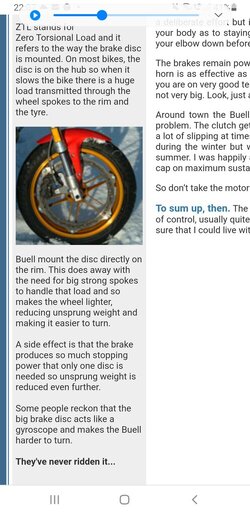
Saw a couple of Buells yesterday at the Bike Shed show...you may recall they use a single rim mounted disc. Looks funky...is there an advantage to that design? As far as I know nobody else uses it?Ha!! Dead right Cam. I should have said rotating mass - or maybe just left it at 'smaller dia gives reduced steering input (if weight doesn't increase)'. If you transfer all the weight from a hub to the rim you'll certainly notice an increase in steering effort but no drop in unsprung weight (reciprocating mass). I think you get the idea.
You better not think I let that go through to the keeper, been out riding that still harsh feeling bike. 2 things, the tyres I use are Radials, Bridgestone T32 that are designed for higher pressures plus I weigh a lot so 40 psi works for me. I tried lower pressures, 34 and the bike tram tracks to an uncomfortable amount, following longantutanial road marks. My new word for the day. I am just about sick to death of playing around adjusting the new shocks on actual big rides with other people than I don't want to impact on and chasing my tail. I need to find a day and a bloody bumpy road, set the shocks up so they're hard on compression and back that off till it's just off bottoming and put it to bed. I am seriously also thinking of making inquiries with the distributor as to what spring rate was installed when I bought them. There seems to be a lot of bottoming happening with limited changes to that with compression damping adjustments, and that should not happen.isn't 40psi a bit high, Vince? No wonder your suspension always feels harsh...
Found this..sounds like its more postive than negative Clem...You better not think I let that go through to the keeper, been out riding that still harsh feeling bike. 2 things, the tyres I use are Radials, Bridgestone T32 that are designed for higher pressures plus I weigh a lot so 40 psi works for me. I tried lower pressures, 34 and the bike tram tracks to an uncomfortable amount, following longantutanial road marks. My new word for the day. I am just about sick to death of playing around adjusting the new shocks on actual big rides with other people than I don't want to impact on and chasing my tail. I need to find a day and a bloody bumpy road, set the shocks up so they're hard on compression and back that off till it's just off bottoming and put it to bed. I am seriously also thinking of making inquiries with the distributor as to what spring rate was installed when I bought them. There seems to be a lot of bottoming happening with limited changes to that with compression damping adjustments, and that should not happen.