Valve clearances

russo011

Senior member
Location
Austria
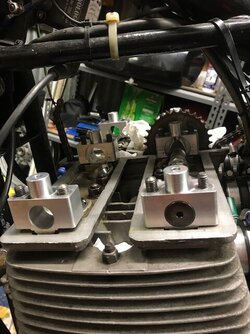
Waiting for parts I've ordered for the new to me 1000 3CL (1976) - I thought I'd remove the cam cover and check the valve clearances. From the info I have:-
Laverda mini-book: inlet 0,20 / exhaust 0,25
Laverda owner's manual: inlet 0,25-0,35 / exhaust 0,25-0,35
Laverda workshop manual: inlet 0,20 / exhaust 0,25
So overall I am assuming: inlet 0,20 / exhaust 0,25 is correct, measuring the clearances I found something odd.
Taking the clearance with the cam lobe directly opposite the bucket (as valve clearance pic 04) I recorded the following:-

EXHAUST (1) 0,24 / (2) 0,11 / (3) 0,20
INLET (1) 0,26 / (2) 0,16 / (3) 0,20

Then I measured the clearance at various other points between the cylindrical part of the lobe and the bucket (as valve clearance pic 01) with the maximum clearances recorded as follows:-

EXHAUST (1) 0,26 / (2) 0,21 / (3) 0,27
INLET (1) 0,21 / (2) 0,18 / (3) 0,21

The biggest is on the exhaust on No.2 cylinder - is this a Laverda thing? Or does anyone think there could be a wear issue somewhere?
From the receipts I got with the bike, it seems the piston rings, cam-chain, cam-chain guides,, primary chain & oil pump were all exchanged less than 3,000 kms (2,000 miles) ago and quiet honestly the motor sounds sweet. Should mention that I have not been out for a any kind of run on it yet as the registration is still pending.

Anybody got any thoughts or advice?

By the way I was hoping to find A4 cams installed (wishful thinking) but they are the standard model A11.
 

Attachments

  • Valve-clearance_04.jpg
    Valve-clearance_04.jpg
    102.4 KB · Views: 143
  • Valve-clearance_01.jpg
    Valve-clearance_01.jpg
    109.4 KB · Views: 135
Triple experts will be along shortly, but when we used to do Kawasaki DOHC Z model two-valves we would check clearance with neighbouring cam lobes in a position to effectively apply upward pressure on the camshaft, thereby accounting for the (minimal) play between cam and bearings. It definitely made a difference.
 
Triple experts will be along shortly, but when we used to do Kawasaki DOHC Z model two-valves we would check clearance with neighbouring cam lobes in a position to effectively apply upward pressure on the camshaft, thereby accounting for the (minimal) play between cam and bearings. It definitely made a difference.
Yep. The triples also have quite generous clearance in their bearing blocks. I use a tool to depress the cam when measuring, to be on the safe side. The cam chain will pull the cams downwards with the engine running, quite useless to measure clearances with un-loaded cams in an old engine. things are slightly better with new bearings, but judging from Russ' photo, those are the grand-daddies of cam bearings...

piet
 
Yep. The triples also have quite generous clearance in their bearing blocks. I use a tool to depress the cam when measuring, to be on the safe side. The cam chain will pull the cams downwards with the engine running, quite useless to measure clearances with un-loaded cams in an old engine. things are slightly better with new bearings, but judging from Russ' photo, those are the grand-daddies of cam bearings...

piet
Mmmmm....... crush city!
 
By the way I was hoping to find A4 cams installed (wishful thinking) but they are the standard model A11.

just small correction: what you mean are 4/C cams. A4 never existed. 4/C give a bit more midrange torque and even top end power in exchange for some very low end grunt. For touring around the city or in the mountains, A11 are not a bad choice. If you want top speed and ride the bike more between 3.000 and 5.000, 4/C can give you that extra punch in that area.

But please consider that every change on the engine might consequent in other necessary steps to get what you want to achieve... Went through it 2 times, nice experience but it also gets you addicted to always more power... and better suspension.... and better handling... and better.... - you know what I mean I assume? Nothing wrong with that path if you really want it. Just be prepared for it if you want to go down that route... ;)
 
just small correction: what you mean are 4/C cams. A4 never existed. 4/C give a bit more midrange torque and even top end power in exchange for some very low end grunt. For touring around the city or in the mountains, A11 are not a bad choice. If you want top speed and ride the bike more between 3.000 and 5.000, 4/C can give you that extra punch in that area.

But please consider that every change on the engine might consequent in other necessary steps to get what you want to achieve... Went through it 2 times, nice experience but it also gets you addicted to always more power... and better suspension.... and better handling... and better.... - you know what I mean I assume? Nothing wrong with that path if you really want it. Just be prepared for it if you want to go down that route... ;)
Yep my mistake, I meant 4C cams, your right though; chasing modifications for improvements is a never ending story. :)
 
Triple experts will be along shortly, but when we used to do Kawasaki DOHC Z model two-valves we would check clearance with neighbouring cam lobes in a position to effectively apply upward pressure on the camshaft, thereby accounting for the (minimal) play between cam and bearings. It definitely made a difference.
So I tried once more with the "loaded" cam as far as possible either side of the measured valve clearance and got the following results:-
EXHAUST (1) 0,26 / (2) 0,22 / (3) 0,26
INLET (1) 0,30 / (2) 0,21 / (3) 0,21
Comparing to the previous measurements exhaust on cylinder 2 and inlet on cylinder 1 show the biggest differences, my way of thinking is that these clearances will be pretty close to the measured values under running conditions with the camshaft being pushed upwards in the bearing blocks by the open valves. So it seems the only ones to give cause for concern are exhaust 2 and inlet 1 which are below and above recommended clearances respectively.
I assume the only way to tighten up the effect of lifting camshafts is to replace the camshafts and bearing blocks themselves, to be honest though I just want to ride the bike to see how it feels before carrying out any major work.
 
I am going to tag onto this - clearances on my 74 triple are 0.25 on all exhaust valves but just slightly under 0.20 on all inlet valves - 0.15 is very loose. Now the Green Book says 0.15 is okay for racing or short periods - that's a bit vague... What are short periods? I only do very grandfatherly riding nowadays and I don't ride when it's super hot outside - should I just leave it for now?
 
I am going to tag onto this - clearances on my 74 triple are 0.25 on all exhaust valves but just slightly under 0.20 on all inlet valves - 0.15 is very loose. Now the Green Book says 0.15 is okay for racing or short periods - that's a bit vague... What are short periods? I only do very grandfatherly riding nowadays and I don't ride when it's super hot outside - should I just leave it for now?
0.15 is tight not loose, you're not going to hurt it, but I'd keep an eye on it
 
Smaller clearances for racing? Yoshimura specified 0.05mm more clearance than standard as it showed a slight increase in power. I have always set clearances optimally to the high side of spec. You can by all means run at minimum, but as said keep an eye on them. In russ011´s opening post he quotes from his ´76 3CL owners manual 0.25 to 0.35 inlet and exhaust, we had the same figures at Stanco from factory literature at that time as well. The practice then was to find the largest clearance over the base circle, as even a few degrees crank rotation gave varying readings so it was not really viable to use TDC.
 
Smaller clearances for racing?
Yeah, I was a bit puzzled...
From the Green Book:

The clearances should be 0.20 - 0.30 mm for both inlet and exhaust. The exhaust can run at 0.35 mm but will become noisy above this. For racing or short periods, the inlet can be run at 0,15 mm.
I don't know much about race engines, but I thought the clearances would actually be a bit bigger because noise and longevity are not as important and the engine will run hotter. But waddaiknow....
 
It's all about keeping the inlet valve open for as long as possible. 0.10mm less clearance can make a difference of maybe 10° or more at the crank, depending on cam profile.

As the standard shim sizes rarely allow a precise adjustment, the tolerance is 0.20-0.25 inlet, 0.25-0.30 exhaust. Shims can of course be ground to size but they should remain parallel/square to the valve stem, not much use going at them with an angle grinder.

piet
 
Russ, Piss them cheese cam blocks off, and get a new billet set from Redax.....😉 money well spent!
 

Attachments

  • 63A06D22-8C7E-43C8-AB3B-5FC0BC58116A.jpeg
    63A06D22-8C7E-43C8-AB3B-5FC0BC58116A.jpeg
    158 KB · Views: 70
  • E6D2E227-F4F6-4A35-9F13-207ED6F8389F.jpeg
    E6D2E227-F4F6-4A35-9F13-207ED6F8389F.jpeg
    75.6 KB · Views: 69
  • FDE668C2-34ED-4637-8B1D-2A946FD5B09A.jpeg
    FDE668C2-34ED-4637-8B1D-2A946FD5B09A.jpeg
    144.6 KB · Views: 71
I use a glass top to have a really flat surface. No picture with a shim at hand.
You've got too much time on your hands... ;) Surface may well be flat, but the small rubbing area doesn't ensure it will remain parallel/square when moving the shim manually.

Quick and easy process on a valve grinder.

piet
 
The practice then was to find the largest clearance over the base circle, as even a few degrees crank rotation gave varying readings so it was not really viable to use TDC.
It's only been in comparatively recent years - say since 2000 - that I've found cams in Italian made bikes with concentric base circles.
It needed an upgrade and investment in machinery to achieve reliably accurate cam profiles.
That may offend some - but it's my experience.
 
Back
Top