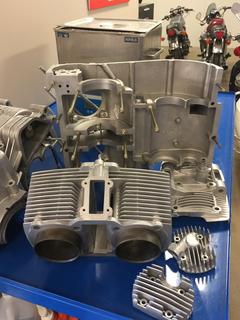
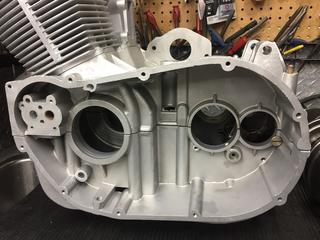
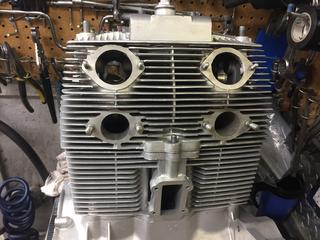
Vapour blasting head and barrels.

Spider Wales

Hero member
Not having had any experience of vapour blasting, (only with dry bead/sand blasting 30 odd years ago) what areas of the head will I need to mask, or ask the blaster to mask, on a triple head? I am assuming guides, cam follower bores, but any advice will be gratefully accepted.
I realise that both items will need a thorough clean, (including all threads) to remove any abrasive residues after it's all done.
WSY Gents?
 
Whatever you decide to mask, do it yourself. Don't rely on the blaster guy to do it for you.

To mask valve guides, just put M6 bolts through them, or threaded rod with a nut and washer each end. For cam follower bores, you might have to make up wooden or plastic plugs for them. I don't know whether that would be necessary though. Vapour blasting isn't as aggressive as sand or dry bead media. I'd also be inclined to insert bolts or bits of threaded rod into any threaded holes too, just to protect the threads and stop any blasting media getting stuck in there.
 
I'd simply insert screws in any threaded holes. It's a pita to have to chase all the threaded holes post blasting. Block any oilways too.

Not necessary IMO to mask valve guides or cam follower bores.

But one thing I've noticed on the last two heads I've had done. The exhaust valve seats came back with visible pitting.
I suspect it was there anyway - but the vaporblasting has removed the carbon packed into the pits.

I pressure wash with warm soapy water, blow dry and pressure wash with solvent. Don't leave the parts sitting on return from blasting,
There'll be a small heap of white fine abrasive slowly fall out over time.
 
I do the same as Greg, well almost, screw something into any female thread and that's it, spark plug threads included, but on return to home, I place the item in a warm spot, radiator, hot tank etc, to thoroughly dry, then I blast every little nook and cranny with a 150PSI air line, turn a tap into every thread and use the air while going in and out with the tap, next I pressure wash with warm soapy sudsy water, and let dry again, one more blast with the air and then run it through the dishwasher, best with no salt, but that is not easy to arrange, so wash under the shower head with warm water immediately on removal from the d/w, lastly wipe some clean engine oil over the cast skulls, and tappet bores (if a very early iron lined type)
CLEM
 
I try to avoid blasting any interior surfaces of engine cases.  Vapour blasting might prevent blasting media from embedding itself in soft alloy, but that's certainly not guaranteed!  Combustion chambers and exhaust ports are no problem, anything stuck in there is quickly blown out the window.  Very different matter where oil circulates.

The chioce between dry or vapour blasting is basically a matter of finish quality.  In any case, lots and lots of cleaning is required, when you think you're done, go over it once more... or twice.

piet
 
sfcpiet said:
I try to avoid blasting any interior surfaces of engine cases. 

piet

Yes, so do I. I was somewhat pissed off recently. I had assembled a set of Honda single cases to be vaporblasted by a friend who has set up a small business at home vaporblasting. He did a better job than I required as he disassembled the cases and did the interior as well...

He apparently felt it was necessary as he wants me to correct the excessive endfloat on his GS1000S cams.
 
I don't know what you lot are worried about with sand  blasting the insides, were they not cast in sand in the first place?
cleaning is the key here though, if you can drop a fried egg on it and then pick it up and eat it, Robert's your father brother!
CLEM
 
Hello all, I started a new business doing vapour blasting a while ago in the UK, originally it seemed like a good idea for my own restorations and preservations but quickly developed into doing work for all types of machine restoration and component prep'

The key to to this is the blast media, my go-to material is glass, which produces an excellent bright finish but most importantly, it does not affect the base material or make any dimensional change. I regularly do heads, pistons, carbs, barrels whatever need doing. I always use an ultrasonic cleaner for carbs after blasting. The only time I am very cautious is oil galleries, if you can get at them after blasting by blowing them through then it's not too bad, sometimes this is not possible

I am so impressed with my cabinet I bought from the USA, I am now the UK supplier of their equipment. Just in case anyone is interested, my manufacturer (Vapour Honing Technologies) do a small "hobbyist" version that does not need a big compressor, the Benchmate unit just uses a small portable unit that you may already have.

My cabinet is a large industrial version. I have been asked to blast complete engines but my experience has taught me that this it not the best idea, I know one of our gang has done this by making blanking plates up for the inlet and exhaust ports. My problem is that the base of the cabinet is a perforated synthetic sheet not realyy strong enough to take heavy mechanical loads. I wouod also be concerned about blast medioa getting past lip seals (gearbox mainshaft) I would not hesitate to vapour blast engine internals but as you all realise, cleaning is crucial, if you have alook at my website www.vapourhoning.co.uk you see plenty of examples. I have attahced a single pdf file showing images of my latest restoration, an early SF750. The bike and in particular engine were in a very shabby state, most of the engine had been painted, it is now overhauled and every item was vapour blasted. If you need any help or advice just ask. You can also have look at the manufacturers website in the states which has some excellent information www.vapourhoning.com 

If nothing else, vapour blasting will enable you to get down to the base material for inspection, measurement and testing. The process is very gentle (using glass) and canbe used on mating surfaces, it is so gentle it will not remove stuff like jointing compounds as they are generally synthetic so the glass simply bounces off
For more agressive work or coating pre-treatment we change the blast media to material such as Alluminium Oxide, ceramics or even Garnett - NEVER USE THESE ON INTERNALS OR JOINT FACES. These more abrasive medias are great for removing factory applied coatings, even powder coating but they are very aggressive and will not produce a polished finish, a matt finish is generally acheivable

I have even used glass media on plastics and GRP mouldings, one of the applications we are looking at is de-burring 3d printed components so as you can imagine, this is not an agressive process

Just one warning, dont forget that after blasting you are left with a surface without any contaminents or surface protection, oxidation will commence immediately, alluminium will tarnish quickly so protect your parts. I use an aicraft industry grade aerosol lube on engine parts, it is very expensive but goes a long way and works very well. Obviously if you are going to paint parts following blasting, just get them primed quickly. I also use sealed bags and squash as much air out of the bag as possible

Hope this helps
 

Attachments

Fitz,

thanks for a good description of what you do.
In every case it comes back to the operator. Choosing one with experience can save heartache and time.

Red taught me many moons ago, after bead blasting engine main castings.  Tap all threaded holes, then power wash, flush, wash, flush and so on, but don't take longer than half the bloody day!  Seemed to work fine.
 
I have a vapour blaster in my shop, I use fine glass bead (#7), you don't have to mask anything off as the process will not damage alloy, cast, carbon steel, brass or even plastic. If you do not plug blind threaded holes with an old bolt you will spend a little more time cleaning out any glass bead residue. I suggest that regardless of plugging blind threaded holes all should be cleaned with a bottom tap after cleaning and flushing.
I have had my vapour blaster for about four years now and it is without question the very best shop tool I have ever purchased. I use it almost every day to clean almost anything I am working on while carrying out restorations. Vapour basting will not damage brass, bronze or steel bushes, bearings races etc, it is absolutely safe.


Thank you for all of your comments and advice Gents, my parts are now at the Engineering Shop for blasting. Hopefully they will come out ok.
The next flurry of questions will appear here soon, but better to be a PITA and get advice than fuck things up right Royally! :)
 
Back
Top