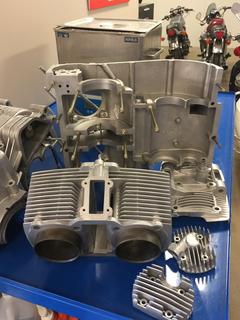
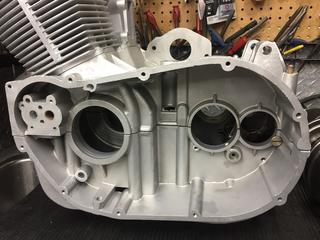
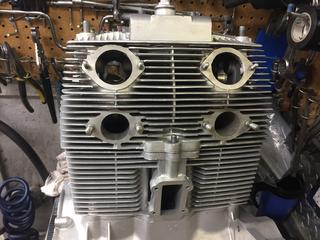
Hello all, I started a new business doing vapour blasting a while ago in the UK, originally it seemed like a good idea for my own restorations and preservations but quickly developed into doing work for all types of machine restoration and component prep'
The key to to this is the blast media, my go-to material is glass, which produces an excellent bright finish but most importantly, it does not affect the base material or make any dimensional change. I regularly do heads, pistons, carbs, barrels whatever need doing. I always use an ultrasonic cleaner for carbs after blasting. The only time I am very cautious is oil galleries, if you can get at them after blasting by blowing them through then it's not too bad, sometimes this is not possible
I am so impressed with my cabinet I bought from the USA, I am now the UK supplier of their equipment. Just in case anyone is interested, my manufacturer (Vapour Honing Technologies) do a small "hobbyist" version that does not need a big compressor, the Benchmate unit just uses a small portable unit that you may already have.
My cabinet is a large industrial version. I have been asked to blast complete engines but my experience has taught me that this it not the best idea, I know one of our gang has done this by making blanking plates up for the inlet and exhaust ports. My problem is that the base of the cabinet is a perforated synthetic sheet not realyy strong enough to take heavy mechanical loads. I wouod also be concerned about blast medioa getting past lip seals (gearbox mainshaft) I would not hesitate to vapour blast engine internals but as you all realise, cleaning is crucial, if you have alook at my website www.vapourhoning.co.uk you see plenty of examples. I have attahced a single pdf file showing images of my latest restoration, an early SF750. The bike and in particular engine were in a very shabby state, most of the engine had been painted, it is now overhauled and every item was vapour blasted. If you need any help or advice just ask. You can also have look at the manufacturers website in the states which has some excellent information www.vapourhoning.com
If nothing else, vapour blasting will enable you to get down to the base material for inspection, measurement and testing. The process is very gentle (using glass) and canbe used on mating surfaces, it is so gentle it will not remove stuff like jointing compounds as they are generally synthetic so the glass simply bounces off
For more agressive work or coating pre-treatment we change the blast media to material such as Alluminium Oxide, ceramics or even Garnett - NEVER USE THESE ON INTERNALS OR JOINT FACES. These more abrasive medias are great for removing factory applied coatings, even powder coating but they are very aggressive and will not produce a polished finish, a matt finish is generally acheivable
I have even used glass media on plastics and GRP mouldings, one of the applications we are looking at is de-burring 3d printed components so as you can imagine, this is not an agressive process
Just one warning, dont forget that after blasting you are left with a surface without any contaminents or surface protection, oxidation will commence immediately, alluminium will tarnish quickly so protect your parts. I use an aicraft industry grade aerosol lube on engine parts, it is very expensive but goes a long way and works very well. Obviously if you are going to paint parts following blasting, just get them primed quickly. I also use sealed bags and squash as much air out of the bag as possible
Hope this helps