Weaving Jota

From times past, this issue earned one of my triples the nickname "The Weaver", as it was so persistent coming on.

Many were the observed concurrences that brought it on. Would describe more akin to an increasing oscillation front to back when brought on. Have to have wheel alignment as a top of list check process. Straight edge ( different tyre width to be allowed for ) with side stand clearance ( if no assistance to hold the motorcycle up ), then the usual suspects as the lads here proffer. j
Thanks, I will try to make up a specific straight edge
 
If cracks are there they are where the lower pipes meet the headstock.
Do the triple clams move easily without any restpoint?
Here is a pic from Red (Redax) of a bike that he has safed. Not sure it was due to normal cracking or an accident involved, but it shows the area where the cracks tend to happen (well hidden behind the tank normaly):

https://laverdaforum.com/proxy.php?image=https%3A%2F%2Flive.staticflickr.com%2F65535%2F52619141328_aed9bf7311_k.jpg&hash=0ebe0648b2f50c0eab988d7ad44ac7d4

HTH

BTW: friend of my brother had a 3C I think many moons ago. He had a cracked frame and did weld it unprofessionally. He bought another frame (back then in the 80's still available...) because he did not like that the bike now "rides like a Honda"... ;)
 
Yes the headstock moves freely. It will drop to the limit on either side.
Means nothing. The whole fork/wheel assembly is so heavy it will still easily move with a too tight steering bearing.

Check for a "centre-positioning" of the forks, ie, notched bearings. Hard to detect with wheel fitted, easier once wheel is removed. If this is the case, the bearings are shagged and should be replaced.

Triples like their steering bearings adjusted on the loose side, just off rattling. The slightest notion of notching will throw straight-line stability out the window.

piet
 
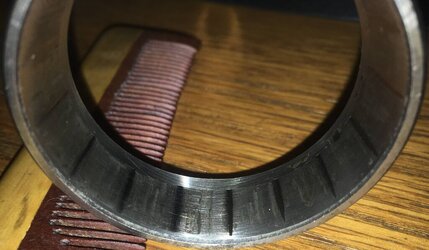
What "notching" looks like:

View attachment 89124
Is that your comb Hamish?.......I would have thought you were more of a Brush man! :giggle:
That’s a bearing shell anti-rolling device, which doubles as a Brylecream applicator, or in this case, a grease applicator.

I’ve been using hair brushes for +40 years.

Misplaced my long term one, my wife came back from the shops with a bearing shell anti-rolling device. I near took my scalp off with it the first time I used it. Sort of forgot how to use it.
 
What Piet said - I was going to suggest a loose adjustment of the steering head bearings trial but Piet beat me to it. The only way to really feel for notches is to remove the wheel and forks. ANY notchiness will manifest as a wobble if the conditions are right (and triples an certain tyres seem to be those 'conditions'). I adjust the bearings so play disappears - then a TINY bit more tension.
 
On the Jota, we used a roller bearing on the top and a conical needle bearing on the bottom of the headstock and then do the top nut just so the lower bearing seats itself, no big force on the nut. The thoughts that went into that setup are, that the forces going into the lower bearing are more along the lines of the headstock (which the conical needle bearing takes well) while on the top, we thought it's more like 90° to the headstock, which a roller bearing can take much better than a conical needle bearing.

Some use two conical needle bearings, which might be a bit harder to adjust, especially if the headstock is not 100% round (which might squeeze the seat of that bearing a bit).

The steering is brilliant on that bike with all the other modifications. By far the best handling street legal and registered Laverda I have ridden. Almost 50.000km with that setup and no negative change in the steering, handling, no notches anywhere and the adjustment was really easy.

Oh - and I am using a fork brace, which also - on my bike at least with it's plastic mudguard - was an improvement.
 
On the Jota, we used a roller bearing on the top and a conical needle bearing on the bottom of the headstock and then do the top nut just so the lower bearing seats itself, no big force on the nut. The thoughts that went into that setup are, that the forces going into the lower bearing are more along the lines of the headstock (which the conical needle bearing takes well) while on the top, we thought it's more like 90° to the headstock, which a roller bearing can take much better than a conical needle bearing.

Some use two conical needle bearings, which might be a bit harder to adjust, especially if the headstock is not 100% round (which might squeeze the seat of that bearing a bit).

The steering is brilliant on that bike with all the other modifications. By far the best handling street legal and registered Laverda I have ridden. Almost 50.000km with that setup and no negative change in the steering, handling, no notches anywhere and the adjustment was really easy.

Oh - and I am using a fork brace, which also - on my bike at least with it's plastic mudguard - was an improvement.
A taper bearing at the bottom is standard practice.
The bearings tend to seat themselves after a few kilometres and a few bumps.
Then you correctly tighten the nut.
Paul
 
that's for sure, Paul, I was more talking about the roller bearing at the top compared to some that use a taper bearing at the top, too.

BTW: on the Vespa of my wife, we had exactly that problem, too. Bike was really hard to steer and when the TÜV guy checked on the bearings (by putting the scooter on the center stand, press the rear down so the front lifts and can flap to one side), the front did not move on it's own!

He suggested the bearing is shot (which is an open roller bearing on the vespa on the lower end of the headstock) or better: the seat had marks/notches and I shall replace it to get the MOT. I went home, took the front apart and found - grease that felt like sticky wax!

I cleaned everything with a break cleaner fluid, checked the rollers and the seat (as the scooter had only done 6.000km in 30 years, I was sure the seat and rollers are good) and found them to be spotless. I put new grease into the bearings and the seat, mounted everything back together and - voila! - the scooter handled completely different and passed the MOT without any issue!
 
Last edited:
Me either but gone to taper bottom and caged ball top - reckon it is lower 'stiction'.
Same here...

Nothing at all wrong with the ball at the top. Angular contact ball MAY be an improvement, but probably negligable. I find the tapered bearings tend to notch a lot quicker.

I've just changed the head bearings in my Matchless, uses the exact same sizes as the Laverda! Seems Plumstead swapped to metric in certain areas shortly before they closed down. Anyway, I originally fitted the tapered/ball combo, now replaced that with angular top and bottom, just to find out how they perform. Feels nice, weather has prevented a prolonged road test.

piet
 
Back
Top