Weird

Diode test to duff RR
Red probe to earth
Black probe to each phase, 2 showed 0.48 and the other -0.002 so that explains it but a couple of weeks ago it checked out OK. Is why I reinstalled it and brought a new stator.
Hopefully they're just duff RRs and not being cooked by something.
The new one from Red isn't a SH530 but wouldn't have thought it would fail so soon.
As the active AC DC test proved, shorted diode, upper diode in U phase, when the U phase AC voltage reverses polarity the lower U phase diode shorts out the U phase output voltage and it collapses to a silicon diode forward voltage conduction ( avalanche ) potential ie around 0,6 to 0,7Vdc. The U phase 13V on DC was a shorted diode to battery positive, that was the clue. Your the man now Rob, Laverda master electrician certificate is on its way....j

+ probe to battery +
DC U 13 V 8.7 W 8.5
AC U 0.68 V 7.5 W 7.5
 
Morning John,
Very happy that this issue is resolved but still not confident the replacement RR will go the distance.
Could have been coincident that Red's RR failed and the original RR failed..
The original must have failed first showing 13.7 so replaced it with one from Red. but when dioded testing it showed the same numbers as the replacement SH530 where as Red's definitely showed it failed. Is why I refitted the original. Then the Duetsch plug issues resolved with terminal block saw 14.5v then out of the blue back to 13.3 and all those dodgy numbers from the various tests.
Will ride the Motodd to Perth next w/e, fingers crossed the RR will get me there and back, about 1000kay round trip.
Don't like not knowing the cause of a problem. It's been a learning curve for sure.
Thanks for all your help.
 
All noted Rob, after pondering ( ponder, wonder if you should have a pond to ponder...quizzical look ), perhaps the intermittent Deutsch plug was causing rapid collapse of drawn stator current leading to back EMF spikes punching through the diodes inside the now damaged RR's. Little else to cause diode failure, i have never had or seen a nuked SH530 going back to early 2000's.

Maybe in your travels to pickup a known good spare SH530 would be wise, mean you can now diagnose a faulty charge system in less time than to drink a tea... out of the bad comes the good.... sure others will have a fighting chance now for difficult charging system diagnosis..... my pleasure in assist j.
 
but still not confident the replacement RR will go the distance.
I understand your concern, keep the voltmeter on your dash and pack a charger 👍

perhaps the intermittent Deutsch plug
Makes sense John, to my coarse understanding. It’s always more comforting to have some reason for a failure, and certainly the rest of us ran out of ideas ages ago 😁
 
As you indicate Andy, attributable reason is good practice, used to hack open a failed semiconductor and view with a microscope the wafer for type of damage, what they call "Hockey Puck" SCR's, 1500V at up to 2kA, you could actually see if the damage was over current or over voltage for the removed failed item, write up a report and hand it on to company management, ours and customer. A "dunno" why the equipment failed is not going very far with large financial organisations/data centres and Stock Exchange. Seen other engineers do similar with failed batteries and mechanical failures. Keeps the confidence high. Tah for the comments Andy... warm here today...luxury! Even started the 79 Jota, what a racket....grin..j
 
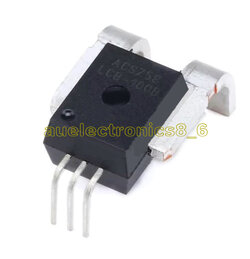
For Cam mostly, here is the Allegro device i mentioned, senses bidirectional current, various ratings. Constitute a meaningful charging system monitor, has advantages over battery voltage monitoring... j.
1663559728546.jpeg
 
Ooh, now we're getting somewhere. That's a nifty little device. Yeah, it's current we want to sense rather than voltage. I didn't know such a thing existed.

I can think of a bunch of uses for a current sensor. One application that comes to mind is to use in my boat's wiring to indicate a blown navigation light bulb. Sometimes it's difficult to tell if a masthead light is working when looking at it from the deck.

I tried to build a current sensor for that purpose many years ago by wrapping a bunch of turns of the current-carrying conductor around a reed switch (my brain is OK with electro-mechanical stuff but doesn't do electronics). It worked but wasn't sensitive enough for what I was trying to achieve. More wire turns would have made it too bulky. Thinner wire in the coil would have increased resistance in the conductor I was trying to measure. In the end it became another abandoned idea.
 
Ok Cam, there is a smaller device from TI, TMCS1100 rated to 30amps through current rating, the prior item from Allegro can be up to 200Amps. Your mast head lamp monitor could be as simple as an LDR/Led coupler, easy if an incandescent lamp, bit more complicated if a LED on the mast head. You had the right idea for magnetic field for sensing....HTH J.
 
Oh, is a little CT??
Rowdypat, Similar, has a through low impedance circuit with adjacent hall effect sensor and buffer scaling circuitry. Be fun sorting out a proper ( in the days ) dash ammeter, battery voltage is only a lesser part of a battery charging system, current more so...

Noticed on ebay a range of adaptable ammeter and readout display items based on hall effect ( DC ) monitoring. Think the vibs on a bike would kill the displays in short order...

HTH j
 
Your mast head lamp monitor could be as simple as an LDR/Led coupler,
If you mean an LDR to look at the light globe, then that would mean running more wires to the masthead. That job would involve de-rigging the mast, which would be more trouble than it's worth. I'd be more keen on something that detects current at the switchboard. Nav lights are incandescent globes at present, so they pull a couple of amps, but I might change to LED at some stage, which would mean a significantly reduced current, requiring a more sensitive CT. I may never do anything but it's an interesting idea to ponder.
 
If you mean an LDR to look at the light globe, then that would mean running more wires to the masthead. That job would involve de-rigging the mast, which would be more trouble than it's worth. I'd be more keen on something that detects current at the switchboard. Nav lights are incandescent globes at present, so they pull a couple of amps, but I might change to LED at some stage, which would mean a significantly reduced current, requiring a more sensitive CT. I may never do anything but it's an interesting idea to ponder.
This reminds me of the swing mounted on a tree, what i was indicating a series resistor with masthead light, developing enough voltage to light a LED and if remote signalling elsewhere an LDR which would drive an active circuit for state of masthead lamp...oh dear we could not be further apart Cam, which department are you from.... much laughing here....j

1663645668993.png
 
If you mean an LDR to look at the light globe, then that would mean running more wires to the masthead. That job would involve de-rigging the mast, which would be more trouble than it's worth. I'd be more keen on something that detects current at the switchboard. Nav lights are incandescent globes at present, so they pull a couple of amps, but I might change to LED at some stage, which would mean a significantly reduced current, requiring a more sensitive CT. I may never do anything but it's an interesting idea to ponder.
Perhaps use TWO nav lights each side, for redundancy. You could even wire them separately. Or use a ring mains approach. LED lamps should inherently be more reliable than incandescent ones due to greater ruggedness and lower operating temperature.

cheers,

bazzee
 
Perhaps use TWO nav lights each side, for redundancy. You could even wire them separately. Or use a ring mains approach. LED lamps should inherently be more reliable than incandescent ones due to greater ruggedness and lower operating temperature.

cheers,

bazzee
I wired up my nav lights on one circuit, so if one stops, both stop. I figure if one stops that would be confusing (not only to others, but also me)………. and I’d motor around in circles all night long. What??
 
Back
Top