What did you do to or for or with your Laverda today?

Went to the TÜV station to get the drummer certified as historic - had endless discussions about procedure and tech details - the number on the handlebars was misspelled in an older certificate. There were also discussions about the drum brake, because the TÜV guy wanted a certificate for stainless steel brake line - I had to explain that this was a brake cable - hence no certificate.... Then he rode the bike - when he came back it was stuck in gear. Haben't gotten it free yet. The when I got it out of the van it slipped off the plank and got a dent in all three downpipes. Anybody want a non shifting drummer with dented downpipes? 🤬
 
Never go to the TÜV, they just look for mistakes orbthey create some to influence their statistic that the old items are not safe. They work together with the politicans and the car industry to improve the busines of new products, There are better certifiers here like KÜS, you have to know who is specialised in old bikes in your area.
When I got a certaificate for my 1000 SFC as a historical bike for a so called 07 no. it just needs 10 minutes and 24 €.
 
Found and fixed my annoying intermittent fuse blowing on the Eagle.
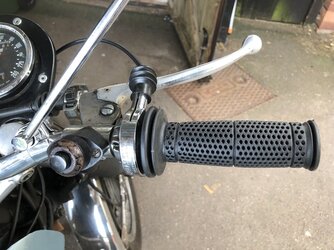
Never happened while riding and only started recently. On the odd occasion it would blow either pulling up somewhere or trying to start off. Never could get it to replicate so started looking at anything dodgy (Surely not on 50+ year old wiring!!) . As I was investigating happened to just lean on the handlebars and bang. So obviously shorts when handlebars turned at a certain point. Turns out one of the horn wires had a very small worn spot through the insulation which was shorting when bars turned and you didn't hold your tongue right. The plastic sheath over these wires (2 horn wires and Earth wire for lights) was very hard and cracked which didn't help and also limited flexibility.
Pulled the whole lot out, cut off old sheath, put some heat shrink over wear spot and put wires in new braided sheath. (I know, there's goes originality, just don't tell anyone;) )
 
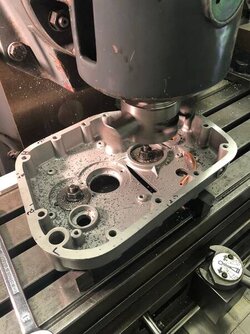
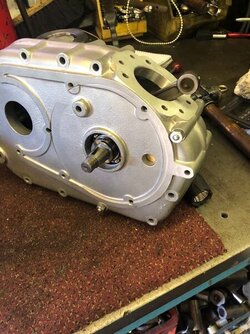
Started work on my 75cc engines after an enforced layoff. I'm not safe with anything more complicated than a wire brush tbh, so my local engineer is doing "stuff" whilst I look on in awe. Crankcases have been skimmed, decked and machined for a brand new cylinder liner (bespoke from Westwood liners). Rebuilt crank fits a treat.
 

Attachments

  • Case skim 75.jpg
    Case skim 75.jpg
    48.9 KB · Views: 28
  • Crank fit.jpg
    Crank fit.jpg
    52 KB · Views: 29
Last edited:
Started work on my 75cc engines after an enforced layoff. I'm not safe with anything more complicated than a wire brush tbh, so my local engineer is doing "stuff" whilst I look on in awe. Crankcases have been skimmed, decked and machined for a brand new cylinder liner (bespoke from Westfield liners). Rebuilt crank fits a treat.
Nice work …
 
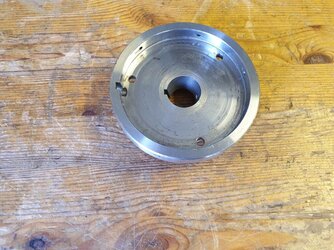
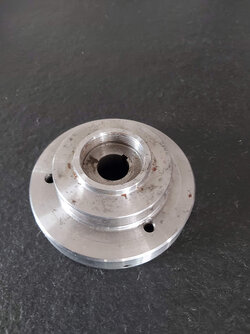
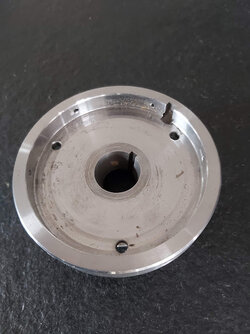
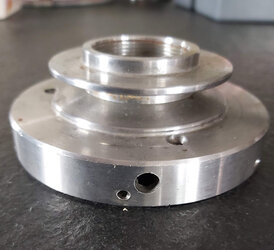
Received my ebay NOS 750 starter freewheel last week.
Very pleased with that.
Note the 6 lube holes dispensing with dismantling the thing every few years to lube it.

Paulebay 1.jpgebay 2.jpgebay 3.jpg
 
très bon, mais n'est valable que si les chapeaux de poussoirs sont percés, la courroie dynamo risque de ne pas être appréciée.
 
très bon, mais n'est valable que si les chapeaux de poussoirs sont percés, la courroie dynamo risque de ne pas être appréciée.
Avec de l'huile fluide, je passe un coup de 3/1 de temps à autre, nulle besoin de poussoir percé, ça passe sur le côté du poussoir. Comme je te l'ai écrit ailleurs, la courroie reste sèche. Le lubrifiant est centrifugé, donc pas vers le courroie. J'ai 3 motos ainsi équipées sans problème depuis 30 ans et plusieurs centaines de milliers de km. Je n'ai jamais eu de problème de roue libre ni de courroie avec un 750.
Paul
 
Received my ebay NOS 750 starter freewheel last week.
Very pleased with that.
Note the 6 lube holes dispensing with dismantling the thing every few years to lube it.

PaulView attachment 65697View attachment 65698View attachment 65699
Quite the opposite, Paul.

The inner ramp ring has bungs in the bores for the springs, these will prevent much lube creeping through to the rollers. Centrifugal force will fling off any lube that might find its way inside...

I've never worked out for what the holes are really meant. They would be handy to remove stuck plungers, but the aforementioned bungs are in the way. Leave them out, the springs are too short.

Nice find nonetheless, becoming very rare.

piet
It must function nonetheless Piet. I squirt some 3 in 1 oil down the holes when I have the belt cover off and that sums up my freewheel maintenance on my two 750s that do about 10 000 km a year between them.

Paul
 
Reckon they were done by the factory (SF3?) to enable extraction of the oft stuck plungers - I was given one with several seized-in plungers - an hour on the lathe creating those holes and bingo, i got 'em all out easy peasy. I find it's usually the springs that give up the ghost first. Bits break off and eventually there's insufficient spring tension to keep the plungers in contact with the rollers for starting - you hear the rattle; once spinning centrifugal force eliminates that contact. So from my perspective, routine maintenance is more about spring replacement that anything else.
 
  • Like
Reactions: Jo
Back
Top