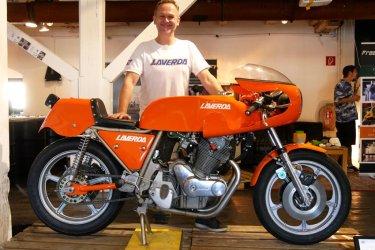
What did you do to or for or with your Laverda today?

Lee, I'd say you're on the track with the pickups. If these are Hall-type pickups, you might be able to check or a defect pickup by measuring voltage changes at the pickup wires, while cranking the hot engine over by hand. There should be a distinctive voltage decrease/increase reading on your multimeter at a certain point. If you have a constant voltage reading over an entire revolution of the crank, then most probably the respective pickup is at fault.
 
Gravelroad said:
Lee, I'd say you're on the track with the pickups. If these are Hall-type pickups, you might be able to check or a defect pickup by measuring voltage changes at the pickup wires, while cranking the hot engine over by hand. There should be a distinctive voltage decrease/increase reading on your multimeter at a certain point. If you have a constant voltage reading over an entire revolution of the crank, then most probably the respective pickup is at fault.

you will not get any reading at all by cranking the engine over by hand as the Ignitech box is programmed to not provide spark until one revolution is seen and no matter how fast you crank that engine by hand the box does not register the one revolution, I have tried in the past to do something similar
Lee would need to change the software setting to zero revolutions and reprogram the box to see a spark when turning the engine over by hand
 
Paul Marx said:
Check the inlet tracts in the head and let us know.

Paul
Ok Paul, have checked and presume you will not be surprised at result!
Inlet tract certainly measures app 27mm. Interestingly though, the insulating spacer is tapered and measures 29mm on carb manifold side reducing to 27mm head side, so I guess this was deliberate??
Comments welcome.
 
First time I've heard about that on the spacers. Deliberate? Maybe.

The inlets on my S were 27mm as well, but in view of the sporting pretensions of the machine, I opened them out.
Somebody more learned than I can certainly advise on your GT.

Paul
 
redax5 said:
you will not get any reading at all by cranking the engine over by hand as the Ignitech box is programmed to not provide spark until one revolution is seen and no matter how fast you crank that engine by hand the box does not register the one revolution, I have tried in the past to do something similar
Lee would need to change the software setting to zero revolutions and reprogram the box to see a spark when turning the engine over by hand

I totally agree, Red. But my intention was not to look for a spark, but to watch the pickup signal wires. With Hall type pickups, I'm pretty much sure the Ignitech will "listen", means it will power up the pickups and wait for a signal coming in, so there should be a notable voltage signal coming from the pickups when cranking over by hand. Won't work with the original inductive Bosch pickups, though. However, I would consider the Bosch series 1 pickups somehow as indestructible, once their brittle old wiring had been replaced with proper silicon insulated stuff.
 
Well changed trigger board last night I have a brand new ignition on the shelf, and now have no spark,put old triggers back on and have spark to 1-3 no spark on 2, same as before only now it's no spark on 2 even cold,what are the odds of having a brand new trigger board that is bad, this sucks as the bike ran so good, I want to ride it, is ther another test to confirm these are good or bad? like an ohms reading or something?
 
Lee, that erratic behavior sounds to me a bit like you have a loose contact somewhere. I'd recommend to unplug the multiple connector of the Ignitech and check all it's wires having continuity to their endpoints, especially the ones going to the trigger board and the ignition coils. I'd consider the loom section running through the engine case as most susceptible for possible damage.
 
I have checked all connections redid all earth connections, swapped main box ,no change, the only variance i have found is while cranking engine the trigger that is working starts a 4.1 volts and drops to 3.7 volts all the others stay at 4.1 volts,, stumped for now, Red is helping and I'm sure he'll find a fix..
 
Paul Marx said:
First time I've heard about that on the spacers. Deliberate? Maybe.

The inlets on my S were 27mm as well, but in view of the sporting pretensions of the machine, I opened them out.
Somebody more learned than I can certainly advise on your GT.

Paul
Thanks Paul.
I assume that when you matched your inlets to the carbs it ran better at higher revs?
I understand the GT is a bit different and probably won't bother unless I have to do other work to the engine, just trying to understand the current limitations. Mine runs well at low and mid range and I know I should just be kind and happy to operate in that area :-[. (just feels a bit strangled much over 5,000 revs)
 
Gravelroad said:
Lee, that erratic behavior sounds to me a bit like you have a loose contact somewhere. I'd recommend to unplug the multiple connector of the Ignitech and check all it's wires having continuity to their endpoints, especially the ones going to the trigger board and the ignition coils. I'd consider the loom section running through the engine case as most susceptible for possible damage.
  It's fixed. the rotor was too far in and the pickups couldn't sense the magnets, runs great now
 
Shajota said:
Thanks Paul.
I assume that when you matched your inlets to the carbs it ran better at higher revs?
I understand the GT is a bit different and probably won't bother unless I have to do other work to the engine, just trying to understand the current limitations. Mine runs well at low and mid range and I know I should just be kind and happy to operate in that area :-[. (just feels a bit strangled much over 5,000 revs)

Quite honestly, I don't know!

I restored that S to as new near 20 years back with notably a complete engine overhaul, and then never used it! Life goes by so fast.

The S is now on the bench for reconditioning, it's suffered from storage, and should be back on the road this winter.

It reved very well in the couple of years I used it before but should be a lot smoother now.

Paul
 
Shajota said:
Thanks Paul.
I assume that when you matched your inlets to the carbs it ran better at higher revs?
I understand the GT is a bit different and probably won't bother unless I have to do other work to the engine, just trying to understand the current limitations. Mine runs well at low and mid range and I know I should just be kind and happy to operate in that area :-[. (just feels a bit strangled much over 5,000 revs)
Maybe this should be it?s own topic in technical. To avoid having to trowel back through this section looking for what has been checked and tried.
It could be slightly mismatched inlets (very easy to rectify) but there are various other things that affect revability. I haven?t ridden a GT type twin since the ?70s when I was road testing serviced bikes around the Kew Boulevarde, but I?m sure they should pull 6500 or more without problem. Plenty of relatively small square slide fitted bikes performed pretty well so this shouldn?t be any different.
It is fairly easy to check how far out cam timing is, but a bit of a job to pull it into spec other than fitting a new camchain. How is compression/valve sealing? A leakdown test will tell if you are losing pressure, and even a normal winding over on the starter type tester will give an idea. Is the ignition timing spot on at full advance on both sides? Are the mufflers as good as open as the originals were? Does it rev out in lower gears at less throttle, could it be a simple main jet issue?
It would be interesting to find out why it won?t rev out more freely.
 
Tippie said:
Maybe this should be it?s own topic in technical. To avoid having to trowel back through this section looking for what has been checked and tried.
It could be slightly mismatched inlets (very easy to rectify) but there are various other things that affect revability. I haven?t ridden a GT type twin since the ?70s when I was road testing serviced bikes around the Kew Boulevarde, but I?m sure they should pull 6500 or more without problem. Plenty of relatively small square slide fitted bikes performed pretty well so this shouldn?t be any different.
It is fairly easy to check how far out cam timing is, but a bit of a job to pull it into spec other than fitting a new camchain. How is compression/valve sealing? A leakdown test will tell if you are losing pressure, and even a normal winding over on the starter type tester will give an idea. Is the ignition timing spot on at full advance on both sides? Are the mufflers as good as open as the originals were? Does it rev out in lower gears at less throttle, could it be a simple main jet issue?
It would be interesting to find out why it won?t rev out more freely.
Hi Tippie, all fair comments. Probably should be in tech but originally it was more a throw away line to see if anyone would comment on how a 29mm carbed bike ran. (To be fair I guess not too many are worried about how fast a 50 yo motor will go :o) I have been tweaking many things as I go however notice it does seem to be quite susceptible to carbie issues. (Had quite a time originally getting rid of all the pops and bangs and getting it to idle right!) I bought new jets and needles just as a matter of course. Main jets in the bike were 112 and the green book said should be 116 (although I think JLO's site said 112). Anyhow got some 115s and predictably not a noticeable difference, maybe I'll try some bigger just for reference. Interestingly Pilot jets were 50 and changed them to 55s (as per green book) however that made running just off idle quite poor (fluffy) so changed back to 50s which are obviously the correct ones. Originally I also had an issue with the throttle as the grip would slip just slightly and being a quick action made running a bit erratic. Also had to ensure carbs were angled just right and take extra care routing cables to get as free a pull as possible as action is quite hard and cables would hang up at the drop of a hat.
Anyhow, at this stage not particularly concerned as bike is running very well at normal operating speeds and will just continue to tinker and ensure it is reliable. I have no doubt there is some other issues as it had been sitting for a long time and would benefit from a complete strip!!
 
Gave it a little bit of lovin'
20180909-CLQ_run.JPG

 
Finally got the 3C ignition sorted it's running perfect, decide to go for a short ride,get a mile from my house and the bike dies, no electrical power , nothing works, after poking around and wiggling wires ,found a internal break in the main power feed to the fuse box, the wire does a sharp bend under the fuse box and and wire broke internally, runs great now and had a great ride, one more week till our IMOC event, Laverda is the featured bike this year
 
Back
Top