...... Were you able to guarantee that the new small end bushes in the conrods were perfectly parallel?
The idea was born out of necessity - I wanted to reduce the time, money and stress on the engine.
The first draft made of hardwood worked so well, that I did not recreate the bracket professionally from e.g. aluminum.
I and others have used this tool very successfully on several occasions (> 10).
The technology is based on the fact, that the cylinder's stud bolts are parallel to the crankshaft.
If the two connecting rods are pressed against this stop, the position of the connecting rods is perfectly identical (with the same type of connecting rod).
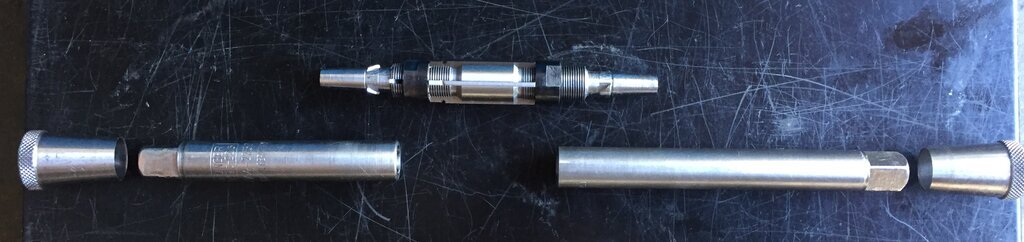
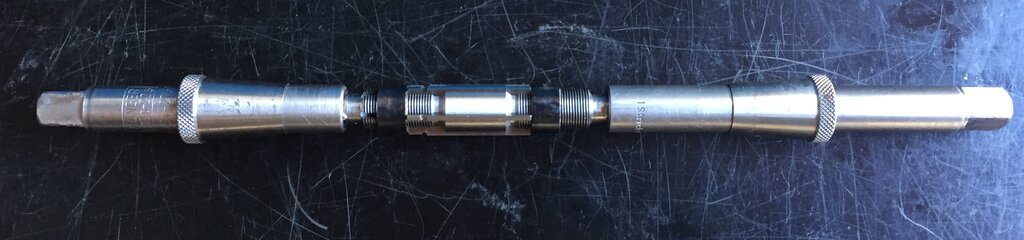
With the conical guide sleeves of the reamer, the outer sides of the connecting rod bearings become support bearings.
The method would also compensate for deviations caused by an inexactly manufactured connecting rod / bore.
During the first work we had clamped an additional support bearing for the guide sleeves on the two outer studs. The reamer is so self-centering that you can do without it. The result is 100% accurate.
If you push a long ground shaft through the piston pin bearing after work, you hit the other side exactly in the bearing of the other connecting rod.
It fits as precisely as a piston pin goes through the piston. I have never achieved such an accuracy with expensive conventionally repaired connecting rod bearings.
It is important that you have a sharp, adjustable and divisible reamer. HUNGER is the market leader in this area.
Thomas aus LAU








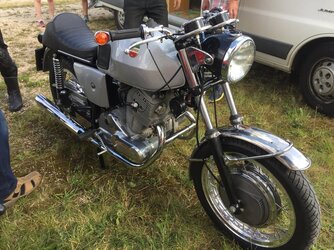




 That'll explain it ..... Guzzi and BMW riders all look the same, the world over.