What did you do to or for or with your Laverda today?

Drove 470 miles, today, to drop the forks off at Maxton's and exhausts for re-chroming, with Malcolm.
Already suffering withdrawal symptoms, knowing I can't ride the bike till the bits are back. Sadly, I don't have spare sets, in stock.
The wait commences,...
You need more bikes Hamish, not just parts..😜
 
IMG_8128.jpeg

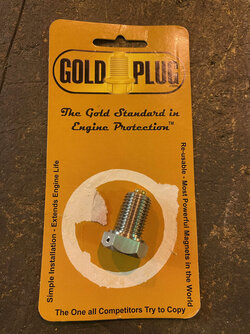
Fitting one of these to my 3CL.
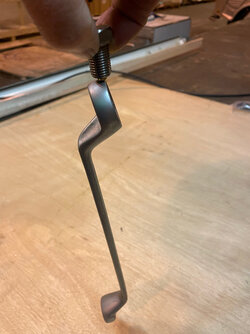
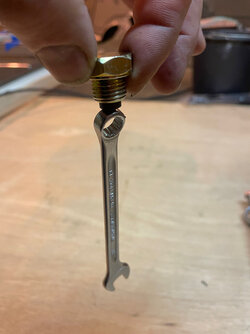
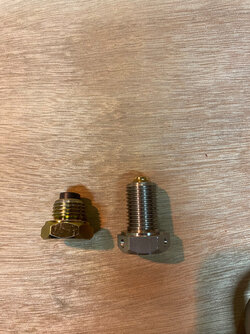
Not sure how to demonstrate the difference so I'll let the photos tell the tale.
The shorter sump plug has a ferrite magnet and is weak.
The longer Gold plug has a neodymium type magnet.
Gold plug suppled by Merlin Motorsport in the UK.
I drilled the sump plug for wiring.


IMG_8129.jpegIMG_8130.jpegIMG_8133.jpeg
 
How in the world are you going to get the spanner through the sump plug hole if you find one floating around in the sump... :rolleyes:

Doesn't matter much how strong the magnet on the plug is, particles that can be caught are minute.

Great sales blurb though!:LOL:

piet
 
Do these things magnetise crankpins as well?
Do they magnetise ferrous debris circulating in the oil which will then go and stick on to the first bit of steel they encounter?
Just a naive question?
Remember that we had to demagnetise the crank and rods on my SFC due to simple magnetising by heat.

Paul
How does magnetising by heat work? It's not a process I've heard of. Magnetisation usually requires the application of an external magnetising force, e.g. from a permanent magnet or an electromagnet. I believe the earth's magnetic field may work but it's not very strong.

cheers,

bazzee
 
How does magnetising by heat work? It's not a process I've heard of. Magnetisation usually requires the application of an external magnetising force, e.g. from a permanent magnet or an electromagnet. I believe the earth's magnetic field may work but it's not very strong.

cheers,

bazzee
You’re starting to show your ignorance now Bazzee. It must be embarrassing having to ask such a question…… which is why I didn’t. 🥴

Let me put it to our forums lucky bastard Metallurgist: AndyW how does this magnetism by heat work?
 
Fiddling around rebuilding the Yellow Peril's carbs. Pulled the actuating shafts off each carb and found wear on each one and the felt washers had disintegrated. Might be something to keep an eye on.
 
How does magnetising by heat work? It's not a process I've heard of. Magnetisation usually requires the application of an external magnetising force, e.g. from a permanent magnet or an electromagnet. I believe the earth's magnetic field may work but it's not very strong.

cheers,

bazzee
I've no idea. I'm neither a chemist or a physicist. I looked it up at the time and heat or heat and cooling cycles magnetises steel. I found on the web a company specialising in de-magnetising F1 engine components at the time, can't find it anymore. There's plenty on the web on the subject. For instance https://cpmachine.com/ Strangely enough, there's also articles on the benefits of magnetising fuel to improve performance.

Paul
 
I didnt know that Shaun Connerry was the president

there must be fresh air in that handlbar grip, unless someone has extended the bar itself, normally the clutch lever clamp is pretty much up tight to the switches and the knuckle, very little plain bar in sight.
CLEM
 
I've no idea. I'm neither a chemist or a physicist. I looked it up at the time and heat or heat and cooling cycles magnetises steel. I found on the web a company specialising in de-magnetising F1 engine components at the time, can't find it anymore. There's plenty on the web on the subject. For instance https://cpmachine.com/ Strangely enough, there's also articles on the benefits of magnetising fuel to improve performance.

Paul
Yeah, and they also cure arthritis 🤣 🤣 🤣
 
What was apparent on my SFC was that the heat from the fire had magnetised the crank and rods.
To avoid ferrous particles adhering, the parts were demagnetised.

Paul
 
What was apparent on my SFC was that the heat from the fire had magnetised the crank and rods. I presume to the point of attracting small metal objects, otherwise, it wouldn't have been noticed I imagine.
To avoid ferrous particles adhering, the parts were demagnetised.

Paul
 
What was apparent on my SFC was that the heat from the fire had magnetised the crank and rods.
To avoid ferrous particles adhering, the parts were demagnetised.

Paul
OK so a bit of research suggests that one possible mechanism is that the magnetic domains of the metal may align themselves with the Earth's magnetic field, apparently this can occur during the cooling process after being heated up. I'm just surprised that it can happen to a noticeable extent! Your experience is an unfortunate way of learning about this.

cheers,

bazzee
 
I have fitted a magnetic sump plug in the steel sump pan of my van.
The level of magnetism is such that it does collect particles but so far, a few years, has not magnetised the steel sump pan or anything else.
Thankfully :) I do not find my van is dragging iron parts around under its engine after a run about.

The level of magnetism in either sump plug purchased for my 3CL is not high enough to cause problems elsewhere.
I posted the picture as much for interest sake.
Fitting the longer, stronger magnetic plug is more about utilising the full depth of available thread in the case, thereby spreading the load over a greater area and hopefully avoiding stripping the threads, which will include use of a 'Dowty' washer and careful use of a torque wrench.
As a side benefit, positioning the magnet into a more advantageous position for collecting iron particles that may otherwise float around my engine.
As for generating magnetic fields either by heat or by just spinning things like propellors in the earths magnetic field, talk to a good ship engineer. There are lots of issues with fluid movement generating electrical currents and the generation of magnetic flux and their side effect.
 
Back
Top