Eurocycleguy
Hero member
- Location
- Chicagoland-USA
Ok thanks for the heads up JimIf you plan on replacing them then leave the bearings in so the bearing seats are not altered ....... otherwise you will be replacing them afterwards anyways.
Jim

Ok thanks for the heads up JimIf you plan on replacing them then leave the bearings in so the bearing seats are not altered ....... otherwise you will be replacing them afterwards anyways.
Jim

My wife caught me washing it in the shower, she was shocked, then I saidPolishing some fork legs today. Only -2 out so good time for outdoor work. Weird how after polishing it gets bigger ......!!!!!
Jim


Washed and polishedMy wife caught me washing it in the shower, she was shocked, then I said
“I’ll wash it as fast as I like, thank you”
Nice job Jim

Washed and polished
Hi Lothar,Steve, if you have an ignition installed with the pickups still there, you might run into that problem again sooner or later. I had a lengthy discussion with Uwe Witt about it and unless the pickups are PERFECTLY set and aligned, this can cause unsteady ideal which can cause issues on the starter sprag clutch. mine had even the plate broken that holds the rollers in place...
Also, if the starter sprag clutch is damaged, you might want to give the starter a service, too. Sometimes the clutch remains engaged if worn and pulls the starter with it, which results in worn contacts and bearings. I had that on my 1000 SFC... (actually found that the starter sprag clutch was worn after the starter did not want to turn the engine... Called OCT, Roger asked me how many kilometers the bike had on and recommended I bring it in for a starter clutch service/repair; saved me from another starter repair...). So - if you face starter related starting issues in the future, this might be the root cause.


Maybe they aren't ridden much and only short distances in fair weather?Ordered a couple of new tyres for the triple the other day so currently have bike jacked up and both wheels off ready for when they get here.
While they're off have been trying to get at all the nooks and crannies for a major clean up but haven't had any polishing luck discussed above
(I also have no f***ing idea how some keep everything so clean and shiny without taking everything apart after each ride............ )


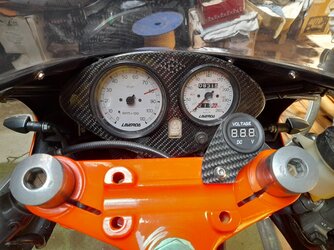
I'm was following some advice which stated that to test whether you are getting 'good' charging current from the rectifier/regulator to measure the amperage between the rectifier/regulator's +ve output and the +of the battery...I realise this is becoming a technical thread so maybe I should post it thereThat's exactly why I love those dashboard-mounted voltage gauges, you very quickly see if you have a hidden problem before it strands you on the roadside. It's probably the Regulator but that's a guess from my experience. If it shows less than at least 13volts at cruising revs you are slowly draining the battery instead of charging it.

Battery dropped a cell……..it happens, even on new batteries. Shithouse QC on gear these daysTook the 1200TS for a run to figure out whether an intermittent power loss had been fixed after cleaning the carbs. Ran like a dream for 100+ Kms and just as I was within 5k of home the power loss re-occurred, again intermittently. Got it home, checked the wiring to the coils, took it out again and it soon stalled and would not start - battery flat, and this a battery which is pretty new and lives on a trickle charger in the garage. Checked the amperage from the rectifier to the battery and got solid 1+ to 6+ amps when the bike is running and revved, so the alternator seems to be doing it's thing. So what is the issue - are the two linked, the flat battery and the loss of power periodically...Upshot is that the 1200 won't be going to Dalgety as it did 4 years ago; this time it'll be the Jota.


It's not clear what you're suggesting an amp check for Lee. Charging amps can vary quite a bit depending on battery condition and revs as Hooksey discovered. It doesn't really tell you much when diagnosing a charging system fault, unless there's no amps at all.Always check both volts and amps. Like Vince says, voltmeter immediately shows up a problem.