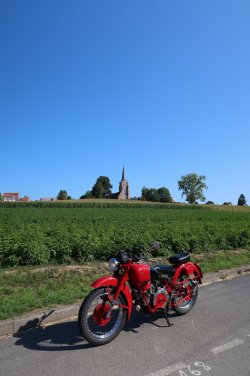
What did you do to or for or with your Laverda today?

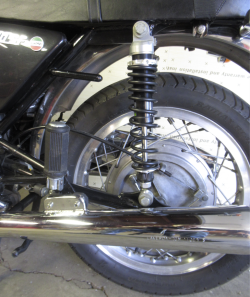
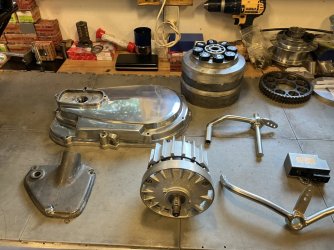
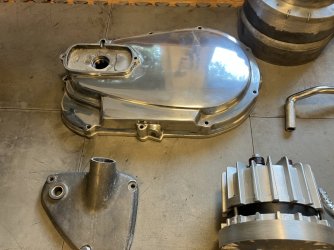
Service on Laverda 1000 year: 1973 I have installed a new ignition/generator system, purchased from Jlo teck, so now there is about 350 w charging current, the old system gave 180 w. Many thanks to Morten Lange, who is always ready when I need expertise for the electrical.
Redax/Ignitech/Sachse kit.
Paul
 
I did clean up the armature. It was black all over before. In the lathe with some dry wet and dry.
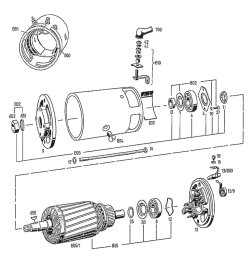
As for the parts list, there's just enough spindle on the armature side for a bearing, not a long shaft with a thread at the end.
Paul
Copper shouldn't be "cleaned" with an abrasive such as emery in this case. Just running wet&dry over it doesn't restore cylindricity either. The commutator should be skimmed in a lathe, especially when new brushes are fitted, the segments slightly cut back. Removing 0.10mm will reduce effective dynamo life from 80 to 75 years, usually, even less is necessary. Rust and debris should be removed from the armature core as well as the field cores, should be shiny metallic. Wipe with an oily rag to prevent further rusting.

Extended armature is apparently for a fan application such as VW or Fiat 500 (which would have a Magneti Marelli dynamo). Seems somebody in Breganze wasn't paying attention as the list was compiled. Never noticed it before!

piet
 
Dans ce cas, le cuivre ne doit pas être nettoyé avec un abrasif tel que l'émeri. Un simple passage à sec ne suffit pas à restaurer la cylindricité. Le collecteur doit être écrémé au tour, surtout après la pose de nouveaux balais, et les segments doivent être légèrement raccourcis. Retirer 0,10 mm réduira la durée de vie effective de la dynamo de 80 à 75 ans ; en général, une réduction encore plus importante est nécessaire. La rouille et les débris doivent être éliminés du noyau d'induit et des noyaux d'inducteur, qui doivent être métalliques et brillants. Essuyez avec un chiffon imbibé d'huile pour éviter toute nouvelle rouille.

L'armature allongée est apparemment destinée à un ventilateur comme celui d'une VW ou d'une Fiat 500 (qui serait équipée d'une dynamo Magneti Marelli). Apparemment, quelqu'un à Breganze n'a pas prêté attention à la compilation de la liste. Je ne l'avais jamais remarqué auparavant !

piet
Documentation BOSCH :
 

Attachments

  • 750 LAV Dynamo.jpg
    750 LAV Dynamo.jpg
    137 KB · Views: 16
Interestingly, it's the ventilation cutouts that account for an increase in amperage rating between the VW unit and the closed SF unit - they produce a lot more than the rated 150w once spinning.
 
Service on Laverda 1000 year: 1973 I have installed a new ignition/generator system, purchased from Jlo teck, so now there is about 350 w charging current, the old system gave 180 w. Many thanks to Morten Lange, who is always ready when I need expertise for the electrical.
They are 250 watts x 3 phase
Same stator as used on the later triples
 
Copper shouldn't be "cleaned" with an abrasive such as emery in this case. Just running wet&dry over it doesn't restore cylindricity either. The commutator should be skimmed in a lathe, especially when new brushes are fitted, the segments slightly cut back.
I frequently use abrasive in that manner, although I prefer comm-chalk. If it looks good after that then it’s good. Although I agree, a light turn on a lathe is the best way, but there’s usually no need unless the comm has been damaged, maybe by running the brushes down to the wipe.
 
I frequently use abrasive in that manner, although I prefer comm-chalk. If it looks good after that then it’s good. Although I agree, a light turn on a lathe is the best way, but there’s usually no need unless the comm has been damaged, maybe by running the brushes down to the wipe.
Sticking/worn brushes will have caused arcing which in turn burns the commutator. When new brushes are fitted, the commutator needs to be parallel to the brush across its entire width, otherwise arcing and uneven wear will occur form the very first revolutions. Not saying the dynamo won't survive, it'll still outlast all of us, but if a job is worth doing, may as well do it right.

The only abrasive I use there is Scotchbrite, nothing can embed itself in the soft copper and cause havoc on the brushes. I also use the rear of a sliver of emery to polish the surface after cutting back the segments.

piet
 
Dynamo back together.
It's quite simple but there's a couple of tricks. Not something that one does regularly so the work needs patience and thought.
Inside, there was a paste made of carbon dust and grease from the bearings. It had to fail one day.

It's the second dynamo I've had let go in near 35 years of riding 750s. The first was the bearings.

Now to look into the ticking at the top end of Corinnes 500.

Paul
 
Never assume anything.
Forgive me for I have assumed.
I assumed that since when I opened up my dud dynamo, I found a brush stuck off the commutator by carbon dust, that the cause of the problem was there.
So, I cleaned everything up, put in new brushes and bearings for good measure and this afternoon put the dynamo back in the bike and fired it up.
Well, nothing, rien, nada, niente. No volts.
So, I took a dynamo from my stock, I'm in the process of cleaning it up, and it'll go back on the bike pretty quick since Friday is August 15th, the Assumption, Ferragosto and the traditional yearly outings of one of the "classic" bike clubs of which I'm a member.

Would one of you electrical boffins tell me how to check the windings on a dynamo? I presume that there's no reason for it to demagnetise all of a sudden?

Paul
 
Have the armature checked on a growler, as previously described. Check field windings for continuity and shorts. The dynamo can be made to run as a motor if it is OK.

If you're looking for volts at the battery, make sure the regulator works as it should.

piet
 
Today:
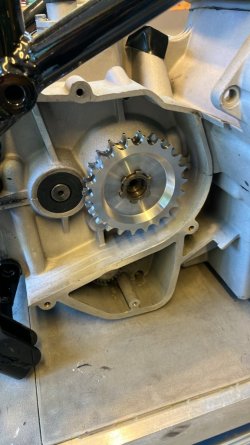
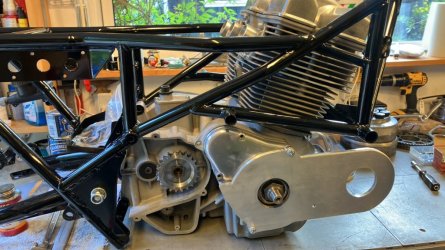
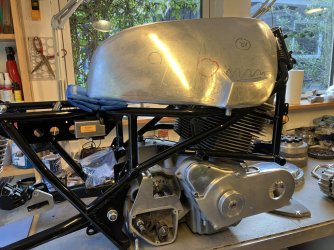
Working on my Spaceframe No 2.
 

Attachments

  • IMG_1371.jpeg
    IMG_1371.jpeg
    108.6 KB · Views: 22
  • IMG_1372.jpeg
    IMG_1372.jpeg
    150.9 KB · Views: 21
  • IMG_1374.jpeg
    IMG_1374.jpeg
    186.7 KB · Views: 21
  • IMG_1375.jpeg
    IMG_1375.jpeg
    162 KB · Views: 22
  • IMG_1373.jpeg
    IMG_1373.jpeg
    206.6 KB · Views: 26
Have the armature checked on a growler, as previously described. Check field windings for continuity and shorts. The dynamo can be made to run as a motor if it is OK.

If you're looking for volts at the battery, make sure the regulator works as it should.

piet
For the moment, I assume (sic) that the regulator is okay, there's nothing coming out of the dynamo.
Paul
 
This is where my charging problem has got me.
I'm now a brother in arms with Hamish.
1754847325147.jpeg
I cleaned up a spare dynamo, put it on the bike and nothing.
I made sure that I was using the right technique to test the dynamo. Either DF to earth and voltmeter on D+ or bridge DF and D+ and from there, voltmeter to earth.
Nothing. The charge light stays on.

So I assume, (sic) that it's the regulator. A bastard of a job to take off. Carbs off and tissue paper down the intakes.
The old and presumably faulty part has been on there since 1990 and seen much use. I do seem to remember opening it up and cleaning the contacts.
A spare regulator is on the bench and will be fitted tomorrow.
Paul

To forget Laverda, I went plodding two hours on the Falcone (which is much in need of some tlc ) this morning.

1754847408412.jpeg
 
Back
Top