Clutch pushrod & ball issues

Clutch pushrod ball is 1/4 inch - been discussed on here before (recently). And I'm almost positive the one in the cover is 1/4 inch also - 8mm sounds very odd to me, but happy to be corrected. Not at home (at a beach house) so can't check.

Piet?!!
The ball inside is 6,5 mm and the one in the cover is 8mm according to Laverda Paradise
 
6.5mm puts it at 1/4 inch. And I reckon a lot easier to find than 6.5mm!! FWIW almost every loose ball rear bicycle hub uses 1/4 inch balls - available everywhere.

Interesting re the 8mm outer cover size - must refresh my memory when I get home. Don't think I've ever replaced one ...
 
Clutch pushrod ball is 1/4 inch - been discussed on here before (recently). And I'm almost positive the one in the cover is 1/4 inch also - 8mm sounds very odd to me, but happy to be corrected. Not at home (at a beach house) so can't check.

Piet?!!
3/16" and 5/16" from memory. Couldn't be arsed to check a manual atm... ;)

Mainshaft bore is only 6.xx mm, 1/4" will be a tight fit and could jam, 6mm would be OK. Ball in actuator definitely larger, closer to 8mm.

piet
 
The previous owner of my Jota shortened one of the clutch pushrods to accommodate worn clutch plates. When I put new (Redax) plates in, it was too short. So I turned up an aluminium spacer washer to go between the square toggle bar and the clutch pressure plate, thick enough to make up the lost length in the pushrod (about 5mm). It works perfectly. Sometimes there's more than one way to fix a problem.
 
3/16" and 5/16" from memory. Couldn't be arsed to check a manual atm... ;)

Mainshaft bore is only 6.xx mm, 1/4" will be a tight fit and could jam, 6mm would be OK. Ball in actuator definitely larger, closer to 8mm.

piet
That's it - memory's fukt! 1/4 inch it seems it definitely is not!
 
The ball inside is 6,5 mm and the one in the cover is 8mm according to Laverda Paradise
We had already clarified the issue with the balls several times in the forum. The information you quoted from Wagner is correct.
"clutch -> clutch rod inside gearbox gear 750 112.5mm -> Ball between clutch thrust rod Ø 6.5mm-> clutch rod inside gearbox gear 750 112.5mm -> Ball on clutch thrust rod Ø 8mm"

Since the pressure load on the balls is relatively high, the diameter should not fit "roughly" but exactly.

You can almost get such balls from the well-known Laverda-parts dealer or nearly for free at the next ball bearing dealer.

Thomas aus LAU
 
We had already clarified the issue with the balls several times in the forum. The information you quoted from Wagner is correct.
Ball between clutch thrust rod Ø 6.5mm-> clutch rod inside gearbox gear 750 112.5mm -> Ball on clutch thrust rod Ø 8mm"
If the inside of the mainshaft is 6mm as Piet mentions, a 6.5mm ball will not fit. 3/16 = 4.7625mm, 1/4 = 6.35mm. I'll make my own measurements when i get the chance.
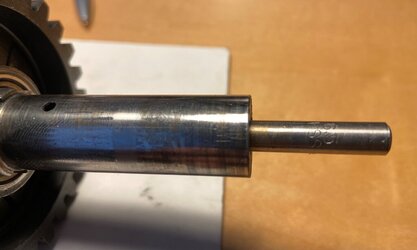
 
If the inside of the mainshaft is 6mm as Piet mentions, a 6.5mm ball will not fit.
What you see is what you get -> I have just measured five different 750 main shafts.

The diameter of the hole is definitly slightly larger than 6.5 mm. A 6.5 mm drill still has enough play in the hole (see photo).
The hole could be 6.65mm.

Balls that are too small lead to higher wear = running-in of the push rods and an inaccurate clutch pressure point. Believe me or live with the disadvantages that arise from it.

Shaft.jpg

Thomas aus LAU
 
Last edited:
By the way - I find it problematic that you cannot search for short words (<4 letters) in the search function.
Sadly a limitation of the MySQL database minimum word length. There is a solution but it requires business spec hosting at GBP99 per month :eek:
One alternative is to try a Google search in the form laverdaforum: tek (where tek is a 3 lettter example!)
 
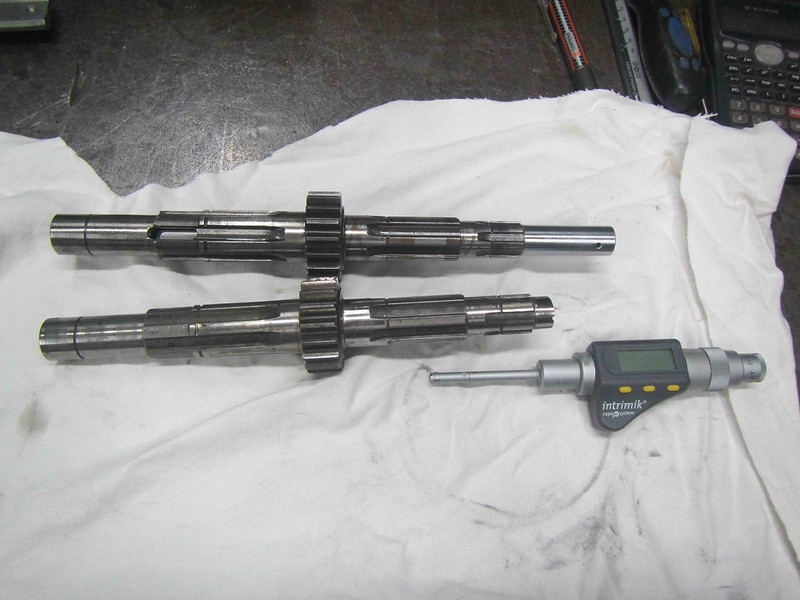
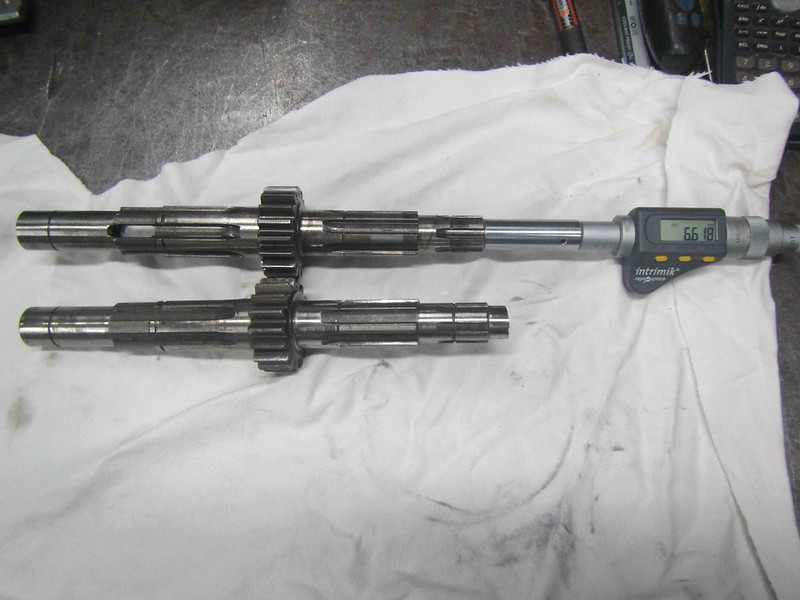
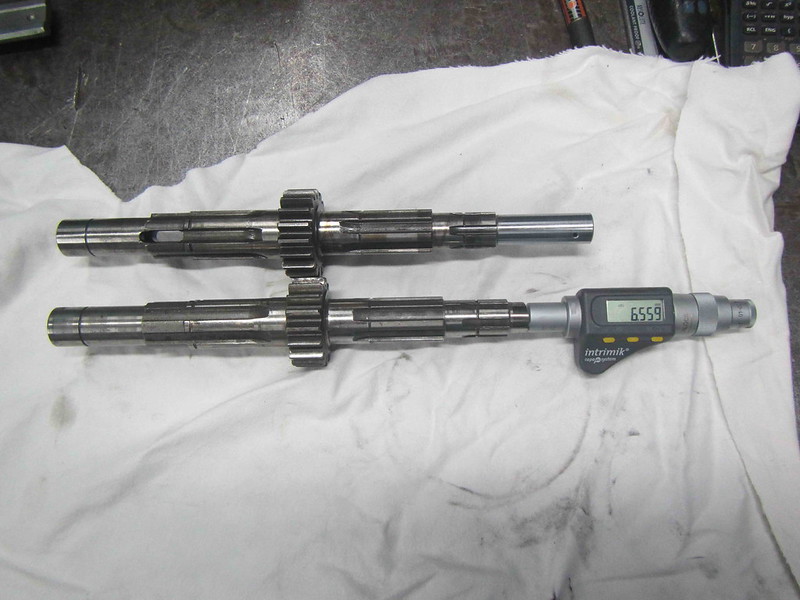
attached photos show actual internal measurements ....
Perfect tool, but at almost $ 1,000 too expensive for home use.
Your measurement result explains, why a 6.5mm ball falls completely through the (clean) bore of the shaft.

Unfortunately, your company is so far away from Germany. If transport and customs were cheaper, I would have a lot of work for you ......

Thomas aus LAU
Thomas, When I saw Red's pic, I thought; "what a great tool/toy." Thank you for bringing me back to earth. :D
 
I bet that's not the only high spec measuring device Red has, when you work in that way having THE GEAR is important.
 
Yep. Red has all the gear. He has probably invested more in measuring tools alone than my entire workshop and its contents are worth. I doubt he'll fix enough Laverdas in his lifetime to pay for all the tools in his shed. :)

My most accurate measuring device is an ancient micrometer that I inherited from my dad. But it's only 0-10mm (approx). OK for measuring shims, but not much more.

I use a digital 'vernier' caliper for 99% of what I do on the lathe, and a steel tape for everything else beyond the range of the digital caliper.

My dad used to use a carpenter's ruler. You know, those fold up wooden things about 3 ft long. I could never see the point of those stupid things, although I think I still have his old one somewhere. A steel tape is so much easier to handle.
 
I used one of those folding rules maybe 3 times in the first year as an apprentice. A 5m steel tape works so much better. To me, their only use was as a temporary packer to space under a door or scribing off the floor to mark an even gap. I could never see the point. I have a digital Vernia that I like a lot, especially as I have forgotten how to use a non-digital Vernia. I do have a set of internal and external CalPERS, Both are approx 300mm long and who knows how old. I bought them in a swap meet, really handy to use when a tape won't do the job.
 
Back
Top