20 50 mineral-based break in engine oil?

Synthetic oil (according to Wikipedia)
I am leaving this in French because the direct translation on the site does not yield the same text; you need to use a translator.
If you want a so-called synthetic oil, you must use polyalphaolefins (PAOs).
The problem is that the technical specifications are far too vague to tell.

https://fr.wikipedia.org/wiki/Huile_de_synthèse

What could be considered true synthetic oil

https://dymresources.com/product/pao/

https://www.eurolab.net/en/sektorel/otomotiv-testleri/polialfaolefin-(pao)-analizi/

Ultimately, the most important thing is to use the oil recommended by the manufacturer.

https://info.ec24.ch/ratgeber/uebersicht/motoroel-mineralisch-synthetisch-oder-vollsynthetisch
Nothing needs translating. You said it all with this sentence(y)
Ultimately, the most important thing is to use the oil recommended by the manufacturer.
 
Nothing needs translating. You said it all with this sentence(y)
Ultimately, the most important thing is to use the oil recommended by the manufacturer.
Problem is, the oil I use wasn't around when the manufacturer built my motor and recommended a particular oil! Neither was electronic ignition or light clutch conversions ... or or or ...
 
Or 5-star 100-octane leaded fuel. The oil Husky Recomends for my 1985 420 Automatic is virtually impossible to buy: Esso Univis J26. The recommended replacement is Olines 5wt suspention oil. Times move on.
 
Problem is, the oil I use wasn't around when the manufacturer built my motor and recommended a particular oil! Neither was electronic ignition or light clutch conversions ... or or or ...
Yes, things move on, I get that, but so does a lot of the other associated aspects in conjunction.
Unless you've hyper modified your engine in some way, & taken it beyond original manufacturer's spec, ( who, as has already been pointed out on this thread, manufactured agricultural machinery ), & as such specified a pretty basic spec oil, why not use a contemporary oil now that's similar to the manufacturer's original recommendation, instead of an oil that wasn't around back then ?
I've followed this thread from the start, & for an engine design that, by comparison to today's water cooled missiles, is pretty agricultural, why deviate from original spec, only to ponder & consider possible consequences.
And as such, I'm sure there are many high mileage examples out there, that have managed those distances, by using the manufacturer's original recommended guide lines & maintenance schedules.
 
Problem is, the oil I use wasn't around when the manufacturer built my motor and recommended a particular oil! Neither was electronic ignition or light clutch conversions ... or or or ...
I have always heard from people with a high level of expertise—like you, Piet, and others (apologies to anyone I’ve left out)—that for the worn engines in our vintage cars, one should use a mineral 20W50 oil. Its viscosity suits the operating clearances of these engines, whereas so-called synthetic oils—due to their additives and composition—can dislodge deposits and create problematic sludge.
Synthetic oils can be used in a fully rebuilt engine.
Surely, though, it must be possible to find an oil that suits the specific engine and climate conditions.
I’m just repeating what I’ve heard, like a parrot.

https://leblog.ffve.org/quelle-huil...ienne-les-conseils-de-notre-partenaire-motul/
I've been using a semi-synthetic 10/40 SG, or above, rated oil in my Kawasaki Gpz900r for 25 years: A 'modern motorcycle' as in water-cooled, but still based on engineering design and architecture with it's origins in the 1970s. Originally, it would have used a 100% mineral oil, but the semi-synthetic has always worked well, and doesn't cause sludge issues. I know of owners in Australia who use different grades due to the varying temperature environment, even 5/50w oil.

My RGA Sprint, though not on the road yet, is using Morris 'Golden film' 20/50 mineral motorcycle oil.

Here's a part of Morris's 'Golden film' SAE20/50 mineral oil specification:

"Golden Film SAE 20W-50 Classic Motor Oil is recommended for use in veteran, classic and vintage cars, motorcycles, commercial vehicles and tractors, where engine design and tolerances prohibit the use of modern high additive level oils.

Golden Film SAE 20W-50 Classic Motor Oil is a low dispersant oil and allows any solid contaminants to drop harmlessly into the sump. This is an important feature where early methods of oil filtration, such as mesh gauzes or strainers are fitted."

The interesting bit is the 'low dispersant oil which allows any solid contaminants to drop harmlessly into the sump' and that it's relevance to 'where early methods of oil filtration, such as mesh gauzes or strainers are fitted.' Such as 1970s & 80s Laverda air cooled engines.
 
Last edited:
So ... am I to believe the 'solid contaminants' drop harmlessly into the sump, never to find their way into the body of oil in the motor or the lubrication system again? So the oil doesn't discolour with use, all the bad stuff just drops like stones into a pond ... into the sump (where the oil pickup vent to the pump sits!) never to cause grief again? Apologies if I sound a tad cynical ... I'm sure it's perfectly good oil - I just have trouble with the spiel.
 
  • Like
Reactions: Rob
The interesting bit is the 'low dispersant oil which allows any solid contaminants to drop harmlessly into the sump' and that it's relevance to 'where early methods of oil filtration, such as mesh gauzes or strainers are fitted.' Such as 1970s & 80s Laverda air cooled engines.
Is this an oil thread?!?!
As they say, 'Down under', "Oils ain't oils, Sal! ", or something to that effect.
I once found a washer in the sump of my 1974 3C. It wasn't the one I was looking for; I don't know who dropped that one, Mr Hartley, perhaps.
Anyhow, the idea that 'any solid contaminants drop harmlessly into the sump' is absurd. When you shut the engine off, contaminants settle, but as soon as the engine is running, contaminants are circulating (washers not included) through the engine.
Oil companies can print anything they want on a label; buyer beware. "Why this here snake oil- synthetic-mineral blend will make your donk run harder all day and all night". "Step right up".
Pick your oil: whatever mineral, full synth, semi; just remember to change it regularly.
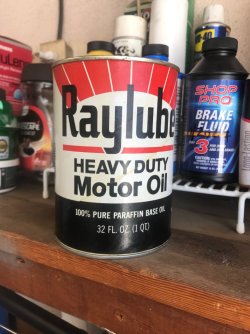
Paraffin-based ' Raylube '; my neighbour swears by it; he runs it in his 48 Chevy pickup, ha ha ha.
 

Attachments

  • IMG_6723.JPG
    IMG_6723.JPG
    136.2 KB · Views: 0
So ... am I to believe the 'solid contaminants' drop harmlessly into the sump, never to find their way into the body of oil in the motor or the lubrication system again? So the oil doesn't discolour with use, all the bad stuff just drops like stones into a pond ... into the sump (where the oil pickup vent to the pump sits!) never to cause grief again? Apologies if I sound a tad cynical ... I'm sure it's perfectly good oil - I just have trouble with the spiel.
It refers to modern synthetic oil carrying the contaminants until they are filtered out by a cartridge filter- if there is no effective filter the crap keeps cycling around the engine until oil change. Old style oils don’t carry the contaminants as effectively and the crap ends up in the sump .
Oil discolours due partly to oxidisation and the amount of detergents - all oil goes black, no amount of filtration can stop that.
 
Is this an oil thread?!?! :ROFLMAO: :ROFLMAO: :ROFLMAO:
No, it is lubrication thread.

Oil thread - Includes mostly opinions, no much actual knowledge about the topic, random experiences often without correct conclusions, impressions, and erroneous testing
Lubrication thread - Includes also facts, science, tribology, talk about widely used international standards based on scientific-empirical methodology, and more correct analysis about actual findings inside engines

-Jouni
 
So ... am I to believe the 'solid contaminants' drop harmlessly into the sump, never to find their way into the body of oil in the motor or the lubrication system again? So the oil doesn't discolour with use, all the bad stuff just drops like stones into a pond ... into the sump (where the oil pickup vent to the pump sits!) never to cause grief again? Apologies if I sound a tad cynical ... I'm sure it's perfectly good oil - I just have trouble with the spiel.
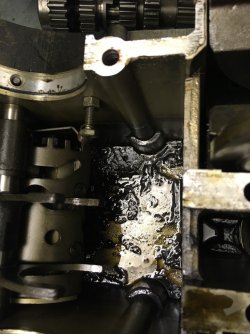
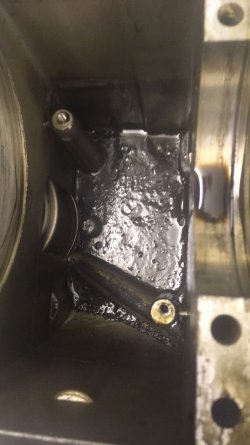
A motor sat for years but "ready to start".
 

Attachments

  • uuid=1311B876-850B-4E6C-B01C-CE60F7C16A94&code=001&library=1&type=1&mode=1&loc=true&cap=true.jpeg
    uuid=1311B876-850B-4E6C-B01C-CE60F7C16A94&code=001&library=1&type=1&mode=1&loc=true&cap=true.jpeg
    244.6 KB · Views: 29
  • uuid=93FAED97-8F4F-4AA4-AAB4-45FD0421E986&code=001&library=1&type=1&mode=1&loc=true&cap=true.jpeg
    uuid=93FAED97-8F4F-4AA4-AAB4-45FD0421E986&code=001&library=1&type=1&mode=1&loc=true&cap=true.jpeg
    183.1 KB · Views: 29
So ... am I to believe the 'solid contaminants' drop harmlessly into the sump, never to find their way into the body of oil in the motor or the lubrication system again? So the oil doesn't discolour with use, all the bad stuff just drops like stones into a pond ... into the sump (where the oil pickup vent to the pump sits!) never to cause grief again? Apologies if I sound a tad cynical ... I'm sure it's perfectly good oil - I just have trouble with the spiel.
Would not come out when draining oil, but can stay in for decades waiting for next engine rebuild. I have seen at least hundreds of engines with every kind of sludge at the bottom of the sump, but I never found such a situation in where a more modern oil without this feature in old engine had caused a problem or faster wear. Should help particles to seek a filter, but it can be as well some of the old school systems, like separators in the crankshaft.

Another topic already mentioned above is if very washing oil is poured to a very dirty engine. The dispersants may wash off contaminants causing a clogg followed by a failure. But before this, an engine cleaner, the one that cleans from the inside, can be used to get the contaminants safely out. Done this successfully for a couple of times for very dirty old engines and then used some selected modern synthetic oils to suit the old school engine. (These engines still had a proper oil filter that can be easily emptied) It is essential to use the cleaner strictly according to the instructions, and after this the oil can be changed a couple of times if it still gets black too early. A bit cheaper, but suitable stuff can be used for one or two short oil change intervals after the washing.

-Jouni
 
Last edited:
A motor sat for years but "ready to start".
Reminds a bit about my Matchless engine when I bought it. A friend of us suggested to start it. Had sat for long time after some non-motorcyclists had assembled it. I just nicely dismantled everything, and found a lot of worms to be rectified. The oil pump would have sucked a 1cm layer of stuff from the oil container. I guess would have been just a couple of parts left that could have been used after that.

-Jouni
 
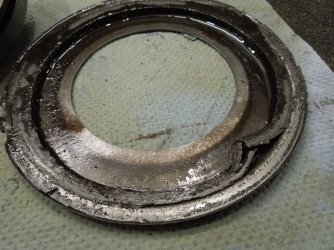
Laverda oil slingers from an engine that ran solely on "old-style" oils. This is from a racing engine, "used only on weekends", as Quentin put it. Stood in a collection since around 1990.

DSCN1975.JPG

"Old-style" oils hold solids in suspension just as well as "modern" oils, only when standing still for a longer period will solids drop to the bottom of the sump, joining the pebbles that have collected there.

Adding a proper filter to the system isn't such a bad idea, no matter what type of oil used.

piet
 
No, it is lubrication thread.

Oil thread - Includes mostly opinions, no much actual knowledge about the topic, random experiences often without correct conclusions, impressions, and erroneous testing
Lubrication thread - Includes also facts, science, tribology, talk about widely used international standards based on scientific-empirical methodology, and more correct analysis about actual findings inside engines

-Jouni
Here is a list of five excellent books on Tribology if anyone is suffering from insomnia.

CRC Handbook of Lubrication Volume 2
CRC Handbook of Lubrication and Tribology Volume 3
Engineering Tribology - 2nd Edition Stachowiak
The Tribology Handbook - 2nd Edition Neale
Tribology in Machine Design - 1990 Stolarski

I skim through all of them from time to time.

I also have a great library of MRI operation and repair manuals if anyone's looking for a side hustle ;) lol
 
So the contention re synthetic oil use is that we all have OLD BIKES, and the dislodging of long-term deposits and where they go, and that affects SKIDING roller bearings have in Laverda Cranks. Where did I put that cartridge filter kit I bought last year? In reality, I dont see myself doing another 100,00 ks on Laverdas in the next 10 years, so I worry less about this. Maybe I need a cartridge blood circulation filter instead of one for my bike; does anyone have one of those kits for sale?
 
The Laverdas have what can be called a "Seagull Catcher" gauze element.
I've fitted a small magnet inside to collect ferrous particles. But a remote filter would be better.
For original spec engines, a good quality Mineral 20W-50, non friction modified, with high Zinc, phosphorous and dissolved ash.
In Oz, Penrite HPR30 has been around for years. It's a 20W-60 for hot weather. (Zinc 1530ppm).
Other brands include Liquid Moly 20W-50 Mineral, Lucas Racing 20W-50 Mineral. etc.
For rebuilt engines that have no sludge, stick with Mineral, or a semi synth (non friction modified) API SM class 2 or 3.
Does anyone know what the Zane Laverdas oil was factory spec. ?
 
.Does anyone know what the Zane Laverdas oil was factory spec. ?
Dunno, but whatever you put in them it didn't seem to enhance their longevity! :eek: :ROFLMAO:

There's an oil blog somewhere online where they were discussing Mobil 1 20/50 so called V-Twin oil. Zinc is over 1700ppm, so at least I'm covered for that! The only reason I use 'expensive' oil is that I like to know my sensitive cams and rockers are getting a deluxe ride. When I'm pushing hard at high revs and in hot weather it may or may not make a difference, but I'm convinced Mobil really did their homework on it.

Crank and big ends don't concern me at all as long as oil is getting to them - I'd happily use any basic 20/50 if they were my only concern.
 
The Laverdas have what can be called a "Seagull Catcher" gauze element.
I've fitted a small magnet inside to collect ferrous particles. But a remote filter would be better.
For original spec engines, a good quality Mineral 20W-50, non friction modified, with high Zinc, phosphorous and dissolved ash.
In Oz, Penrite HPR30 has been around for years. It's a 20W-60 for hot weather. (Zinc 1530ppm).
Other brands include Liquid Moly 20W-50 Mineral, Lucas Racing 20W-50 Mineral. etc.
For rebuilt engines that have no sludge, stick with Mineral, or a semi synth (non friction modified) API SM class 2 or 3.
Does anyone know what the Zane Laverdas oil was factory spec. ?
10W-50 or 20W-50 mineral or semi-synthetic was recommended, probably Agip.

Motul 300V 10W60 was what we at OCT filled into them, seemed to work better than most others by keeping temps to an acceptable level in the 650 and 668. Engines that were switched to this stuff also displayed a greatly reduced mechanical noise level and a lot less wear issues. Didn't help much on the issue of the dodgy big-end bearings though... :rolleyes:

piet
 
Back
Top