66HP at rear wheel

Totally roxxed mine up. New pods too.
Would not pull past 75mph on the road.
Removed them and it was like a different engine.
Free-revving and loads of power.
YMMV.
 
Laverdalothar said:
At top-peak rev, the operator normally pulls in the clutch lever and the system calculates the transmission resistance based on how much the drum of the dyno slows down during a defined time.

I've never seen or heard of anyone pulling the clutch at max revs on a dyno pull. While it's theoretically possible to calculate transmission losses from deceleration rate, there are too many variables to make accurate assessment practical. You'd need to know the rotational inertia of all the components of the transmission for a start, not to mention any drag on the disengaged clutch. And it'll only give a partial result anyway because it won't include the primary drive losses. Given the inaccuracies inherent in such a practice, I find it hard to believe that a de-clutched deceleration test would provide any meaningful information.

If you add 10 - 12 % to 66HP, you end up between 72 and 74HP Engine - absolutely correct for a stock engine!

Blimey. 74HP at the crankshaft would be a sickly Jota indeed. Even a milder tuned 3C should do better than that.
 
74HP is exactly what a 3CL came from factory with...

The process with pulling the clutch is absolutely necessary on an acceleration type dyno (which most smaller shops use) to measure and calculate the transmission resistance. How else would you do that, please, to get to crank power?

I can see though that the guy did not pull the clutch, so this is real RWHP, which is to my experiance fully OK for a stock 3CL. If it is Jota engine (82HP from factory I think), you should see something like 72 - 74 RWHP. But as said, it all depends on what the resistance in your particular bike is.

F.e.: Take a  badly lubrificated 630 Chain with steel chainwheel and sprocket and compare it to a well lubrificated 520 chain with alloy chainwheel. The difference can be several HP at rear wheel, allthough the engine puts out the same HP. How can you compensate that without measuring the resistance?

Force is a result of mass and acceleration compared to time. If you know the mass (of the dyno's drum...), you can not only measure how fast the bike accelerates it, you can also measure how much the bike slows it down. This is done by pulling the clutch to disengage the engine from the backwheel and measure - as much as possible - the resistance the rest provides. with that, you can calculate how much power gets lost in the drive chane and can calculate with that the crank power. Sure this is not measuring the crank power, it is calculating it based on best knowledge and known facts.

That is why I always ask how the power was measured...

Again - if it is a 530 chain, steel chainwheel etc., the resistance can be up to 15% even. 66RWHP plus 15% = roughly 76HP crank. Fair to say that the crank power is somewhere between 73 and 76 I would say.

If it is a Jota, minimal setup-changes (or in my case a wrong collector) can make  up for the difference.

My (limited, I admit) experiance with dynos is that the difference between two systems and the same bike, 600Km and 2 months between the two runs, was within 0,3HP. It all depends on the right Operator... You need to enter a lot of factors and sometimes - if you do 10 runs f.e. at a time - the place heats up a lot and the operator forgets to correct the temperature and/or humidity.
 
Hi Carlo you need to be very careful and logical trying to gain horsepower from opinions on a forum.
As you may know there is a huge list of factors that can effect output from an engine and you should go through each of these factors in a logical and scientific sequence so you don't end up with another side effect from misinterpretation.
For example changing an ignition map.
You probably need to know what spec your engine is ie compression ratio, compression, cylinder head characteristics, cam design and a whole lot more.

I had a "dyno"expert very familiar at tuning modern race engines on his dyno lean my ( old air cooled) race bike engine out based on the exhaust readings and picked up about 4 HP RWHP pity it ended up  cooking some of the valve seats!!!
 
Laverdalothar said:
74HP is exactly what a 3CL came from factory with...

The process with pulling the clutch is absolutely necessary on an acceleration type dyno (which most smaller shops use) to measure and calculate the transmission resistance. How else would you do that, please, to get to crank power?

I can see though that the guy did not pull the clutch, so this is real RWHP, which is to my experiance fully OK for a stock 3CL. If it is Jota engine (82HP from factory I think), you should see something like 72 - 74 RWHP. But as said, it all depends on what the resistance in your particular bike is.

F.e.: Take a  badly lubrificated 630 Chain with steel chainwheel and sprocket and compare it to a well lubrificated 520 chain with alloy chainwheel. The difference can be several HP at rear wheel, allthough the engine puts out the same HP. How can you compensate that without measuring the resistance?

Force is a result of mass and acceleration compared to time. If you know the mass (of the dyno's drum...), you can not only measure how fast the bike accelerates it, you can also measure how much the bike slows it down. This is done by pulling the clutch to disengage the engine from the backwheel and measure - as much as possible - the resistance the rest provides. with that, you can calculate how much power gets lost in the drive chane and can calculate with that the crank power. Sure this is not measuring the crank power, it is calculating it based on best knowledge and known facts.

That is why I always ask how the power was measured...

Again - if it is a 530 chain, steel chainwheel etc., the resistance can be up to 15% even. 66RWHP plus 15% = roughly 76HP crank. Fair to say that the crank power is somewhere between 73 and 76 I would say.

If it is a Jota, minimal setup-changes (or in my case a wrong collector) can make  up for the difference.

My (limited, I admit) experiance with dynos is that the difference between two systems and the same bike, 600Km and 2 months between the two runs, was within 0,3HP. It all depends on the right Operator... You need to enter a lot of factors and sometimes - if you do 10 runs f.e. at a time - the place heats up a lot and the operator forgets to correct the temperature and/or humidity.

Going to go through stuff systematically and correct the things that are potentially holding things back. It's fair to say that the engine had a hard life before it was rebuilt (using mostly re-used parts apart from conrods). Have asked Red for some information to perhaps prioritise that work as any engine work is costly.
 
maurice turner said:
Hi Carlo you need to be very careful and logical trying to gain horsepower from opinions on a forum.
As you may know there is a huge list of factors that can effect output from an engine and you should go through each of these factors in a logical and scientific sequence so you don't end up with another side effect from misinterpretation.
For example changing an ignition map.
You probably need to know what spec your engine is ie compression ratio, compression, cylinder head characteristics, cam design and a whole lot more.

I had a "dyno"expert very familiar at tuning modern race engines on his dyno lean my ( old air cooled) race bike engine out based on the exhaust readings and picked up about 4 HP RWHP pity it ended up  cooking some of the valve seats!!!

Ha yes, see my last post, I missed yours. I am in contact with Red who knows the engine and as always is being generous in sharing his knowledge. My dyno guy was very conscious of that and loathe to do much more than get the jetting and a/f right.
 
I'd be heeding Maurice's advice here, Carlo. I have to say. I'm surprised you're only visiting the state of the engine's health and level of tune at this (what seems) late stage!

Before getting uptight about low power output (so many variables! the least of which is the dyno and sys of measurement - as
Lothar says). I'd find someone in Oz with another Jota and have a drag race with them - it will tell you (very quickly  :o) how your bike performs against something similar.

Alternatively, take out the donk, send it to Red, and in (probably several months) you'll get back a known quantity. You might be a tad poorer too  :D .

Can't comprehend how pod filters can affect carb performance so badly, Grant. Must be the quality of filter - haven't heard of such a drastic redusction in efficiency and power since Lee put a stocking over the bell mouth of his Ducati Mk3 350! Only travelled about 1km before tossing that  :D
 
Piranha Brother 2 said:
I'd be heeding Maurice's advice here, Carlo. I have to say. I'm surprised you're only visiting the state of the engine's health and level of tune at this (what seems) late stage!

Before getting uptight about low power output (so many variables! the least of which is the dyno and sys of measurement - as
Lothar says). I'd find someone in Oz with another Jota and have a drag race with them - it will tell you (very quickly  :o) how your bike performs against something similar.

Alternatively, take out the donk, send it to Red, and in (probably several months) you'll get back a known quantity. You might be a tad poorer too  :D .

Can't comprehend how pod filters can affect carb performance so badly, Grant. Must be the quality of filter - haven't heard of such a drastic redusction in efficiency and power since Lee put a stocking over the bell mouth of his Ducati Mk3 350! Only travelled about 1km before tossing that  :D

The bike has now been tuned twice in two years, both times because of rough running caused mostly by carburettor related issues.

The engine is a known quantity as Red did it as a budget rebuild in 2016.

I have never really cared about HP as the bike was running smoothly and pulling strongly.

I spent the weekend testing that with HCMC at Collie Motoplex 😛

I don't have the coin to do any major work so it's really about how we get it running as sweetly as possible, whilst making sure we're not ignoring any obvious issues that could be easily fixed.
 
Piranha Brother 2 said:
Lee put a stocking over the bell mouth of his Ducati Mk3 350! Only travelled about 1km before tossing that  :D

Ha ha. I did that with a Yamaha 250 2-stroke twin when I was a teenager. Cut bits out of one of my mum's stockings (she wasn't happy) and secured them over the bellmouths with rubber bands. Bike started OK, but when I gave it a rev, the stocking 'filters' disappeared down the carb throats! Didn't seem to do any harm though. The engine ate them without missing a beat.  :D
 
Laverdalothar said:
74HP is exactly what a 3CL came from factory with...

OK. I thought it was about 80

The process with pulling the clutch is absolutely necessary on an acceleration type dyno (which most smaller shops use) to measure and calculate the transmission resistance. How else would you do that, please, to get to crank power?

You don't. That's why people estimate the transmission losses. For the reasons I said earlier, pulling the clutch won't give a meaningful reading. Does the dyno bloke know the moment of inertia of the bike's rear wheel, clutch hub and plates, and each shaft in the gearbox? That info is necessary to assess their contribution to the kinetic energy, and therefore the deceleration rate of the whole bike-dyno system. I suppose you could make a guess at those variables, but then the resulting HP calculation would be little better than a guess.

Of course I may be wrong, but the whole idea of measuring transmission losses by deceleration rate seems rather implausible to me. So I did a bit of research on the web since yesterday and I haven't been able to find any reference to anyone doing it. Lothar, can you refer me to your source of info? I'd be very interested to educate myself about it.

Anyway, who cares what the crank horsepower is? It's where the tyre meets the road that matters.

Cheers,
Cam
 
So does pulling the clutch in at full revs also allow the clutch pushrods to friction weld themselves together, see that being corrected once. Not a lot of fun getting them out. Every dyno run I have seen has the operator allowing the engine to coast back to idle with the clutch lever  fully out.
 
carlo%20lav.JPG


One of the runs...
 
What cams are in it, 4C, A11 or A12?
Looks smooth overall, just not a lot of top end.
Shame you didn't pull off the filters, may have made an immediate change.
As Red has been inside it I would think it should be healthy, but make sure it is in tune and all chains adjusted correctly.
I would do this before changing ignition curves or other more drastic changes,
And just take it for a run without the filters on it. Your seat of the pants dyno might find the missing power.
 
What change was made to get the 5hp on the last run? Try doing a compression test, you can buy one for less than $100 and that will tell you a lot. I would say why but not going there, my memory is completely different from what others reckon happened with my bike. Lots have had A11 wheels fitted with C4 cams over the years as well. One thing done wrong can affect engine power heaps. Spark timing plus advance and jetting only works if everything else is correct. How does the bike go on big long hills, or overtakes? If it doesn't pull hard from 4 grand easily especially up hills any gear there is something not right, maybe try a fat pillion as well. Pulling strong under load should feel effortless. Load is the key, mine would be okish on the flat, add a hill and I would back to 3rd or 2nd gear. Just for shit and giggles, take the air filters off and give it a rev while watching the back of the carbs. Look for fuel spitting out of the carb mouth.
 
Hi Carlo,
Looking at the Dyno chart posted the engine appears to cut out at approx 6800 and only  on the second run pickup at 7200.
Between runs did you change the main jet for smaller? The motor cutting out could be caused  by over fueling .

Another way of looking at it could be lack air, the motor unable to breath at that point.
Did the operator roll the throttle off and back on  at 6800 on the second run to get the motor pass that point?

What have you set the rev limiter too?

Andy
 
Vince said:
What change was made to get the 5hp on the last run? Try doing a compression test, you can buy one for less than $100 and that will tell you a lot. I would say why but not going there, my memory is completely different from what others reckon happened with my bike. Lots have had A11 wheels fitted with C4 cams over the years as well. One thing done wrong can affect engine power heaps. Spark timing plus advance and jetting only works if everything else is correct. How does the bike go on big long hills, or overtakes? If it doesn't pull hard from 4 grand easily especially up hills any gear there is something not right, maybe try a fat pillion as well. Pulling strong under load should feel effortless. Load is the key, mine would be okish on the flat, add a hill and I would back to 3rd or 2nd gear. Just for shit and giggles, take the air filters off and give it a rev while watching the back of the carbs. Look for fuel spitting out of the carb mouth.

It was all fuelling, changed the size of the jets and lowered the main needle that was at the highest setting.
 
KERMIT1200 said:
Hi Carlo,
Looking at the Dyno chart posted the engine appears to cut out at approx 6800 and only  on the second run pickup at 7200.
Between runs did you change the main jet for smaller? The motor cutting out could be caused  by over fueling .

Another way of looking at it could be lack air, the motor unable to breath at that point.
Did the operator roll the throttle off and back on  at 6800 on the second run to get the motor pass that point?

What have you set the rev limiter too?

Andy

He reckoned it was a glitch with his dyno, something about reading off the spark plugs - made no sense to me. He didn?t back off.

I have swapped to bellmouths to tune next week and experiment with the map Red sent me today.
 
Dellortoman said:
Anyway, who cares what the crank horsepower is? It's where the tyre meets the road that matters.

Cheers,
Cam

Hi Cam,

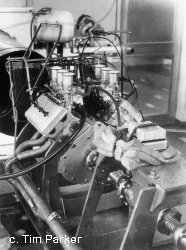
well - if you compare factory values (which are crank power as far as I know...) with RWHP, it does not surprise me that people get disappointed with 66 HP...  Factory values were allways taken with the engine out on an engine Dyno. So - no secondary drive resistance! Not sure where exactly they measured the engine power, if they used a chain f.e. to connect the gearbox with the dyno or what. I only found a pic of the V6 engine and that was directly connected via a shaft to the crank:

dyno_250.jpg


(Source: http://www.breganzane.com/history/v6_2.php)

Regarding your comments about measuring the transmission losses - well... You do not know the values you are asking for for the acceleration measuring - why do you think they are important for measuring the resistance? The point is, that you know the mass of the dyno drum. The system knows how much this drum would slow down under normal conditions. Now you simply pull the clutch at top revs and measure how much MORE it slows down. this gives the best possible way of measuring the resistance. Is it accurate? maybe not. But it is more accurate than just estimating a 15% resistance (as many do) no matter if your Chain weights 1,5 Kilo or just 0,5 Kilos and being happy with such a powerful bike...

This is what I was explained by 3 different Dyno Operators on three different Dynojet dynos. A small correction though on my side: it is called "Clutch power", as it can not measure the primary drive resistance. Here is a german webpage explaining things a bit. For your comfort, I put it through Google translator already. Scroll down to "coupeling power", it describes it perfectly (but maybe not in a good english due to Google translate?!?)

https://translate.google.com/translate?sl=de&tl=en&u=http%3A%2F%2Fwww.sd-performance.de%2Fleistungsmessung.html

Hope this helps.
 
Back
Top