
You are using an out of date browser. It may not display this or other websites correctly.
You should upgrade or use an alternative browser.
You should upgrade or use an alternative browser.
Building a race bike
- Thread starter julian
- Start date

hochkoenig said:Thanks for the info!
From which Book you talking about?
Whats the Topic on Ignition Time?
Tx
Not a real book, Its a saying, but just if you read the scientific equations etc for correct fuel air ratios etc, that is the result you get, however reality says otherwise. You know, "Go by the Book" I threw that out a long time ago

Ignition.
Burn is much slower therefore a good combustion shape is needed and quite a bit more advance. No rules, just start by not get it advanced or let it go lean and then set it up on a dyno.
No blower PB2, just a real short stroke motor with a very light crank etc and lots of luck needed.
Lot of work to go though.
Julian

breganzane
Hero member
- Location
- NSW Australia
hochkoenig said:Thanks for your Thoughts.
We talk about Methanol. I thought the Jetting should be +10%, but I wantet to ask someone who has real life experience....
Errr.....


I'm enjoying the thread Julian, keep it up. After numerous historical failures I did a gear drive for mine (EDIT: advice and final manufacturing kindy by Ian Drysdale the absolute bloody legend!) as well and ran it a few times in test days. It worked well but in the year or so it took to design and build the prototype Andychain came along so I also made a new set of duplex sprockets to try out the Merc chain alongside the gears. The chain system was a little lighter and turned out very reliable (in combination with an added cush drive) so given I was busy developing other parts of the bike the gear drive was set aside. It sounded mental at idle but was disappointingly silent when whizzing past the pit wall at speed. Probably meant it was doing what it was meant to.

Jo
Hero member
- Location
- Cologne, NRW Germany
Don't understand your picture Steve - what does it mean ..?

breganzane
Hero member
- Location
- NSW Australia
Sorry, the photo is not all that clear. Paul is quite correct in that it's a main jet from my race bike. The fuel is methanol rather than ethanol, though I understand ethanol would require quite a large flow also - stoich being about 8 vs meth at 6 and petroleum at 14 (rough figures).

hochkoenig
Senior member
- Location
- Salzburg-Austria
breganzane said:Sorry, the photo is not all that clear. Paul is quite correct in that it's a main jet from my race bike. The fuel is methanol rather than ethanol, though I understand ethanol would require quite a large flow also - stoich being about 8 vs meth at 6 and petroleum at 14 (rough figures).
What you need Carbs for, you could hang the Petrol Hoses in the Cylinders.....

How far can you go with 3 Jetts like this?
Did you check the Engine with Lambda? That I meant actually with 10% more rich....
hochkoenig said:What you need Carbs for, you could hang the Petrol Hoses in the Cylinders.....
How far can you go with 3 Jetts like this?
Did you check the Engine with Lambda? That I meant actually with 10% more rich....
Yes, with a Lambda, and run it at about 0.8 on the Lambda so well rich. The Lambda measures exhaust oxygen content and as CH3"O"H contains its own extra oxygen, the lambda reads correct. although over 0.95 is rather dangerous at full power.
Julian
breganzane
Hero member
- Location
- NSW Australia
hochkoenig said:What you need Carbs for, you could hang the Petrol Hoses in the Cylinders.....
How far can you go with 3 Jetts like this?
Did you check the Engine with Lambda? That I meant actually with 10% more rich....
Proper race Laverdas only require two jets!
The races in Australia are short so range was never an issue, but the bike would probably not be the first choice for long distance touring.

Small update,
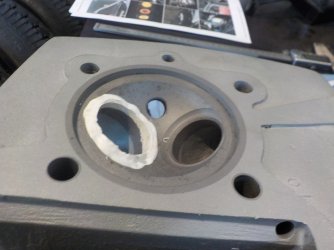
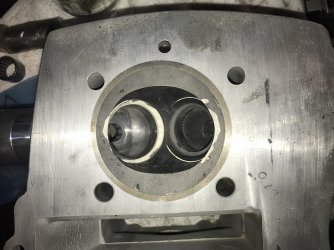
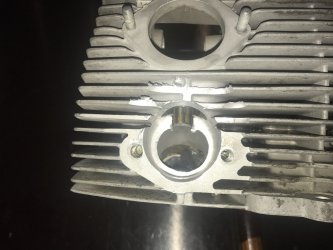
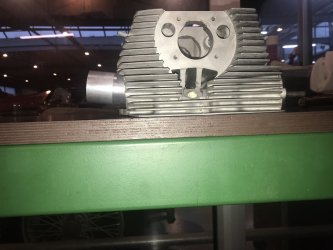
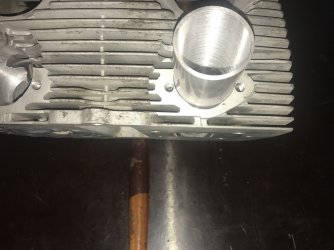
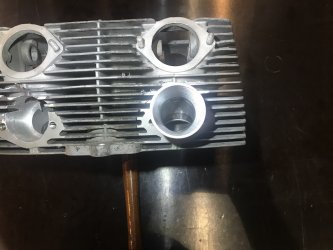
Been doing a little more to my development cylinder head,
Decided to go with my gut and get it as good as I can.
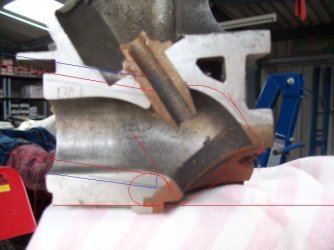
The standard ports are actually not badly shaped, however the short side curve is very close to the valve seat and this directs fast flowing mixture directly at the centre of the valve almost from the side, and not allowing much flow on the short side turn.
Not too much I can do about this because of the internals of the head, However, because I have changed the complete combustion chamber shape I was able to add a lot of material to the valve seat to bring it in further and increase the length of the short side in order to straighten the airflow as much as possible and direct it evenly around the valve head, thus increasing the short side flow considerably.
I also bored out the ports to 45mm with a downdraft angle so that I would be meeting the floor of the short side at 0, but adding about 6.5mm to the port entry height. (You can see this by looking at the original manifold stud holes.
I bored the tube with a 1 degree taper from 40mm at entry to 37mm at the short side curve entry and lightly ported it on the lower joint to get a nice light radius but as you can imagine, the top side had a good bit of work.
I nicked Phill's drawing and added some lines to show where I machined etc. and the blue shows where the tube is. (I will eventually weld the tube in place but at the moment it's a heavy press.
Julian
Attachments
G
Grant
Guest
Top stuff.

phil37
Hero member
- Location
- Lincolnshire
Nice work Julian - are you going to make a valve spring adaptor plate and use shorter springs - interested in your solution in this area as i've got a similar set-up in mind for my 860? - merry Christmas - Phil
Hi Phil,
I was intending to weld the tube to the head on the flange area and inside where the spring seat was, raise this up slightly and going to use special valve springs, been using a special type on other engines with great success so want to try here. Small, compact, large open / compressed ratio and very resistant to valve float.
Having Titanium valves made also.
Regards,
Julian

Laverdalothar
Hero member
- Location
- Germany
as the germans tend to look at the problems rather than the opportunity  , my innitial thoughs were...:
It reminds me of something...not that I want to compare your skills really with - let's say - autodidactive experiance of a well known Laverda dealer from southern Germany , who tried similar things in the 90's, ending up putting all heads on a flow-bench just to find out that the head with the best result was - actually the standard factory one... it just reminds me of the same route (changing the inlet angle to a more down-draft one), for sure the excecution was different.
Therefore, I am really interested to see where you are getting to. Hope the rest of the engine will hold up to the hopefully additional power and - not totally avoidable - heat. Don't forget the exhaust design, on both my Jota and the 1000 SFC, the difference between two systems (one optimized by someon who knows his stuff and the other one completely re-designed for the bike) was just impressive.On the Jota, the wrong system killed 20 HP Top, on the 1000 SFC the right system found another 10 Top and roughly 20 - 25 in Midrange. Pretty sure with your love to details, you will come up with some clever solution there, too!
keep us posted! exactly the stuff that keeps the winter blues away!
, my innitial thoughs were...: It reminds me of something...not that I want to compare your skills really with - let's say - autodidactive experiance of a well known Laverda dealer from southern Germany , who tried similar things in the 90's, ending up putting all heads on a flow-bench just to find out that the head with the best result was - actually the standard factory one... it just reminds me of the same route (changing the inlet angle to a more down-draft one), for sure the excecution was different.
Therefore, I am really interested to see where you are getting to. Hope the rest of the engine will hold up to the hopefully additional power and - not totally avoidable - heat. Don't forget the exhaust design, on both my Jota and the 1000 SFC, the difference between two systems (one optimized by someon who knows his stuff and the other one completely re-designed for the bike) was just impressive.On the Jota, the wrong system killed 20 HP Top, on the 1000 SFC the right system found another 10 Top and roughly 20 - 25 in Midrange. Pretty sure with your love to details, you will come up with some clever solution there, too!
keep us posted! exactly the stuff that keeps the winter blues away!