Building a race bike

Yup,

Balance shaft,  Counter Balance shaft / gear.

I recon I can modify things to work well,  Just got to calculate the exact weight for the counterbalance and where it must be as the twisted twin arrangement adds a spanner into the works because I need two masses at 90 degrees to each other and probably overlapping.  I think if I use a big chunk of Mallory metal I can manage to make it quite small and compact.  Just up-rated the needle bearing spec to cope with the extra loads and managed to get even better spec than I had wanted.  ~Yummie! 
The crank gear is 25 teeth and the jockey was 24t so have also just ordered a new 25t to replace it and have to re-calc the idler shaft bore position now.

Fun though.
J

 
I just realized that actually for a race bike I am writing bollocks!  (not my first time)

Counter balance.  There lies the problem.
Adding balance weights etc to the crank is fine and counters the imbalance.  However by adding a balance shaft / gear weight arrangement I am not actually stopping the imbalance at all,  all I am doing its cancelling it out with an equal and opposite imbalance.    Making the rider not feel the vibes but actually the forces are still there but band aided.

Am I thinking correctly???

If so then back to the original design but will keep the nice new bearings I just ordered  :LOL:

Jules
 
I don't think you are thinking wrong. The imbalance is countered out, thereby it does not manifest itself. The rider won't feel it, the frame won't suffer it, it is not there. The only downside of counterbalancers is that they add weight, which is not necessarily a bad thing if you build a super light crank. Do these trick mx and enduro singles run balancers?
Compare it to noise cancelling earphones, a counter "noise" is created at half a hertz out, thereby negating it's motpart (or is that a norwegian word? - opposite?), you don't suffer hearing damage.
 
Rode s Honda dirtbike with a chain driven counterbslancer out of wack once,it was very very noticeable. I though some pulled this off Laverda 4 valve twin race bikes to remove weight.
 
My faverite race engine design was that Ducati single,actaly a twin but with the second cylinder replaced with balancing gear.It would rev to the moon with no vib damage.Your onto something good Julian
 
julian said:
I just realized that actually for a race bike I am writing bollocks!  (not my first time)

Counter balance.  There lies the problem.
Adding balance weights etc to the crank is fine and counters the imbalance.  However by adding a balance shaft / gear weight arrangement I am not actually stopping the imbalance at all,  all I am doing its cancelling it out with an equal and opposite imbalance.    Making the rider not feel the vibes but actually the forces are still there but band aided.

Am I thinking correctly???

If so then back to the original design but will keep the nice new bearings I just ordered  :LOL:

Jules

Yes, you're talking bollocks, but not for the reason you think.

You're quite right that a counterbalance shaft does nothing to relieve out of balance forces within the engine. Pistons, conrods, crank will all experience the same inertial stresses. It just gives the structures around the engine an easier time, like the engine mounts, frame and anything attached to the frame, including the rider.

Also, your proposed counter balance weight is at one side of the engine only, so it'll introduce a rocking couple that may be as bad as the vibes you're trying to counteract. A proper balance shaft goes across the engine and has a bob-weight at each end.

However, none of that matters in your case. The main reason for your 'bollock speak' in my opinion is that the crankshaft and the idler gear are rotating at different speeds. You have 25 teeth on the crankshaft gear and 24 teeth on the idler gear. So if you stick a balance weight on the idler, it won't stay synchronised with the crank.

Cam
 
OK. I would have guessed counterbalance if I'd gleaned the 'above'.

Cam, Julian mentions replacing the 24T with a synced 25T. Yes, the balance shaft needs to counter the rocking couple - I hadn't realised (or had forgotten) that the crank will be a twister. The four-bearing crank and overall width definitely introduce a rocking couple once you phase the webs 90 deg.

I have given much thought to this with my own SFC twisted crank. I'ts now been dynamically balanced by Red's guy in Qld, and I've upped the factor from 50% (statically balanced by me) to 60% (Phil T used 65% on his twister with great results). I was in contact with a guy in Canada who does major rephasing work on Pommie race twins and he knew his stuff ... website shows pics of two-bearing cranks with the bobweights on the large inner 'flywheel', as close to the rod big end as possible. Being a much narrower package these twins don't have to counter the same degree of rock as the wide SF ones - the SF cranks are enviable in Classic racing due to their inherent strength (press fit web/pin design of the std SF notwithstanding) but the width is a prob AFIIC once we rephase them.

I posted on here some years ago my (possibly crazy) idea of balancing the outer webs of the SF(C) crank to zero (calculating the weight of that web by including the weight of the pin and possibly half the big end assembly) and shifting all the balancing work to the inner webs. I haver even started collecting bits for the experiment but until the SFQ is a real road-going motorcycle all other distractions (apart from domestic obs, family, Xmas, holidaying etc etc  :o :o :o) are out of the way I can't proceed.

A counterbalance shaft for each half might be the answer for you Julian. Any reason why you can't incorporate a wider shaft? Do racing regs require the external engine profile to remain the same as std?
 
bazzee said:
Keep it simple, then there's less things that can go wrong.

Cheers,

bazzee

Turning an SF into a 12,000rpm short stroke monster with gear primary drive and god knows what else kind of throws the 'simple' out the window, Bazzee!!  8)

But I know what you mean ...
 
The modern tech retrofitted to classic race bikes is not limited by much.Urvine Vincent and dozens of others.Good to see a Laverda step up
 
Dellortoman said:
Yes, you're talking bollocks, but not for the reason you think.

You're quite right that a counterbalance shaft does nothing to relieve out of balance forces within the engine. Pistons, conrods, crank will all experience the same inertial stresses. It just gives the structures around the engine an easier time, like the engine mounts, frame and anything attached to the frame, including the rider.

Also, your proposed counter balance weight is at one side of the engine only, so it'll introduce a rocking couple that may be as bad as the vibes you're trying to counteract. A proper balance shaft goes across the engine and has a bob-weight at each end.

However, none of that matters in your case. The main reason for your 'bollock speak' in my opinion is that the crankshaft and the idler gear are rotating at different speeds. You have 25 teeth on the crankshaft gear and 24 teeth on the idler gear. So if you stick a balance weight on the idler, it won't stay synchronised with the crank.

Cam


Hello Cam,
me thinks, you missed this one:

julian said:
The crank gear is 25 teeth and the jockey was 24t so have also just ordered a new 25t to replace it and have to re-calc the idler shaft bore position now.

Cheers
Jo

 
Hi All and thanks for your input,

Great input and additions,  Cam,  That is exactly what I was thinking,  getting rid of the feeling but not the actual forces, I did think later about the rocking couple and this added to the "throw the idea out of the window" decision.  Thanks for reaffirming. 

With the new idea of running a one piece crank we think we can lose another kilo at least from the crank making it one hell of a light crank and rod setup so vibes should not be terrible anyway  (in theory)
I have been doing some experimenting with software at a mates work where they design cranks for a living and have all sorts of clever stuff,  we recon 56% balance factor should be ideal with my rod/stroke ratio and the twisted crank. 
Now just got to get the rods finished and delivered before we finalize the crank design and counter weight design etc.
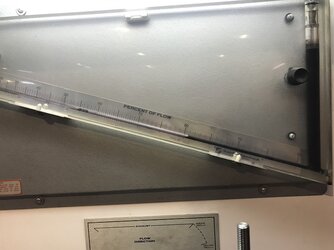
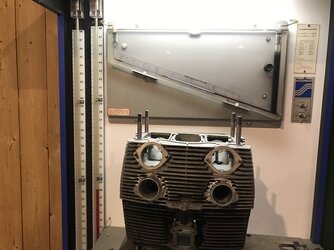
Flow bench arrived the other day and now installing it,  maybe working tomorrow, we will see,

Best regards,
Jules,  and thanks all again.


for complications try the Russian  Zveda M503 engine, 42 cylinders of diesel aero engine, one of which lucky rally goers with the Amicale Laverda 750 got to view in a French aircraft museum, or the 48 cylinder FKFS flugmotor.
CLEM
 
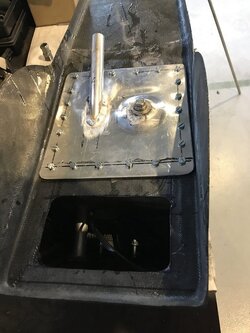
Just in the middle of making my breather / oil catch tank,  regs say 2 x engine capacity so not a small tank,  Found a great position for it and a way to make it super light weight,  Think it will only add about 200g tops according to my calculations and needs no brackets so saves more weight.  Easy access also.  Will show pictures on Saturday as hope to finish it then.

Regards,
Jules
 
Quick picture of where I made my engine breather tank. Behind the seat in a nice vacant hole, glassed up the front and back, ally plate on the bottom with sump plug and stand pipe, Ally tube bonded in at the top and exiting the tail near the light, baffled inside and hey presto.
 

Attachments

  • engine breather tank small.jpg
    engine breather tank small.jpg
    147.8 KB · Views: 87
Then played some more on the breathing.

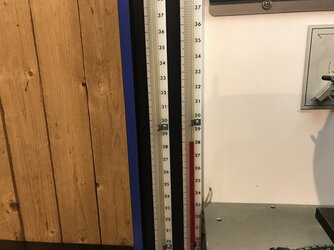
Inlet tested on the old head was a quite good 172cfm @ 28" pressure drop at the same lift as I am using on the special head.
Exhaust tested at 132cfm

New head after a few forgotten to do moments and a little gentle coaxing, (not finished yet but close I think) I got a staggering 235cfm from the inlet and 202cfm from the exhaust with very good numbers all the way through the lift curve from both.
Going to go up a little on inlet valve size to lower the mach number as am in the upper realms of max @ 0.57 so hope to get a little more flow and a mach of about 0.54
Both ports are unfinished and only with very basic 3 angle seats at present but good enough to stop shortly and use as a pattern for machining. Very pleased with the results. Hope to see 250cfm and a Mach of 0.53 - 0.54 and 202cfm from the exhaust is ample.

Did a couple of tests on the inlet with the carb attached and saw a 1cfm drop so obviously the carb is flowing very well. Going to also do some carb alone tests to see how the bell-mouth is working.

Fun but very time consuming.

Jules
 

Attachments

  • IMG_5675small.jpg
    IMG_5675small.jpg
    149.5 KB · Views: 104
  • IMG_5674small.jpg
    IMG_5674small.jpg
    142.8 KB · Views: 97
  • IMG_5673small.jpg
    IMG_5673small.jpg
    167.6 KB · Views: 107
Back
Top