Carb insulator removal

smlav

Senior member
Location
Shropshire UK
I have a GTL fitted with SF1 motor, and it has PHF 36mm Dellortos’s which I think came from a Guzzi Lemans. The GtL airbox is gone, and there’s barely enough room for the carbs to fit in the frame, they just touch some of the brackets where the regulator mounts.

I’m planning on fitting something like K&N or similar filters. Ideally I’d like to get inlet manifolds/stubs that have an angle to lower the carb by a cm or two. Is there such a thing?

Is it safe/practical to remove the insulator that lies between the inlet stubs and the head? The rubber boot between carb and stub should give enough insulation I think.

I am going to replace the ancient inlet balance pipe with something which can cope with modern fuels. Any tips for where to get something, can’t seem to see anything on usual vendors.
 

Attachments

  • IMG_6485.jpeg
    IMG_6485.jpeg
    192.8 KB · Views: 34
very (very) late GTL's were (sometimes) fitted with 36mm carbs as SF!, 2, and 3. your setup is all wrong, no road 750 Lav ever had rubber tubes and two jubilee clips, the SF1,2,3 type carbs are spigot mounted and the insulator is a plastic sleeve in the engine side kneck of the carbs, this would move them a fair bit closer to the engine and absolve your clearance problems, however, the vast majority of GTL's had a square slide Dellorto carbs called VHB30, it may be that your inlet manifolds as shown are for this carb fitting, not hard to obtain on the used market, or if the manifold suits, try getting some PHF32's with spigot mount, THEY ARE GOLD DUST because owners wiggle them off the stubs and break the female spigots in the process, there will be a way, take the carbs off and measure the stubs on the engine as a starter. the engine number in full and the chassis number would be a help here, was it new in UK?, does it have an alternator or a dynamo?
CLEM
 
Thanks Clem. The small valve GTL motor which was original is sat in boxes waiting a trip to Glasgow. Meanwhile the bike has a large valve SF1 motor, has the straight inlet manifolds, bit the carbs didn’t come with the motor, they came from eksewhere. Guzzi Lemans I think. So if I read you correctly, I need to source the correct bit that gors between Carb and inlet stub, to replace those rubber hose bits, and that will shift the carbs forward enough to clear the regulator bracket. It’s a UK GTL, dynamo.

Thanks
Sean
 
No, you need to source the type of carb used on SF1/2/3. They will be 36mm and will fit straight onto the alu stubs. The internal passages using those Guzzi carbs and that rubber will be awful. Withe the right carbs it'll all fit together beautifully and you can then fit the airbox and intake rubbers.

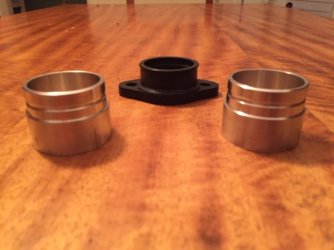
Alternatively you could source some Mikuni rubber inlet manifolds as shown (middle) in my pic. But to my mind that setup would be too short in the manifold department and you'd lose midrange.

Inlet manifolds nearly done.JPG
 
The carbs currently fitted are PHF 36mm, which I believe came from a Guzzi but cannot be certain. Is there a difference between PHF 36 SF1/2/3 and PHF 36mm from Guzzi Le Lemans (other than internal brass ware)?

The bike has run on those carbs okay, decades ago mind you, I’d just like to get rid of the rubber bit between carb and manifold and make things tidier.

Issue with airbox is that the GTL has different brackets than SF1..3. I’ll be okay with K&N types if I can get them in there neat without air leaks. Bike is for gentle riding.

Thanks
Sean
 
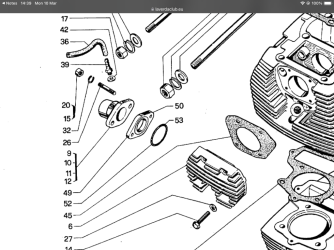
So if I understand correct, the carb should just pop straight on to what is labelled as 9, 10, 11, 12 in the picture below, grabbed from parts list. And if it’s mounted direct, then item 50 (insulator) is required. I’ll set about removing the carbs, see if I can figure out why this bits of rubber between carb and manifold were put there.

Thanks again for the knowledge folks
Sean
 

Attachments

  • IMG_0150.png
    IMG_0150.png
    527.9 KB · Views: 11
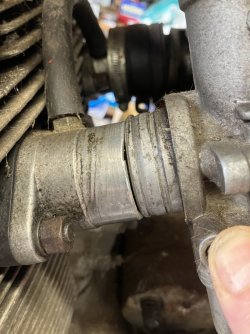
Removed the rubber connector and see that carb is same diameter as inlet stub, and therefore won’t slide over inlet stub as which suggest PHB for Guzzi is different to PHB for Laverda in the way it connects to the inlet stub.

Don’t suppose anyone has a picture o hand of a Lav PHF at end where it fits on to inlet stub?
 

Attachments

  • IMG_6487.jpeg
    IMG_6487.jpeg
    149.6 KB · Views: 25
Here some Fotos
 

Attachments

  • IMG_20250310_174048.jpg
    IMG_20250310_174048.jpg
    143.7 KB · Views: 15
  • IMG_20250310_174130.jpg
    IMG_20250310_174130.jpg
    99.3 KB · Views: 15
  • IMG_20250310_174006.jpg
    IMG_20250310_174006.jpg
    170 KB · Views: 15
So now the issue is which carbs and where from. I’m reluctant to use eBay etc, and the only supplier I can find listing them is Andy Wagner, but they’re about £600 for the pair! I prefer the idea of going Mikuni, which a search through the forum gives the impression provide better low and mid range, which is what I’m interested in, and they are said to be half the price of DO. But which models and where to get them? Any advice appreciated, I believe Keith N has them, but he‘s a bugger to get hold of.
Cheers
Sean
 
there is nothing wrong with using your current carbs
remove the insulating flange behind the Inlet manifold and just use the rubber coupling to join the carb to the Inlet manifold
which was your original question

Is not going to be standard but will work just fine and will save you a lot of fucking around
 
there is nothing wrong with using your current carbs
remove the insulating flange behind the Inlet manifold and just use the rubber coupling to join the carb to the Inlet manifold
which was your original question

Is not going to be standard but will work just fine and will save you a lot of fucking around
Thanks Red, that was my gut feel, but I’m no expert. Couldn’t care about original, just want rideable.
Cheers
Sean
 
The first time I ever heard about insulators on inlets was on Bonnies, apparent the concern was vibrating the fuel in the bowl or heating it enough for the bike to run badly.
 
If you go Red's route (simplest and least expensive) make sure the alu inlet manifold seals completely against the mating surface of the head. The insulator you remove has an o-ring on each side that does this.

mikunioz.com in Australia have a stack of suitable manifolds that I'm guessing the Guzzi style male spigot carbswould fit straight into - and they seal against the head.

Unfortunately, the insulator also allows the inlet stub flange to distort when over-tightened, a very real possiblity looking at the pics...

The inlet stubs should ideally be modded to have the rubber connectors seat positively and firmly on them, hoping on only a jubilee clip to keep things inline is quite ambitious if the carbs are not further supported at the intake end, eg, by an airbox. Mk II inlet stubs could be used for the 750, the balancing barbs would be lost though. These stubs accomodate a sealing o-ring and are meant to be fitted without the insulator. Most PHB/F versions have a blanked-off bore for a vacuum take-off, as used on triples and the 500s. Not too difficult to modify though if not featured.

The clamp-type PHB/F carbs were discontinued around 1977/78, the spigot/rubber type introduced around 1976, gradually replacing the clamp type. The transition at Laverda took place shortly after the introduction of the Mk II engines. Mk II started from #7237/1000 annd #3063/1200. The spigot carbs from #7518 and #3308 respectively. No production 750s were fitted with the spigot type. 500s also had the clamp-type through the entire production run.

If the pictured carbs are from a Guzzi, they will most probably have a different type of atomiser tube fitted than the type used by Laverda. I retro-fitted the tubes from my original PHF32 to the PHF36 that I sourced from a Guzzi LM I, which made set-up a doddle.

piet
 
Last edited:
Thanks Piet, all useful information. Was that the twins which switched from clamp to rubber type connection, or the triples. I was getting the impression from the info in this thread that the twins were all clamp. I was speaking to a mate who is into Brit bikes, and he thought that the connection via rubber clamp/boot had the advantage of protecting the carb from vibrations. If I could find a rubber clamp that had a 20 degree bend which would allow lowering the carb away from the frame and brackets I think that would work, and I could keep the insulator along with it’s O ring. Thanks for highlighting need to support carb at rear if it’s not got an air box. I’m still climbing this learning curve.

Cheers
Sean
 
Back
Top