Clutch arm stops on outercase

Elf

New member
Location
Danmark
First of all I want to thank all on the forum for sharing their knowledge 😁
I have read much about clutch issues but haven’t found what needed.

This is my first post ☺️

New owner of a 1000 3cl 1973.
PO imported from Spain to Denmark installed 4c cams and HC pistons.
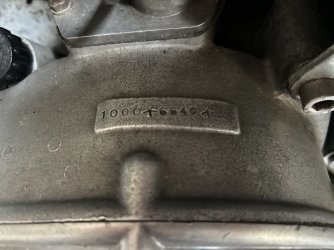
Different motor serial number, year? See fotos.

Question:
The clutch lever arm stops on the outer case and doesn’t allow the clutch to engage.

Done:
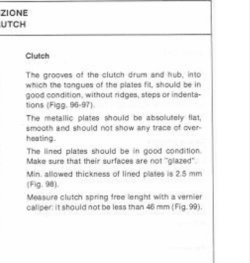
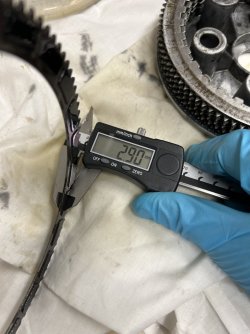
- opened primary case to check min allowed measure, plates 2,6-2,9 - springs 47-48.
- pushrod free of movement, can see ball being pushed toward the clutch arm

Question:
Can this version of the lever (see foto) arm allow the plates to compress?

Thanks in advance for any help 😊
 

Attachments

  • IMG_0852.jpeg
    IMG_0852.jpeg
    112.9 KB · Views: 44
  • IMG_0845.jpeg
    IMG_0845.jpeg
    142.4 KB · Views: 42
  • IMG_0846.jpeg
    IMG_0846.jpeg
    121 KB · Views: 45
  • IMG_0852.jpeg
    IMG_0852.jpeg
    112.9 KB · Views: 49
  • IMG_0853.jpeg
    IMG_0853.jpeg
    767.1 KB · Views: 38
This happened to me the first time I made and fitted one. What you need is a slightly longer clutch pushrod. That's one of the 2 with a ball bearing between them. that crosses across the case to the clutch. The difference between success and failure is only tiny, 2 mm is all it takes. Don't do what I did and make it out of Stainless Steel rod. That lasted 20 minutes. The Standard rods are made out of heat-treated tool steel, which can take a very big point load. I am a bit surprised your pro kit didn't work; mine was home-made. To me, this is a game changer, I was damaging myself using mine. It's an eternal argument re this, some bikes don't need it, mine absolutely did
 
Only if they were compressing before fitting. The kit is designed to give an easier lever operation.

Coming from Spain, makes one question if the rod is factory, as mentioned by Vince, previous owners can attempt to make an easy fix because they live in Bum Fuck Nowhere, but can fuck things up without knowing any better.
 
It looks like I wasn’t clear 😊

The question is:
What if I swap the original clutch arm which the one on the foto? I aspect the pushrod to move to the right and give room for the plates to be compressed from the springs.
 
Not easy to explain if English isn't your first lingo. I think you mean the lever goes too far to the RiGHT (when sitting on the bike) and contacts the outer case before the clutch engages (as in connects the engine to the rear wheel)? Is this the problem? If so, the replacement lever won't change this - the shape of the part within the case isn't different - it's just longer, designed to reduce the travel produced by the handlebar lever, thus reducing the effort needed to operate it.

When the clutch cable is removed there should be free movement of the lever in the case in and out, ie, there should be no pressure being exerted onto the pushrod.

My advice would be to remove the right hand cover and check everything: length of push rods, proper size ball between them, proper sized ball in the cover itself that the lever pushes against. Then you'll have the learning experience of refitting the cover (plenty of tips in here if you search) and hopefully won't have to adjust the selector system.
 
The clutch plates sound a bit thick, should be around 2.6mm max. 7 x 0.3mm = 2.1mm, this adds up to a lot of extra travel required to deploy the clutch. Thickness of plain plates? There's not much room for any great deviation of the total lever travel inside the sprocket cover and you only have a window of around 10mm where everything chimes in nicely. The thinner the plates, the further the pushrod protrudes from the mainshaft, allowing for maximum lever movement.

Could also be worn push rods, perhaps the ball between the rods is missing?

When all is in order, the outer edge of the actuating arm should be about 3-8mm from the inside of the inspection hole in the sprocket cover.

piet
 
Last edited:
It looks like I wasn’t clear 😊

The question is:
What if I swap the original clutch arm which the one on the foto? I aspect the pushrod to move to the right and give room for the plates to be compressed from the springs.
Looks like you're misunderstanding. Something is at its limit, before attempting a cure you need to address the symptoms. It's not rocket surgery... :rolleyes:

The pictured lever is only a bit longer than the original to ease clutch action, the actual throw at the clutch is in fact considerably reduced. Chances are the special lever won't even allow the clutch to be deployed at all! Once the clutch works satisfactorily, you can decide if you still need that lever.

piet
 
Check for the cross bar in the clutch assembly. If missing the whole caboodle will not work.

Gerald
 
"Question:
The clutch lever arm stops on the outer case and doesn’t allow the clutch to engage."
Is the question that the clutch does not engage? By this I understand that the clutch plates are kept loose against the springs, dis-engaged, as when you pull in the clutch lever. All the answers are addressing the clutch not dis-engaging.
 
My misunderstanding, my old issue was that the clutch arm hit the inner case, and the fix was a longer rod.
 
My misunderstanding, my old issue was that the clutch arm hit the inner case, and the fix was a longer rod.
Same here...

Either way, investigating why is the first step.

Something VERY wrong if the lever hits the sprocket cover. Disassemble, check and assemble correctly.

As Chris has mentioned, spanish bikes are notorious for their bodges.

piet
 
You, me, Lee and Vince, Piet!! I asked for clarification of two things, without which it's impossible to determine anything. If you don't know the problem you sure as hell ain't gonna find the answer!! I understand trying to explain in English would be tricky if it's not your mama tongue.

We're both in agreement that the sidecover needs to come off and everything checked - without doing that it's just pissing into the wind.
 
You, me, Lee and Vince, Piet!! I asked for clarification of two things, without which it's impossible to determine anything. If you don't know the problem you sure as hell ain't gonna find the answer!! I understand trying to explain in English would be tricky if it's not your mama tongue.

We're both in agreement that the sidecover needs to come off and everything checked - without doing that it's just pissing into the wind.
...and getting your feet very wet.:ROFLMAO:

piet
 
Crossbar in place
 

Attachments

  • IMG_0869.jpeg
    IMG_0869.jpeg
    112.5 KB · Views: 40
  • IMG_0871.jpeg
    IMG_0871.jpeg
    135.4 KB · Views: 37
  • IMG_0868.jpeg
    IMG_0868.jpeg
    107.9 KB · Views: 37
  • IMG_0866.jpeg
    IMG_0866.jpeg
    86.5 KB · Views: 32
  • IMG_0865.jpeg
    IMG_0865.jpeg
    75.8 KB · Views: 32
  • IMG_0863.jpeg
    IMG_0863.jpeg
    142.4 KB · Views: 33
  • IMG_0862.jpeg
    IMG_0862.jpeg
    165.9 KB · Views: 31
  • IMG_0861.jpeg
    IMG_0861.jpeg
    144.8 KB · Views: 33
  • IMG_0859.jpeg
    IMG_0859.jpeg
    184.4 KB · Views: 34
To my eyes, in the pic of the lever in the case off the bike it looks as though the ball is too close to the opening, considering that the lever is all the way back against the cover. The pushrods are the correct length and protrusion though the output shaft looks good, so the only thing that can be pushing on the rod is the ball in the cover.

I'd reassemble the clutch, fit the rods and the central ball and fit the cover without the bolts - if the inner surface of the cover doesn't clearly contact the case without any pressure being exerted on it, then the lever and ball assembly in the cover is the cause. I'm putting my oney on that being the root cause - why it's happening, we won't know until you look into it.
 
Back
Top