Dellorto floats

Garry

Junior member
The RGS drives me crazy sometimes...😱
I have/had the problem that after driving for about five minutes, it would run on two cylinders and sometimes on just one. Because I’ve completely restored it and replaced or modified all sorts of things, I didn’t know where to start looking...
Eventually I got round to the Dellortos, where I replaced all the brass parts (jets etc.) and the throttle needels, as well as the floats.
The black 10g ones were no longer available and were replaced with the equivalent type 7450-01 in white.
When fitting them, I didn’t compare them with the old ones, only to discover that these are actually the right ones.
I swapped the floats back to the old black ones, and only then did I notice the differences.
Looking at the photos, does she get too much fuel with those white ones?
Which might explain why she then runs on just 2 or 1 cylinder?
After a short test drive, she does indeed run better and the exhaust headers are turning more brownish-blue.
A longer, more thorough test drive will show whether this was indeed the problem.

Does anyone have any experience with these white floats?
 

Attachments

  • IMG_20260521_132609687_HDR_AE (1) (1).jpg
    IMG_20260521_132609687_HDR_AE (1) (1).jpg
    214.8 KB · Views: 42
  • IMG_20260521_132509131_HDR_AE (1) (1).jpg
    IMG_20260521_132509131_HDR_AE (1) (1).jpg
    266.7 KB · Views: 39
  • IMG_20260521_143449052_HDR_AE (1).jpg
    IMG_20260521_143449052_HDR_AE (1).jpg
    130.4 KB · Views: 36
  • Screenshot_20260521_150218_Opera.jpg
    Screenshot_20260521_150218_Opera.jpg
    58.5 KB · Views: 40
I have heard that the first white ones they produced even splitted in half at the seams if ethanol was present.
Problems with the seams is a known problem. I guess even if they got their glueing process sorted at some stage, and if people avoid these like illness, there may be old stocks of faulty ones available for long time, and even longer if first-in-first-out is not working for the stocks that is often the case. I don't know if there is any batch identifiers on them. I don't know what would be the results for durability if all of the stocks would be somehow properly tested against leaks, at least I have checked mine not to leak, at least when new and again shortly after, still ok after several years and fingers crossed.

These white ones have thin walls with glued seams, the earlier black ones have thick walls and mold in place. Now I don't remember if one black I sawed open was hollow or solid inside, but at least very thick walls.

I think in the US alcohol fuels may have higher content of methanol than usually in the Europe. In Finland petrols available everywhere are 98E5 (5% ethanol max.) and 95E10 (10% ethanol max.), this is defined in fuel standard EN228, the value is maximum, not minimum. I think the stuff should be according to DIN EN 228 in Germany.
The Finnish fuels are poison for carburettors. Then we have a so called distribution obligation that means some percent of the sold fuels must be renewable, 19,5% at the moment, but this does not violate the maximum limits in fuel grades, most of the renewable stuff goes to Diesel and other fuels. I think similar should apply in EU. I don't know if in Germany they add some protective additives to their fuel or if there is some other differences. I open the bowls once a year for used bikes and there is grey dust at the bottom of the float bowls, and at least some of this originates from the Aluminium. Gumming of the fuel is also a notable problem, I find often, green, yellow, or white gum inside carburettors, sometimes even solid as plastic. Very notable precautions are a must. Carburettors in cars may work a couple of years without bigger maintenance. Finnish fuels used to achieve very low levels of Sulphur. Suplhur is known to cause corrosion and was a notable issue in many places especially some decades ago. I have thought about going to the later anodized Dell'Orto carb bodies (darker grey colour) and black plastic bowls on some bikes.

I have not got any issues with the mixtures, and I did not noticed any difference on the AFR meter when the floats changed from black to white. I guess that the white floats probably have smaller volume achieving similar density, for example, they don't have the wings on the button shaped floats. The part number was not changed, which to my understanding should mean a replacement on Dell'Orto, but this does not itself prove anything. I'm not stating for sure they are like this without studying them further, but I suggest some people should check again the laws of the physics.

In Finland we generally use 98E5 with valve guard on these Laverdas, except some rare ones confirmed not to need the valve guard. If some rare engines need over 100 RON fuel, then we lower the compression and use again 98E5. In Finland the standard pistons last normally around 300 000 kilometers in these big Massimo era twins and triples, not necessary in SFC spec engines, and I don't necessary suggest this result for all aftermarket pistons e.g. short skirt racing pistons. Valve train components also normally use to last n x 100 000 kilometres. This is how it has been normally last several decades.

People read such, strange answers, when reading this site such pistons need to be replaced after every 50 000 kilometres and valve seats are sink out of the adjustment range after every 80 000 kilometers.
We don't have many of the strange piston, combustion chamber, and valve train problems reported then and then on this forum.
Using lower octane rating fuel than designed is generally known to sensitize engines to these failure modes especially if something else fails.
As a general rule of thumb, in engines there should be safety margin designed-in for one fault at once, not for all of them, and not for two at once. Lower octane rating fuel also causes lower engine output.
Retarding ignition is generally known to increase heat load for exhaust valves, sensitizing them for heat problems especially if paired with other faults.
I suggest to read engine building books, one good one in English and well available is A. Graham Bell's Four-Stroke Performance tuning. Much of the content in the book is based on scientifically or other way well verified information. I seriously suggest to have a second thought for this "out of the box" thinking.
If some day there will not be 98 RON available anymore in Finland, I think we will lower the compressions mostly by changing pistons, and then we do the same again with somewhat lower engine output.

Well, I can say that I genuinely think that there very likely will be even more strange answers especially for this one, and I already know the formats of them - take popcorn and more beer for reading further replies.

And what, no proper output on a Laverda engine...

-Jouni
 
People read such, strange answers, when reading this site such pistons need to be replaced after every 50 000 kilometres and valve seats are sink out of the adjustment range after every 80 000 kilometers.
We don't have many of the strange piston, combustion chamber, and valve train problems reported then and then on this forum.
Jouni,

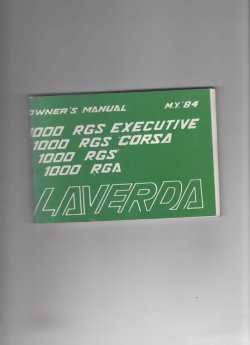
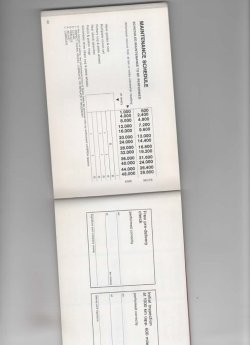
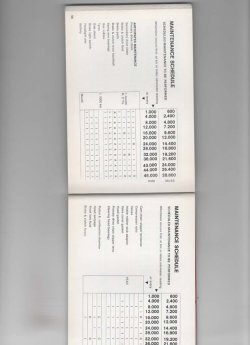
I may have mentioned it here in the past, here you have it black on white...Scan_20260530.jpgScan_20260530 (2).jpg

From the factory owners manual for the 120° models. You will see that replacing the pistons and rings at 48000km is shown in the maintenance schedule. You will also see the factory recommended replacing the entire clutch plate set, rear shocks, primary drive sprockets along with the final chain drive at the same time.

Of course, nobody bothers to do this, not even I... but it tallies with my experience of finding worn top piston ring grooves on pistons of more than approx. 60000km. Stock Marzocchi shocks of the period were knackered within 30000km, final drive chains rarely lasted more than 25000km. The factory was aware of all these issues!

For the non-believers, primary chain replacement, along with a couple of other points;


Scan_20260530 (3).jpg

I've also repaired more than my share of knackered cylinder heads with recessed seats, these also are not a myth.

HTH,
piet
 
Yes, for example in Germany and possibly in the UK and some other countries fuel still in 1980's had a notable amount of Sulphur. This is also generally known to cause wear on the piston rings, and was a notable factor back in the days, especially if engine oil was not changed when should. Nowadays when there is no such amount on Sulphur, I suggest the same result can be achieved by using fuel with lower octane rating than designed, that is also generally known causing faster wear.

Laverda wanted to sell more parts, and at the end they wrote the shortest found intervals from differing countries in the manual for some components, sort of just in case. In some cases, replacing valve springs every time when opened in RGS manual, I don't find this necessary. Replacing valve springs by kms would be better for some of the the late 1970's heads that use to break springs. I think replacing RGS springs by length measurement would be the normal need if no excess amounts of kms. In some cases, like the pistons, can be replaced according to inspections. In Finland it is normal if taking pistons out, for example, after 150 000 kilometers and the ring clearances are still ok, not causing the engines turning to giant oil pumps. The pistons go back again (usually new rings + honing + old cleaned pistons).

For example, my SFC 1000 was imported from Germany in 2001 and had burned exhaust valves after 10 000 kilometers in Germany, machined, then at 20 000 kilometers it was imported to Finland. I opened the engine, the exhaust valves were burned again, and the base ignition advance was set to 2-3 degrees retarded. I suggest that 95 RON or similar was used without valve guard. I replaced all of the valves, the seats were cut just by touching lightly on MIRA. Base advance set standard, 98E5 in + valve guard. Now after a couple of 10 000kms, just nothing happens and they stay. Not differing anyway from other bikes in Finland that use to have much more kilometers on them.

I think for things like shocks and secondary chain short intervals are normal, and even they can be replaced by inspections.
Personally I very dislike all shocks that are not intended to be maintained by disassembling them. These are generally assembled by pressing methods and even oil is not intended to be changed. I use to drill oil change holes on them and replace the oil, use to go a couple of maintenace rounds.

In Finland the first Laverda importer ordered one kit of spare mass plates for clutches in 1970's. The kit was finally sold in 1990's. The mass plates were also replaced by measuring their thickness, if nothing else was wrong on them.

-Jouni
 
Last edited:
Back
Top