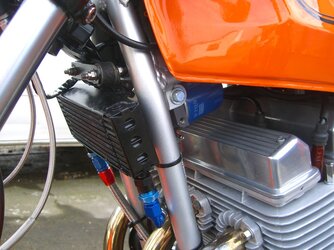
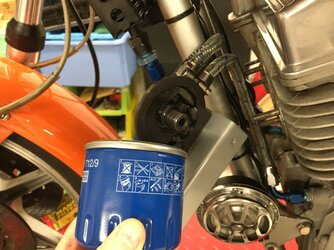
External Oil Filter/Magnefine Setups

There is the Austrian Tuscher bike that the owner modified to take a spin on oil filter direct onto a machined section on the front of the lower engine case, that was very neat and I would have looked at doing the same but I had already finished building the Motodd engine before Mike asked me to install an oil filter
... slightly correction Red: Hans Tuscher is in Bavaria/Germany at home, not far from the Austrian border. Ciao, Gert
 
Meaning that Laverda oiling doesn't rely on pressure, there's hardly any. It's a ball and roller bearing engine. Just one step ahead of engines relying on oil mist.

Paul
I think that was what I said in my post.. roller bearings except for the camshafts ( which has plain bearings ). Anyway, as said, when measuring with and without filter there was, because of cold thick oil, a measurable pressure and when hot no measurable pressure ( the filter made no difference ). More than 40 years ago I put a pressure switch / warning light on my Honda cb 450 and had the same experience ( by the way only centrifugal filter on that one ) and roller bearings except for the camshafts.
Friend had for some years an SFC 1000 which had an oil pressure warning light on the instrument board which was´nt connected and without the switch. He wanted that to work and put on a switch, but the lamp glowed all the time when hot motor until he found a very sensitive switch from some Jap bike, presumably from a Suzuki - Yamaha - Kawasaki with rollerbearing cranks.
 
Amongst all the pro-and-cons of fitting an oil filter, I think there is one thing that is essential to do, and that is to assess the oil pump for wear before doing so. A near worn-out pump is happily able to just spin in its own space, providing little oil displacement. Especially so when presented with the extra upstream pressure drop of a more complicated oil routing.
 
I think that was what I said in my post.. roller bearings except for the camshafts ( which has plain bearings ). Anyway, as said, when measuring with and without filter there was, because of cold thick oil, a measurable pressure and when hot no measurable pressure ( the filter made no difference ). More than 40 years ago I put a pressure switch / warning light on my Honda cb 450 and had the same experience ( by the way only centrifugal filter on that one ) and roller bearings except for the camshafts.
Friend had for some years an SFC 1000 which had an oil pressure warning light on the instrument board which was´nt connected and without the switch. He wanted that to work and put on a switch, but the lamp glowed all the time when hot motor until he found a very sensitive switch from some Jap bike, presumably from a Suzuki - Yamaha - Kawasaki with rollerbearing cranks.
I had a pressure switch on my SFC. It was fine a steady speeds but would light up when accelerating showing that the pump probably wasn't picking up oil any more, the oil having migrated into the gearbox.

Paul
 
I dont need an external filter simply because my old motor (built from used parts of unknown mileage) is totally knackered and needs a bit of fresh stuff after 1000 miles, about half a litre usually does it, you could call it total loss (note lower case "t") since if you didnt top it up you would have totally lost it, after about 6,000 miles, it would have all gone, but the motor would probably have stopped a bit before that. I did one time decades ago do an oil change in a gravel layby in Italy, that was a total pain, more oil on the floor than anywhere else, and I had to carry a cut out pastic 5 litre can all the way with me, old oil out,new oil in, very slowly due to not having an auto transmission filler which I use at home, but a simple (P J Todd designed) folded bit of alloy sheet, and when done the old oil dropped in a rubbish bin! none of that is environmentally friendly, so I now never bother, and I am not fussy about what oil to buy when I top up, just try to get 20/50 but usualy fail on that respect as well, a full sump of not quite the right stuff is better than a half full sump of the bang on stuff. I do start every long trip on fresh oil, currently using Silkolene 20/50 classic diesel car engine oil.
CLEM
 
Quick question from an ignoramus, which way does the oil go through the cooler, left to right or right to left ( sat on the bike that is )
 
I thought I would jump in with a few points, my apologies if I repeat what others have already said.

The facts:

1. Oil from the pump comes out of the LH side front of the engine and back in on the RH front side, seen sat on the bike.
2, The mesh in the sump is their to protect the oil pump from large debris pieces. it is not in itself an oil filter.
3. The oil pump is a positive displacement pump. i.e. it will pump a set amount of oil per engine revolution almost regardless of restriction.
4. Oil filters (spin on or cartridge) are designed to be just that and to minimise pressure differentials between inlet and outlets.
5. Yes, changing your oil regularly is a good thing in an unfiltered engine such as a Laverda.
6. However an oil filter will ensure that clean filtered oil is delivered to the expensive parts of your engine continuously and not just at the point of an oil change.
7. Full synthetic oil of equivalent viscosity range (i.e. 20w-50) will always be superior to mineral oil, will last longer and will keep the insides of your engine cleaner. Synthetic oil tends to carry debris in solution therefore should be used in conjunction with a full flow oil filter.
8. You can fit an oil filter, still use mineral oil and still get benefits.

My observations:

a. My original timing side ball main bearing (mineral oil / no oil filter) failed at 73,000 miles (117,000kms) in 1993 due to oil borne debris contamination. (based on a cut up failure analysis report by SNR bearings of Annecy) . The rebuild crank, was run with full synthetic oil from the outset and used in conjunction with a full flow oil filter fitted behind the oil cooler under the tank). It has done a further 91,000 miles (146,000kms) and sounds just sweet. The engine remains beautifully clean.
b. I can ride the bike from here in the UK, down to the Breganze 75th and back and then onto various other events without needing to change the oil. I normally change the oil at 4,000 miles (6500kms) and the spin on filter at every other change.
c. The oil appears to remain cleaner for longer.
d. Fitting a full flow oil filter is relatively easy and well within the capability of most competent mechanics / engineers. Just make sure it is plumed in the right way round!
e. I changed my oil pump to a 9mm unit from an RGS Corsa but only because later versions of the triple had wider oil pumps fitted by the factory.
f. The neigh sayers abound on these forums but never seem to produce any empirical evidence to support their dire predictions. Look at the engineering facts and first principles to satisfy yourself of the benefits.
g. Enjoy your ride knowing that your engine is receiving continuously filtered clean oil at all times!

Nick
 
Nick,

Your observations correspond to my findings that I reported here many years ago. A filter was fitted in conjunction with a full and very thorough engine rebuild for my 3C in 1991/92.

The only negative running full synthetic 10W60 was a slightly noisier top end, especially when hot.

I stretched my change intervals to 4000km based on my experience with Harley Davidson Evolution engines, which have a very similar lube system. The filter was renewed every 2nd oil change. The engine internals were spotless at 70000km when I swapped out the crank for a lightened item, together with a set of 78mm pistons. The sludge traps in the used crank held about 1 mm of soft sediment. In my long experience with Laverda engines of all types, such a mileage would normally result in about 3-5mm (depending on maintenance routine) of hard sediment in the traps, which is proof enough for me that a full-flow filter is extremely efficient.

piet
 
I dont know enough, to enter in to the debate here, though find it fascinating.But how can it be that Laverda didn't design a proper filtration system, though? Was this unique at the time? Look at my humble XT500, 1976 launch,1 spin on filter, 2 fine mesh filters... and things have gone on apace, witness my 2022 Husky 701sm with Ktm 690 single cylinder? No less than 2 spin on filters, yes 2, plus 2 very fine cylindrical fine mesh filters. Even my 1978 XL125 had a cleanable centrifugal trap....so, did any other manufacturer go the non filtration route?
 
Possibly has something to do with the school of design. The Laverda triple was laid down in the early 70's and was largely based on the 750, which debuted 1966. Laverda oil change intervals were specified at 2500km, fresh oil was considered the better option. Not many italian bike engines had effective removable/cleanable filters back then, most had a simple strainer. Guzzi V-twins come to mind, but their spin-on filters were IN the sump.

Laverda triples may have been sold up to 1989, but the basic design was firmly rooted in the late 60's and hadn't changed much.

The oil slingers on the Laverda crank are actually very effective, they catch most of the solids floating around. Seeing how full they are at around 150000km gives an idea of the life span the designers envisaged for these engines. Given the metallurgy found in these engines, they're generally pretty worn by then. Massimo wanted us to buy a new bike every couple of years, just like everybody else in the business.

Oil tech has also moved on, modern engines make the most of the benefits it offers. Despite your Husqvarna having that many filters, I wouldn't expect it to last as long as most Laverdas do/did. Modern bike engines are pushing out more than double the specific power of our old clunkers, a tribute needs to be paid. The filters are required to retain the tight machining tolerances these things are built to, but they will also eventually go bang. A mate that worked in a fairly large KTM dealership until recently has enough tales of woe.

Filter-less engines, simply the way it once was. Live with it, or do something about it. I've never heard any complaints about 60's Ferraris not having electric windows, or DB6s not having ABS...

piet
 
The oil slingers on the Laverda crank are actually very effective, they catch most of the solids floating around. Seeing how full they are at around 150000km gives an idea of the life span the designers envisaged for these engines.
Well said. And that is my whole point. My crank is now on 146,000kms, if it were in an unfiltered engine I would be expecting a failure fairly soon, mid France on my way down to Breganze, not good! But as it is the engine is running beautifully and although I'm not about to strip it to make a point, I bet my crank will run on and on. And its not just the crank, its lower piston and bore wear, plus all other moving parts in the engine. Big £££ $$$ €€€€ to replace!
For a small investment I have probably saved a whole load of money on expensive engine repairs.
 
I reckon it's a great idea. not sure where I'd mount one on a twin (no lower frame). is there a particular type of filter that needs to be used with Laverda type oil pumps (high volume but low pressure)?
 
I reckon it's a great idea. not sure where I'd mount one on a twin (no lower frame). is there a particular type of filter that needs to be used with Laverda type oil pumps (high volume but low pressure)?
Ok, a gear type oil pump as mentioned before is a positive displacement pump. It is not high or low pressure or high or low volume. Any pressure is due to back pressure and the flow is entirely dependant on the capacity of the pump and the speed it is rotated at by the engine.
As for filters, I started using Harley ones as those engines also have a gear type oil pump feeding a roller crank i.e. old style air cooled engine. Now I just use any spin on car or motorcycle oil filter that will fit nicely. They are all basically the same inside.
The hot oil comes out of the engine to the filter via its remote filter head first (as hot oil is thinner and should pass through the filter easier) then from the filter it is looped back into the oil cooler and then the cleaned and cooled oil is passed back into the engine.
I use full synthetic 20W-50 motorcycle specific engine oil.
As for twins, I have seem them with the filter head mounted in line with the dynamo. However, I believe you will need to drill and or weld on the outlet / inlets first. This clearly cannot be done with the engine in one piece.
 
That Mocal is really neat, I plan to fit a filter to my ex race SF motor via the currently blanked off oil cooler stubs. Good stuff, had been wondering what to get.
 
Back
Top