Fuel stabilizer for off season motorycle storage

Paul LeClair

Administrator
Staff member
Hi all

unfortunately nearly the time of year here in western Canada to start thinking about putting the motorcycles away for the winter......

with roughly 10 % ethanol in most of our gasoline, storage for 6 months is a real issue. This year I put a little more effort into figuring out how I am going to prepare the 8 remaining motorcycles for storage, and I came across this video testing fuel stabilizers which is well worth a watch

what I took away from the testing is that most of the fuel stabilizers are useless snake oil. This past spring I had to run four sets of carbs through the ultrasonic to get all the crud out of them from the prior winter storage, was a royal pain.

I am draining all the tanks of their current fuel that has ethanol in it, pouring some water dry stuff in to dry the last of the water out of the bottom of the tanks, then starting fresh. I am still going to use Sta-Bil in the fuel tanks of all the motorcycles, but I just went on a hunt for ethanol free fuel, and found that a couple of Chevron stations local to me currently sell 94 octane ethanol free fuel from a separate pump. I just filled two 20 liter fuel containers this evening, and will use the first 40 liters to fill a couple of bike tanks to the brim, then will go back and get another 40 liters, etc.. WIll have to run the bikes long enough to get the ethanol free fuel with the fuel stabilizer into the carbs, then put them into hibernation with battery maintainers hooked up.....

one of the interesting suggestions I came across was to fill the carbs with automatic transmission fluid, supposedly keeps them clean and preserves all the rubber bits, but would be a bit concerned about draining it all out before first start in the spring......

what do the rest of you do to prepare motorycles for seasonal storage?

Paul LeClair
 
We don't, it's all year riding here. BUT I made an error by not riding my Pantah for 3 months and the fuel, non-ethinol by my choice and available everywhere here made a hell of a mess in the carbs. I wish I had drained the carbs or ran them dry but didn't know that long stoppage was happening. If it wasn't such a pain to do I would drain the carbs when parked all the time. Interesting subject, I know nothing except having heard it being done in Snowy places. Gummed-up carbs and rusty fuel tanks best avoided.
 
Can you run it for ten minutes every month? Turn the idle up to 2-3000rpm as you move from bike to bike?
It will take a while in a cold garage, but might work out better than renovating the carbs every year
 
I was doing that with my Pantah plus charging the battery, I think I was stuck away from the bikes for a while cause of the Covid lockdown and that bit me with gummed carbs.
 
Ethanol is hygroscopic and therefore absorbs water, one way of removing ethanol from petrol is;
With a clear 5 gal container fill with approx 1 gal of water and then top up the container with petrol.
Shake the container vigorously to mix the petrol and water, then leave for say 1 day.
The water will absorb the ethanol from the petrol and you'll see when looking at the container the separation line between the water and petrol.
Syphon off the petrol, bingo, no ethanol.
 
I run mine with the Stabilizer and a bit of 2/S oil. But drain the float bowls and leave the tanks full of fuel. Seal off exhaust system and air intakes with plastic bags while engine is still warm - no moisture trapped inside, and no critters can move in. 2/S oil leaves a film of oil throughout.
 
If any of my bikes were likely to be out of action for more than a couple of months I would switch petrol off , run it till the carbs dry , then remove and empty tank , obviously planning to have as little fuel as possible in there in the first place .

Leave the tank empty , why bother to refill it - just store it somewhere that isn`t damp .
Remove battery and recharge every 4-6 weeks.
I might feel happier reconnecting the battery every few weeks and turning the motor over a few revs each time , not likely to start with no fuel , and maybe remove plugs and squirt some WD40 or something into the cylinders before replacing the plugs and leaving it for another few weeks .

I would also look to renewing the engine oil when it comes to bringing the bike back into life .
If the tyres are bearing the weight of the bike then move them to a different position every now and again .
Cover the bike to keep the dust and spiders off .

Also , if like me you keep the bike in an unheated garage , around about November time I spray everything except tyres and brakes with WD40 ( I reckon ACF50 is too gloopy for this sort of thing ) , to protect against damp and condensation . I do this whether the bike is being used or not , and then come Springtime clean it all off .

Alternatively I would just start the bike up every 2-3 weeks , run it till it reaches operating temperature , or the fan cuts in , wheel it around a little bit . apply the brakes a few times , give the contents of the tank a good shake , leave it and then repeat again a few weeks later .

As for fuel...I had a Honda C90 that had stood for nearly two years with what would have been E5 in it...started second kick .

Also a 1998 Yamaha R1 on which I had to remove the oil / coolant pump recently from inside the sump (to renew the seals ) that started third prod on six month old petrol...which would have been either E5 or E10...not sure which . Again carbs and fuel supply were run dry before work on the pump started .

So maybe modern fuel isn`t quite as bad as some say it is...still a good idea to check the fuel supply system every now and again though...

Whenever I fill up I just reach for the pump which is nearest to me , whether it`s E5 or E10 , so most of my bikes run on something like E6 or E7...just don`t stick diesel it it , that`s the main thing...
 
Last edited:
I've been using Sta-Bil plus filling the carbs of the Mirage with ATF for many years. I have found that preparation exceeds by a large measure the time Sta-Bil says your engine's fuel will remain useable. When the time comes to put the bike back on the road I have never found it necessary to strip and clean the carburettors. I admit that the winters here in southern Idaho are not so severe as what you face, but I'm confident the prep I use would be satisfactory for at least 6 months in Calgary.
As an aside, I think the F9 YouTube videos frequently promote some very dodgy ideas. For more vigorous testing and comparisons, have a look at the Project Farm YouTube videos. His work is very thoughtful, methodic and detail-oriented.
 
Last edited:
Excuse the fat fingers..damn near a full time job storing stuff for off season. I recently re confirmed what a local powersport dealer who does lots of winter storage servicing. Bottom line for my Laverda I put in stabilizer with a full tank of gas. Also drain the carbs. Small engines I just dump the gas out. Boats and cars I just use stabilizer with a full tank of premium fuel. Winter temps here to -40c. Never had a problem when doing it right. Have had problems when I forgot or took shortcuts.
 
Hi Henry

V Twin 267 Cc gas powered snowblower that sits all summer, gas powered 250cc pressure washer that sits all winter, a boat with carbureted 4 barrel 350 cubic inch V8 and 150 liter fuel tank that sits all winter, two remaining collector cars that are stored all winter, and all the motorcycles that are stored all winter, and as you noted, temps down to minus 40 C and worse. Then the lawn care stuff, gas power Honda lawn mower, gas powered chain saw, rototiller, weed whacker, etc., etc.. I think we need to move to a more moderate climate where seasonal storage becomes a non issue.......
 
  • Like
Reactions: AJ
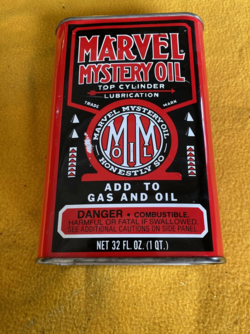
Paul this is what I did last winter for a 2007 Kia Sportage and a Ford V10 both parked outside in the snow and cold of northern Idaho, along with an old XT Yamaha 250 parked in a lean-to, yeah not as cold as your Alberta but pretty severe weather.
For each vehicle, I filled the tanks with ethanol-free gas (still available in Idaho)but before filling with gas I added the recommended
amount of 'Marvins Mystery Oil' (gasoline additive), it's relatively inexpensive and you can get it in 16-ounce bottles all the way up to gallon jugs at most auto part stores and agricultural supply outlets.
Run the vehicle motor to get it fully circulated, shut the fuel tap off on the motorcycle, and run the carb dry, that's it done. I had the Kia and Ford on a trickle charger I came back in the late spring after they sat for 6 months and bingo the Kia started up instantly and ran smooth. The Ford cranked over for 10-15 seconds and settled into a smooth idle, both have fuel injection. For the Yamaha, I took the spark plug out and kicked it over 10-12 times put the plug back in turned on the fuel taps and it started on the 3 rd kick and idles with the choke on, nice.
Marvin's oil has been around for many, many years long after Marvin 'kicked it, and works for my needs. Used it in a lawn mower and chainsaw too, HTH
1665178022801.png
 
I’ve had great success with aviation fuel , it’s not cheap , and unfortunately here in the UK it’s getting difficult to find and buy… there used to be a card operated pump at a small local airfield where you could just pull up and fill a can , unfortunately they’ve stopped that this year and you now need proof of your aircraft to purchase 🤷‍♂️
A mate is buying it in 40gallon drums for his race bike , but it’s scary expensive.

So this year I’m trying (after a recommendation from a golf course groundsman ) a product called Aspen , synthetic fuel , he says that they have used it at the golf course for wintering the small engine equipment (brush cutters , hedge trimmers etc) with no reuse problems after winter for the last 2 years.
I have a 2 litre plastic container with tap and long pipe (with a hook to hang from the bars) and use that straight onto the carbs to flush out the petrol.
I’ll report back in spring to see if it is any good !
 
For the SF1, I drain the fuel tank & the carb bowls, put the battery on a trickle-charger/maintainer & plug the mufflers with stainless-steel scouring pads to keep the critters out. For the 2017 Triumph & do the same, except for filling the fuel tank to the top & adding fuel stabilizer (as recommended by Triumph). Never had any problems so far.
 
Interesting discussion!
The second video claims that carbs are made from aluminum, which puzzles me. The ones I have are a die-cast Zinc alloy.
I avoid the e10 (10% ethanol) fuels sold in Germany like the plague, but my understanding is that most automotive fuels can contain up to 5% alcohol. My normal winter preparations include drainng the carbs and removing the carb bowls. I don’t use a fuel stabilizer on the Laverdas or Triumphs. No issues with the carbs so far, but I have no idea what the bottom of the fuel tank looks like ….
The only bike I use fuel stabilizer on is the (fuel injected) Harley, which may not move for a year at a time. However, Arizona is renowned for high temperatures and low humidity. So far, I haven’t had an issue, after a year in storage it starts first time. I don’t know if it would do the same without Sta-bil, never tried it.
Regarding aviation fuel (I burn thousands of litres per year of the stuff) I can say the following:
100 LL (aka. Avgas) is non-hygroscopic. It is also very expensive, currently around €3.20 per litre in Germany.
The unleaded variant (“Super Plus”) UL 91 is not allowed to contain any alcohol whatsoever, and is cheaper at around €2.60 per litre. (For reference, rnormal car fuel is around €2.00 per litre)
The downside to this fuel is that it has a higher vapor pressure, meaning it evaporates more readily than Avgas. Increased tendency to vapor-locking in warm weather, and no lead to protect your valve seats.
You pays your money, and you takes your choice…😁
Steve
 
Back
Top