Hard to start 3CL Project with Mikuni carbs

Crete

New member
Hey guys
Looking for advise on a starting issue with my 3CL.
First a little history
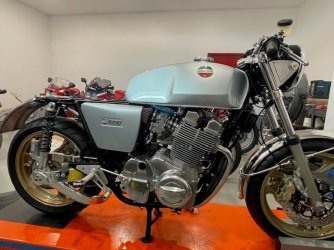
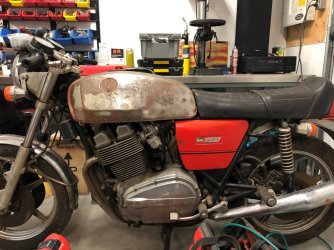
I purchased the bike a few years back off another forum member as a project. Apparently it sat in a barn for 30 years.
Very rough but mostly original with around 9000 miles indicated.
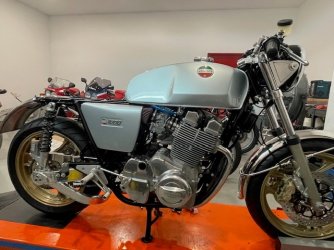
I did a frame up restoration with a few mods along the way.
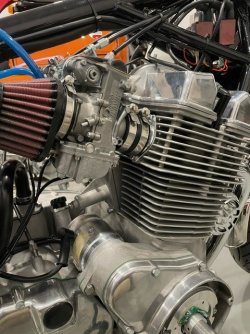
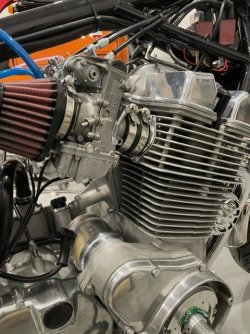
I rebuilt the engine with high comp pistons and Axtell cams from Wolfgang.
Head was also redone including larger valves. Running factory jota exhaust
Ignition and Mikuni carb kit from Red
YSS rear shocks, hard anodized fork sliders with race tech springs and emulators up front
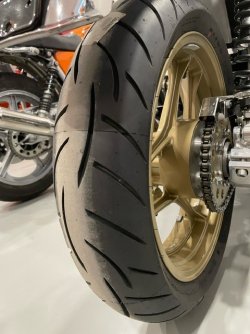
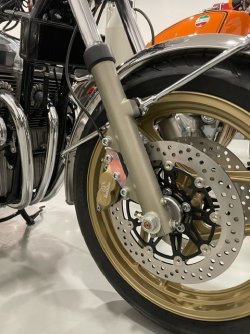
JMC swing arm GSRX 1100 rims with spacer kit and caliper mounts from Red
Brembo 4 piston calipers with Hel brake lines and Metal Gear disks
530 chain with sprockets from Red
I managed to fit a 160 rear tire Metzler Z8
Waiting on refurbished gauges to arrive and a 3C style hump seat from Tony at Eldorado.
The issue I'm having is getting it to start. With a cold motor and choke on the motor will fire for a second then die. Repeated attempts produce the same results. switching to half choke same thing. Motor only fires for a split second then dies. If i open the throttle very slightly with the choke half on it will start but it's hit or miss.
Once running it sounds ok and throttle response is good but it won't idle. After a few tries I pull the plugs and inspect. Wet and slightly sooty. I've gone through 4 sets of plugs. Jetting in carbs is as received from Red. Mixture screws are one turn out.
I've ran through some basic checks
Compression 180 PSI on all 3 cylinders
Set cam timing with dial gauge and degree wheel Max lift at 103 degrees on intake 104.5 on exhaust
Valve clearance .20-.25 intake and .25 -.31 exhaust
Triple checked ignition installation. Used dial gauge to find TDC when installing rotor.
New NGK B8ES plugs with new wires and 5 k ohm caps
Nology Coils. Checked for spark with plugs out and grounded to head. spark looks good on all three.
Using battery from my 2500 Duramax
Lots of cranking amps and the stater spins as it should. Its also new from Wolfgang
I'm not sure what my next set should be. I feel like I'm missing something.
I have a 79 jota and that thing starts instantly with a touch of the starter button. I must have something wrong.
Any help would be appreciated.

Tony
3C.jpg
 

Attachments

  • Laverda rear side.jpg
    Laverda rear side.jpg
    87.5 KB · Views: 68
  • Laverda front.jpg
    Laverda front.jpg
    108 KB · Views: 68
  • Laverda engine.jpg
    Laverda engine.jpg
    125.2 KB · Views: 80
  • Laverda 3CL.jpg
    Laverda 3CL.jpg
    95 KB · Views: 77
  • Laverda rear side.jpg
    Laverda rear side.jpg
    87.5 KB · Views: 77
  • Laverda front.jpg
    Laverda front.jpg
    108 KB · Views: 72
  • Laverda engine.jpg
    Laverda engine.jpg
    125.2 KB · Views: 75
  • Laverda 3CL.jpg
    Laverda 3CL.jpg
    95 KB · Views: 76
I went through similar after some early major jobs on my 3c many years ago resulting in extreme frustration. It's very easy to get the valve timing one tooth out especially fitting new cams. Good luck sorting it, its going to be one cracker of a beast when its sorted.


.
 
Lovely job on the bike. Well done!

You've got good compression and with Red's Ignitech ignition you should have a good strong spark (unless there's a dodgy connection somewhere).

Did you program the ignition curve with the correct base advance for your bike? That's a pretty important step that you didn't mention in your story, and it can affect ease of starting. If you can confirm that all ignition program data are OK, that really only leaves fuel as an issue.

Make sure there's no air leaks around the intake spigots and the float heights are OK, then try playing around with idle settings. Those little idle mixture screws are pretty sensitive on Mikunis. A small tweak can make a big difference. Try adjusting in increments of 1/8 of a turn at a time. Also, important advice I remember from Red is to never close them too tightly when screwing them in to find the zero datum. The fine little point on the tapered needle can jam in its seat like a morse taper and snap off when you back it out again.

Your valve timing is a wee bit out, but not so much as to affect starting, so I doubt that's an issue. But it's worth attending to at some point when you're looking for something to do.

Axtell cam specs say max lift is at 100° on both intake and exhaust. It's worth dialling it in as good as you can get it. I was surprised how much difference a few degrees made on my Jota. My fuel consumption improved heaps after dialling in the cams. You only need to tweak it a few degrees so you should be able to get that much adjustment by filing the bolt holes in the camshaft sprocket flanges.
 
Very nice! Are you going to install indicators? I know it's a bit of a weird question, just prompted by the front indicator mounting tabs on the 'before' photo...

cheers,

bazzee
 
Did you use Red's angled inlet stubs? Helps get the Mikunis at a better angle (with straight stubs the carbs are right at their limit for proper operation). Assuming you fitted the carbs as supplied from Red, then they should be set up correctly. Probably worth mentioning that I find cold starting here in the UK a hit and miss affair. Full choke and the engine dies after firing. Half choke and it dies as soon as I touch the throttle! Partial answer is to use a couple of twists of the throttle to get the thing running on half choke and don't touch the throttle for a while. The RS carb series were intended for race use and I personally reckon the cold start arrangement ain't up to snuff!
Once warm, tickover is like a grandfather clock, so have you balanced the carbs, adjusted the throttle stop, checked for leaks around the manifold-head joint and manifold-carb rubbers?
 
Thanks for your comments

Cam : I haven't done any programing. I may have incorrectly assumed the baseline settings would be close enough to get it started.
My plan was to get it running then synchronize carbs and take it from there.
As for cam timing Red suggested 100 on intake and 105 on exhaust.
I will break out the dial gauge and degree wheel to verify my numbers and plug in my lap top to confirm advance.

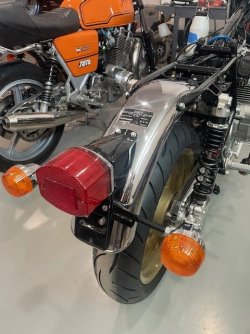
bazzee : Rear signals are mounted down on the fender. Using a 3c style seat so needed to move them from stock location.
Rear fender is slightly shorter than stock to show more tire. Its off my SF750 ( Ron's old bike) complete with the original dealer sticker intact. Waiting on signal stocks from Wolfgang to mount front signals

Chrisk: One 85 GSX R 750 the other is a 85 VF1000R which is a total tank but I kinda love it.
 

Attachments

  • Laverda signals.jpg
    Laverda signals.jpg
    101.5 KB · Views: 20
Hi Tony,
Ignitech is programmed with the same settings I use on all Laverda triples unless the engine is "fully" worked at which stage I may change to using 3 x single coils instead of the dual/single combo
Carbs are jetted to suit your engine

If as you say everything is installed as suggested then
First, check all your earth connections, I see you have painted the frame so make certain all the earths are touching bare metal

If that does not work check the output of the Regulator or even better, remove it from the circuit for a few starts
Ignitech boxes do not like over charging, nor will they run at voltage below 9.5 volts
If your voltage is too high the Ignitech will shut down to avoid itself being damaged
 
Hi Tony,
Ignitech is programmed with the same settings I use on all Laverda triples unless the engine is "fully" worked at which stage I may change to using 3 x single coils instead of the dual/single combo
Carbs are jetted to suit your engine

If as you say everything is installed as suggested then
First, check all your earth connections, I see you have painted the frame so make certain all the earths are touching bare metal

If that does not work check the output of the Regulator or even better, remove it from the circuit for a few starts
Ignitech boxes do not like over charging, nor will they run at voltage below 9.5 volts
If your voltage is too high the Ignitech will shut down to avoid itself being damaged
Thanks for the reply Red
I went through all the frame connections as you said to ensure they were grounding to bare metal. All good.
I will try removing the regulator from the circuit and see what happens.
I'm starting to doubt my cam timing. I wonder if got mixed up and went the wrong way on the degree wheel. I have the exhaust set a 104.5 and the intake at 103.. but maybe I'm reading the wheel incorrectly and have set exhaust at 95.5 and intake at 97??
I'm definitely no engine builder....need to check that again
 
When you set the degree wheel up use No 2 cylinder to find TDC at 180 degrees
No 2 crank web controls the cam timing on No 1 and No 3 cylinders

By setting it up on No 2 you can also check the crank phase is correct on 1 and 3
 
Cam : I haven't done any programing. I may have incorrectly assumed the baseline settings would be close enough to get it started.
Yes, that's most likely the case. But if your base timing on the bike is substantially different to the "Base advance" setting that's programmed into the Ignitech, it could make a difference to starting.

I'm pretty sure Red includes uses a static method to set base advance (position of the pulse rotor on the crank) in his setup instructions. If you followed his installation procedure, it'll be pretty damn close so that's unlikely to be your problem. But if you didn't follow his procedure exactly, it might be.

I've found that there can be a small difference (a degree or two) between static and dynamic ignition timing. I presume it's the dynamic reading that the ignition system actually sees during normal operation, so I like to fine tune it dynamically after installation with a degree wheel and a strobe. Here's the procedure that I employ:

1. Fit a degree wheel zeroed to TDC.
2. Plug a laptop into the Ignitech module, switch it on, start the Ignitech software and verify that you have a connection. The red warning "No connection with PC" will disappear.
3. Before changing anything in the Ignitech software, hit the "Read" button to display the current settings, and save the file on your computer.
4. Once you've saved the existing data, set all programmed advance figures (including base advance) to zero in the Ignitech.
5. Start the engine and strobe the degree wheel to see where it's actually firing. It'll need a bit of gentle throttle to smooth out the engine speed enough to get an accurate reading (with no advance curve the firing position won't change with revs). Whatever reading you get on the degree wheel tells you where the ignition pulse rotor is set in relation to TDC. Make a note of the number. This is the base advance that you must enter into the Ignitech program.
6. Open the advance map file that you saved in in step 3 and then set the base advance to the reading you got in step 5. For example, if it strobed at 4° BTDC, go to the "Advance map" tab in the Ignitech software and set base advance (little box below the advance map chart) to 5.
7. Hit the "Program" button in the software to upload the data to the Ignitech unit and that's it. Job done.
 
Cam's procedure will work.
A quick way to check the Ignitech is set up with correct base advance is to crank the motor on the starter (plugs out & earthed). You'll still need to set up the degree wheel on TDC, but this avoids the need to fire up the motor and alter advance map settings. Cranking revs (around 400rpm) will be below all advance settings. If the base advance is correct, you'll see zero degrees on the degree wheel.
I believe Red's instructions set the pulse rotor to TDC in which case base advance is zero degrees.
 
.... the actual crank velocity is not uniform, ie while the degrees are static, the time it takes a crank/piston to travel between those degrees is not linear. Unless you encode a crank with say 255 "hard positions" or fixed reference electrical phase positions, the digital ignitions ( including mine ) use a time derived extrapolation of crank position between fixed crank encoder or "hard" positions, iis uses 40dbtdc as hard reference, some ignitions use far greater with far greater inaccuracy of timing signal. The less hard vectors on an encoder the less accurate the timing will be.

As a piston comes up to TDC there is a compression of the fuel load, and the crank slows down, non linear, or instantaneous velocity is not easily derived or calculated by the hardware software in the digital ignition. Degree it all you like, the actual digital ignition will make best of what it can with the crank encoding installed.

By and large the above is transparent to the motor/rider, yet it is a factor if your setting up base advance or more important, cold crank start and idle, the actual ignition event timing can be greatly effected by the piston instantaneous velocity. HTH j
 
Not really, Jon! I only understood that the speed of the crank is not linear (ie, slows as piston goes through compression).

Is Rob's suggestion - checking base advance setting vs actual by using a strobe while turning the motor over with plugs out and earthed - a good way of confirming you have base advance set up correctly?
 
Ooh. Now I'm not sure. Thinking about how an electronic ignition must work, the signal to fire the ignition is not triggered when the crank encoder gets its pulse. The plug is actually fired when the ignition system thinks it's time to do so. There's a whole lot of processing going on between the pickup pulse and the ignition coil switching. If the "hard position" of the crank is only known by the system when the crank is at TDC, then to fire at say 1° BTDC, the ignition has to guestimate that position since the last pickup pulse. Given the variations of crank speed during one full rotation, the spark could be miles out. I presume that's why the advance jumps all over the place if you strobe the crank at idle speed.

Now, If you set the advance to 0°, does the ignition box do the same calculation and fire the coil on the next rotation, in which case it could also be miles out, or does the ignition think to itself ... "the advance is 0° so I don't need to calculate the firing position, I can simply fire the coil when I see a pickup pulse". You'd have to know how the unit actually processes its data to get an answer to that question. As far as I'm aware, Ignitech doesn't go into that level of detail in their documentation.

Anyway, from practical experience, setting a zero advance map and strobing the ignition does give a reliable indication of base advance. Provided the engine revs are high enough to smooth out variations in crank speed.
 
In order to overcome the extrapolated position to actual piston position, digital designs have a "hard" reference signal centred around TDC, designer decided. Involves leading or trailing edges on the output pulse from the crank encoder. Explain as in the iis, as have never seen an ignitech crank shaft encoder as such. Have a leading edge at 40dbtdc, and a leading edge at TDC dead. The leading to trailing edge span is about 35 degrees for the rectangular pulse on the Hall Effect/10m/m diameter SmCo magnet. Can either cold crank start at the leading TDC pulse, or can trigger on trailing edge 40degree HE segment, in 180 there is Cyl 1 TDC Cyl 2 rotational sequence.

Cyl 1 and Cyl 2 leading edges occur at 40btdc, after cold crank start and above 1250rpm the iis will only use leading edge pulse, trailing edge is ignored as a guide. Back to cold crank start and idle, since 40-35 is about 5dbtdc then we start and idle at "base advance" of 5dbtdc this is ostensibly a "hard vector" for actual piston position, i could start a motor at hard TDC though pointless as you will be igniting the cylinder mixture load while decompressing. Your correct Cam in deciding base advance is hard, though it depends to a great degree ( pun! ) on actual crank encoder design chosen. Seek the HTH...a grin here. j
 
Not really, Jon! I only understood that the speed of the crank is not linear (ie, slows as piston goes through compression).

Is Rob's suggestion - checking base advance setting vs actual by using a strobe while turning the motor over with plugs out and earthed - a good way of confirming you have base advance set up correctly?
Rob has a good handle, though understand the flash of the strobe is spark initiation, and dependent on the type of encoding of the crankshaft position ie not "extrapolated" then this may not be actual TDC dead. Ignitech may well have a hard TDC dead signal edge, others can comment on that. The only sure fire ( another pun! ) way of having a TDC dead strobe light pulse is to have an actual TDC sensed. To my last memory, Witt does not have a TDC postion encoded, rather a base advance of somewhere before TDC which does work in practical if not scientific level.

Make these comments when i read about degreeing cam shaft(s) interoperational workings to high degree of accuracy, has merit, just do not assume a digital ignition is capable of exact absolute timing degrees also. j.

*** i sent out with every iis a dead stop calibration tool ( read old spark plug ) with 8m/m bolt and thread to stop the piston forwards and backwards, inbetween those two stops is TDC dead, no error.
 
Tried Rob's trick this arvo - TDC checked with piston stop, my base adv is 0, curve jumps to 7 deg BTDC at 500rpm. Not sure how many RPM the ND starter spins the motor with plugs out (and grounded) but the strobe said it was firing at 7 deg BTDC. I can only assume it's spinning faster than 500rpm, otherwise I would have seen 0. The best thing was , I saw 7 deg on both left and right ... fina-fukn-ly!!
 
Last edited:
I really like the swingarm/gsxr wheels, etc- did you have to alter the frame to accept any of it? It should handle and brake better. And are the GSXR wheels any lighter than stock?
 
Back
Top